

S16 Episode 7:AI and Kids: Protecting Critical Thinking in a Digital World // Jeannie Ondelacy Sprague
Hosted by Hillary Wilkinson
“The way that we think about things is flawed because we're human, but there's also beauty in that.”
— Jeannie Ondelacy Sprague
You may recognize her voice from the Healthy Screen Habits Handbook and website ads, but today, she's stepping out from behind the scenes and into the guest seat! 🎧
Jeannie Ondelacy Sprague is a digital wellness educator, writer, advocate, mom of four, COO of Healthy Screen Habits, and one of our founding members. She's passionate about how technology shapes the way our kids learn, grow, and connect with one another.
In this episode, we dive into a BIG topic on every parent's mind: Artificial Intelligence and our kids. 🤖
Jeannie shares thoughtful insights to help parents navigate AI with curiosity, confidence, and a healthy dose of caution.
Healthy Screen Habits Takeaway
Resources
Instadocs: AI Gone Wild
Show Transcript
Hillary Wilkinson: (00:06)
Today, I'm especially excited to introduce our guest, that sounds very formal, because she's not just an expert in healthy screen habits. She's one of the people who brought this organization to life, and someone I'm lucky enough to call a friend. Jeanie Ondelacy Sprague is an educator, writer, advocate, and the chief operating officer of Healthy Screen Habits. She's what's called a multi-hyphenate. She's one of our four founding members and a co-author of The Healthy Screen Habits for Tweens and Teens Handbook. You're gonna recognize her voice when she starts talking, because she's the one who does the ad for it. Jeanie spent years working with the elementary school education in Los Angeles, Chicago, and Seattle. She also holds a master's degree in educational psychology from Loyola University, Chicago. Her passion lies in understanding how technology affects childhood development, learning, and social-emotional growth. And just as importantly, how our media habits are impacting the way we connect with each other as families.
Hillary Wilkinson: (01:24)
As a mom of four, Jeanie offers great advice, and she also understands that finding balance in our families, like digital life and on everyday challenges are easier said than done. Our conversations between Jeanie and myself often circle around how we can have a healthier relationship with technology without the guilt, shame, or all-or-nothing thinking, where there's a lot, lot of, like, room for growth here. As most moms do, we often have four conversations going at once, but today we're gonna focus and we're gonna lock in. We're taking a deep dive into the thing we are all talking about, but very few of us seem to understand. That is AI. Welcome to the other side of the mic, Jeanie Sprague
Jeannie Ondelacy Sprague: (02:26)
Thank you, Hillary. What an introduction.
Hillary Wilkinson: (02:30)
Well, had to, had to give everybody your backstory.
Jeannie Ondelacy Sprague: (02:33)
It's so fun to be here.
Hillary Wilkinson: (02:36)
Jeanie, in all of the conversations surrounding AI, I think there's this overwhelming feeling for those of us who aren't in the tech sector, which it's this lack of truly understanding what AI is. And so this is where I kinda wanna start. Simply put, what is AI?
Jeannie Ondelacy Sprague: (02:59)
So first off, AI stands for artificial intelligence, which is kind of a misnomer because when we think of intelligence, we think of, um, the way that we use the knowledge that we're given, um, in a human way. But this is more of, instead of thinking on its own, the way humans think on its own, it's using mathematics to give answers to the questions that humans have for it. The first, um, kind of known way of artificial intelligence was, uh, machine translation when computers were translating language to another but it's evolved since then. Um, now we have ways that algorithms can take information and answer questions in non-deterministic ways where we can find variable answers to different questions. You're gonna get different answers depending on what kind of input you put in.
Hillary Wilkinson: (10:48)
And I'm gonna say, well, the, the challenge with AI is that it is based in mathematics, and for those of us who don't understand math very well, it employs this sort of mysticism around it, you know? Mm-hmm. Which gr - which gives it a lot of, um, a lot of, um - Weight. A lot of weight and a lot of lack. Uh, there's, there's a lot of blind faith applied to it.
Jeannie Ondelacy Sprague: (11:31)
Absolutely. That is such a good way to look at it.
Hillary Wilkinson: (11:34)
One of the things that I hear discussed in the realm of AI is the phrase LLM. Mm-hmm. And like, I don't, I don't know what these things are. Can you break down what that is?
Jeannie Ondelacy Sprague: (13:52)
Yes. So it's the foundation of, of how artificial intelligence works. So it stands for large language models. So they're language models, but they're large, and they were trained on the written language found on the internet, right? So, for example, ChatGPT, was trained on Reddit. Maybe you know the... Yeah. I see your eyebrows raised because - Yeah. If you know the, um, website Reddit, you know that sometimes the information on there is not, A, correct, or B, even very nice, right? Yeah. So now, these large language models, these LLMs have an idea of how humans sound and how they give answers to questions to other humans. Mm. And it's not always that good.
Hillary Wilkinson: (14:56)
Yeah. Yeah. And I think on Reddit forums, my hunch would be that it's a, it's a younger base. I don't think it's gonna be an older generation that's necessarily on Reddit. So maybe I'm wrong in assuming that, but... So there's, um... I find with the younger generations, there tends to be a lack of formality in the written word, which - Oh, absolutely. Yeah. Which also can make the AI communications seem, because it's less formal, it's like, it seems a little more conversational, a little more human. Right.
Jeannie Ondelacy Sprague: (15:39)
Right. A little more human, but not in always the best ways. Mm-hmm. Right? And guards are down, and even with the anonymity of that internet space and a lot of other internet spaces, there's a lot of ugliness that comes out and a lot of, um, misrepresentation. And, um, I think in some ways, inhumanity to others, right? So here we are, these large language models have learned how to be human from some of the worst spaces of being human. Yeah. And then the question is, you know, why? Why, why are we looking for this? Why are they developing this? Well, the goal, I think, is to, um, extend the reach where humans are needed. That's the altruistic way that these, um, large language models were developed. But unfortunately, I think, you know, they look at more of dollar signs as a way to, you know, keep going because the more, the more it sounds human, the more outreach and the more money is made, so.
Hillary Wilkinson: (16:50)
Sure. Sure. And the more connection is made amongst people to AI agents, which we know with the loneliness pandemic, like, that's what most people are, are hungering for, is connection. So they're, that's a way they're kind of hacking, hacking the human experience as well. So -
Jeannie Ondelacy Sprague: (17:15)
Right, but it's false, right? Because it's not a human.
Hillary Wilkinson: (17:19)
Right. Right. At all. Yeah. So I just used that, that phrase, um, agent. And can you explain what agentic AI is or what we mean when we say an AI agent?
Jeannie Ondelacy Sprague: (17:36)
Maybe. We'll give it a try. We have to go back to what is the purpose of AI, you know, e - altruistically or even just realistically. It's, it's a model that's been created to answer human questions. And so these models are built after the kind of the engineering framework where, you know, you have a problem, you, you seek, uh, a solution for the problem by testing different things, you come up with the best solution, and then you come back and check. So an agent is like a harness that's built around these models. So it's made to go back and check and evaluate the system that they, that it's looked at. Um, the interesting thing is that they've created these agents, to have kind of a human- like, access to memory and thinking where it's got, like...
Jeannie Ondelacy Sprague: (18:48)
We'll go a little neurologically, uh, brain dense here for a second, but we've got episodic memory, you know, where you have episodes that you can recall. We've got long-term memory, short-term. They... Agents have access to all that. So if anybody out there's used something like ChatGPT, it's giving you answers based on the question previous, and then the, you, you respond back, and it's going back and looking back and having a memory of what it previously told you. And so that if we think about, you know, the model being like a horse where we're, we're trying to get it to go someplace, then we can think of an AI agent as being like the harness that the programmers, developers built around, um, that model so that it can, um, go back and check and, uh, make sure that it's, um, doing the safety checks and, um, getting the answer that is most, uh, efficient and most valuable to the user.
Hillary Wilkinson: (21:15)
Right. Um, and this is where it gets interesting to me, because efficiency does not equate to ethical.
Jeannie Ondelacy Sprague: (21:29)
Exactly.
Hillary Wilkinson: (21:30)
So my concern, I'm gonna lift this analogy or this example right out of the Netflix Instadocs, um, one on AI that I just watched the other night which I highly recommend if anybody has, um, Netflix, and they do a very good job of kind of bri - a brief overview. It's just like a half-hour documentary, deep dive. And they talk about, um, because of the lack of humanity within AI, some of the decisions that get made would be determined unethical. For example, if we gave AI the, the problem, the query, if you will, to reduce carbon emissions, um, the thing they gave an example of is there's nothing... What's, what would be most efficient is to ground airlines - uh-huh. And to ground flights by whatever means.
Jeannie Ondelacy Sprague: (22:42)
By whatever means, that's exactly it.
Hillary Wilkinson: (22:44)
So that's, that's something to take into consideration when you have, you know, capsules of 300 plus people flying across Atlantic that are, that are, you know, as we move more and more into AI, where... Well, like, uh, like, where are... We use the, the analogy of the horse and the harness, which I like a, a lot. My concern is, like, is there a corral for the horses?
Jeannie Ondelacy Sprague: (23:15)
Brilliant, brilliant question. Right. And so, if we think about, um, AI is receiving a directive, so the AI agent is receiving a directive when you give it a prompt. So, again, going back to something like ChatGPT, if you're familiar with that, you go in and you have a question, you're giving it a prompt, you're saying, "I want you to tell me this information. I want you to go about doing it this way." That's the prompt, that's the directive. It's going to accomplish that directive, period.
Hillary Wilkinson: (23:52)
Uh-huh.
Jeannie Ondelacy Sprague: (23:53)
Without any ethics, common sense, or any of the humanistic values that we hold dear and for good reason, it's going to accomplish that directive no matter what. And that's what AI is. There... It's going to do what it's going to do and get it done. Mm.
Hillary Wilkinson: (24:29)
So when we come back, I'm going to be asking Jeanie more AI questions, and if it deserves a seat in the classroom.
Ad Break : Thank you donors
Hillary Wilkinson:
I'm speaking with my dear friend, Jeannie Ondelacy Sprague, the COO of Healthy Screen Habits. Jeannie's the person who takes my calls at all hours for help with IT support. She's the creative brain behind our graphic design and on a continual quest to find the very best path forward for parenting in our digital age. As a mom of four, she's firmly invested in it, and she's got a lot of informed opinions on what's happening with AI in classrooms. And, um, okay, so before we kinda dive into AI use in schools, let's just talk about it on, like, day-to-day use. And, uh, Jeannie, how often do you use AI?
Jeannie Ondelacy Sprague: (26:08)
I use AI fairly often. I use it for healthy screen habits occasionally to fine-tune some questions or when I'm writing to sort of have a sounding board. Does this sound the way that I wanted it to sound? Or, you know, is there a way that I can tweak that a little bit, um, to get a better response? Yeah. Things like that. Also, just in my personal life, sometimes... Actually, my husband did this the other day. He said, "I've got this ingredient, that ingredient, and another ingredient in the fridge. Tell me what I can make with that, that will be good." And it came back with a great recipe that we all actually really liked. So I think there's a lot of value, um, to its use, but with a lot of caveats,
Hillary Wilkinson: (26:58)
Which - Yeah. We're gonna
Jeannie Ondelacy Sprague: (26:58)
Go into, I hope.
Hillary Wilkinson: (26:59)
Exactly. Let's talk a little bit about that. So how... So all of these are great, but it's kind of like formulaic, step-by-step, like applied things and basically time-saving methods. But how would you say AI kind of gets in the way of developing critical thinking?
Jeannie Ondelacy Sprague: (27:20)
Well, I'll be very candid here. There was a recent experience I had that I just shook my head at, and I thought, "Oh, dear. If I'm struggling with this with all I know, then what, what's out there for everybody else?" I, uh, was working on a project that I was on a time crunch for, and, uh, something for Healthy Screen Habits. And I gotta be honest here, I really wanted to hand it over to AI to write it up for me, because that would've been super easy. But how in the world could I face the audience that I was doing this proposal for and say, "Yep, this came from my own brain." And so I just thought it's too, too easy to offload any thought, any work, any critical thinking, any analysis. It's too easy to just hand it over to some AI agent to do it for me.
Hillary Wilkinson: (28:30)
Mm-hmm.
Jeannie Ondelacy Sprague: (28:31)
Because it can do it in a way that sounds pretty good. It sounds like a human.
Hillary Wilkinson: (28:37)
Well, and here's the thing, is it also... I know, um, I, you know, I... Within corporate America, it's being encouraged to use because it is an incredible time-saving device. And a lot of people will use it as kind of like, I don't know, a, a basic, like, blueprint, if you will, and then they'll go in and flush things out. Um, my issue with that is, is these are people who are using it in that capacity who have already had the sort of underlayment of knowing how to do the, the first steps. So my concern with AI being used in classrooms is, are we still facilitating the how-tos in the right areas? I don't know. It's, it's - Right.
Jeannie Ondelacy Sprague: (29:34)
And I don't think that is the default anymore. I don't think the default is you need to devel- develop the way that you look at anything, any writing, and, and do the heavy lifting mental work of thinking it through for yourself, because it is too easy to offload that to AI. And I think that that's what's happening is that for whatever reason, maybe intentionally, maybe not intentionally, because computers are already in the classroom, which is another huge problem that I see in our, um, educational systems, this one-to-one, um, device ratio that we have. Because that's already there, how can we help kids understand that we don't just go over and type in the question and get the answer? How do we help them see that they need to spend the time working through the answer first? Because like you said, Hillary, with the way that people have, that are adults that are using AI, they've already developed, hopefully, the critical thinking skills.
Jeannie Ondelacy Sprague: (30:54)
If we don't have that critical thinking skills as a foundation, even the people that do have them can be easily deceived by the answers that they receive from AI. So when we take that away altogether, when we're just off-putting it all to AI from the very beginning of learning, then there's no way that they can, that kids will be able to look at information and actually think it through.
Hillary Wilkinson: (31:22)
Yeah. Yeah. A lot of times, I, uh, the brain gets, um, compared to muscle, which we know it is clearly not, but it's like without that friction and that struggle that comes with growth in learning, there are areas that will simply not develop; it's a hard place to know where education is going to be of most worth. But the thing that I think will always be applicable is the, this value and the struggle of learning. Learning is hard.
Jeannie Ondelacy Sprague: (32:21)
And - It is. It's supposed to be. That is how you grow. That is how your brain grows and literally has to be built line upon line - Yeah. For understanding.
Hillary Wilkinson: (32:32)
Yeah. So, um, I feel like we're kind of covering m- my next question was going to be, like, how AI gets in the way of developing these critical thinking skills. And I think what we're saying it is, it, it all has to do with that sort of friction that comes with learning. And like, I don't know, it seems as though some of us relish the friction and celebrate it of, you know, doing, doing the difficult things, and some of us are less inclined to want to do that.
Jeannie Ondelacy Sprague: (33:10)
Right. And there are some instances where that's fine, you don't have to spend the time digging in, and it can, it can be okay. But for the most part, to fully be human, I think we need to be in the friction, working through it.
Hillary Wilkinson: (33:31)
Yeah. And that includes - It makes
Jeannie Ondelacy Sprague: (33:32)
Us stronger on so many levels.
Hillary Wilkinson: (33:34)
And it includes relationships, right? Absolutely. That is my greatest concern about, um, AI and children, is this, that AI agents provide this lack of friction and they're sycophantic in nature and always choosing your side and a lack of perspective. What, what's your greatest concern about AI in children?
Jeannie Ondelacy Sprague: (34:00)
Well, I just realized we haven't really talked about all of the areas that AI can impact us negatively. Mm. Mm-hmm. And I feel like there are quite a few. And there's, they're pretty severe as well. I mean, we hear all the time on the news AI is coming for our jobs. People are scared that they won't have a place in the world to work. Another huge fear that I hear constantly is AI is going to kill us all because it's going to take over and, you know, we, we've got a, um... Oh, I can't even think of the movie right now. The Arnold Schwarzenegger one, what's it called?
Hillary Wilkinson: (34:39)
Oh, Terminator.
Jeannie Ondelacy Sprague: (34:40)
Yeah, right. It's gonna be Terminator times. And I don't know, I'm not gonna speak to that either, but, but there are so many ways that it is impacting us right now as adults and as kids. So we talked about the cognitive, uh, decline where, where we can offload our critical thinking skills. That's huge. Being able to analyze and understand what we're reading, we're offloading it to AI. Um, being able to write. I think people's ability to write even clear sentences is declining because it's just easier to have AI write that email for us than to sit and kind of stew on How do I really wanna say this? How is this gonna impact another human? Um, with, like you said, with relationships, there are multiple chatbots that f - pretend to be your friend where that's their whole goal is like trying to help people feel like they have a girlfriend in AI or that kids can have a playmate in AI just to get what, more money?
Jeannie Ondelacy Sprague: (35:59)
I mean, I don't know. I don't know the altruistic purpose that they could possibly have, but to me, there doesn't seem like there's that much more than it's another way to make money off of us. Um, I was telling you this the other day, Hillary, but I feel like with how we're using AI to do all the heavy lifting in our thinking and in our writing, um, it's kind of like that book, Cyrano de Bergerac - uh-huh. Or if you're from the '80s and Roxanne with Steve Martin. Mm-hmm. Um, and Daryl Hannah, where here we are, we're sending off this letter, this email saying it's from us, but in fact it's not, right? It's somebody else's words, in, in this case, not somebody, but something else's words trying to pass off as our own. So then you've got this whole lying thing, kids in the classrooms, if they're, if they're writing up papers because they put in a prompt to AI and it just spits out a paper that's a perfectly formed five-paragraph essay, that's not their work.
Jeannie Ondelacy Sprague: (37:13)
That's cheating, that's lying. So you've got those morality issues as well. I mean, you see this list is growing long and long. Mm-hmm. Um, the fact that we, as humans, whenever we've read anything in the past or really seen anything in the past, we've had this sort of connection to it, knowing it's coming from another person, another human. This is somebody you could think to yourself, this is somebody who understands. What I'm reading right now is connecting with me because that other person is a human who has either thought through it the same way that I have or experienced it the same way that I have. It's an important human-to-human connection, and now we don't have that guarantee. We don't necessarily know that that is another human that is speaking to us. And to me, that is a huge loss in humanity.
Hillary Wilkinson: (38:11)
Yeah. So how do you recommend talking to our kids about all of this? Because I feel like that's like a, um, generational thing of applying your lived truths to today's, uh, reality, if you will, has been, uh, a pretty common source of disconnect generationally. Right. I mean, going back for, since forever, you know? And then people, you know, that's where I feel like the divide starts to happen with relationships. So how do we -
Jeannie Ondelacy Sprague: (38:52)
Right. You don't understand, mom.
Hillary Wilkinson: (38:53)
Exactly. Exactly. You don't get it. You don't, like, it's not the same and all of that. And, um, so how can we communicate concerns without sounding like, you know, a bunch of old people who don't really get life?
Jeannie Ondelacy Sprague: (39:19)
I think helping our kids to remember that AI is a tool that we can use at our own discretion and in our own way, and not something that we look to as the end all and be all of understanding knowledge and import. Helping them see that the, the way that we think through things as humans is still more valuable than the way a large language model takes input and gives us a probable output. The way that we think about things is flawed because we're human, but there's also beauty in that. And it helps us stay connected to one another as humans. My biggest fear in all of this is that we will lose our humanity as we offload our agency. When we stop critically thinking through things and allow a machine to decide for us what we should do.
Hillary Wilkinson: (40:39)
Mm. Mm-hmm. On that, let's take a short break. And when we come back, I'm going to ask Jeanie for her healthy screen habit.
— Ad Break - HSH moms night --
Hillary Wilkinson:
We're back, as you know, on every episode of the Healthy Screen Habits Podcast. I ask for a healthy screen habit. And even though Jeanie is one of our primary habiteers, uh, she is no different. I'm going to ask for a tip or takeaway that listeners can put into practice in their own home. Jeanie, what is yours?
Jeannie Ondelacy Sprague: (48:17)
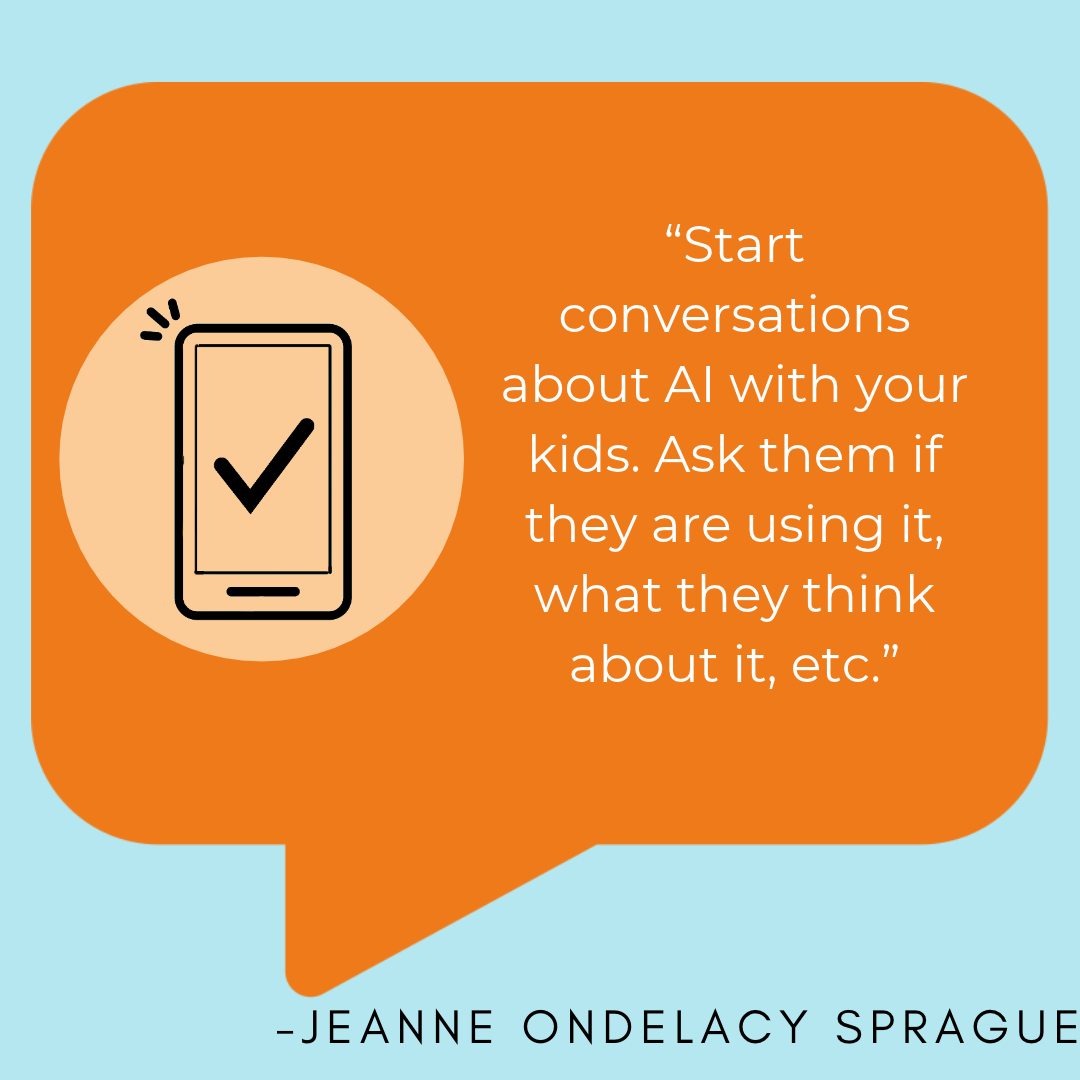
Well, thinking about AI and how it's affecting not only the world, but specifically our children, I think at this point, it's good to have multiple conversations, m- maybe daily conversations, being curious about their experiences with AI. How do they feel about it? How tempting is it to turn over their whole writing project to AI? Just getting curious with them about ways that we can see AI for what it is as a tool and not as the end-all and be-all of everything that we know in the world.
Hillary Wilkinson: (49:03)
Awesome. As always, you can find a complete transcript of this show by visiting the show notes for this episode. You do this by going to healthyscreenhabits.org, click the podcast button and find this episode. Jeanie, thanks for coming on here, my friend, to share your knowledge and to empower others.
Jeannie Ondelacy Sprague: (49:25)
Thank you, Hillary. I'm so glad we could talk.
About the podcast host, Hillary Wilkinson
Hillary found the need to take a big look at technology when her children began asking for their own devices. Quickly overwhelmed, she found that the hard and fast rules in other areas of life became difficult to uphold in the digital world. As a teacher and a mom of 2 teens, Hillary believes the key to healthy screen habits lies in empowering our kids through education and awareness.
Parenting is hard. Technology can make it tricky. Hillary uses this podcast to help bring these areas together to help all families create healthy screen habits.
Recent Episodes