

S14 Episode 15: Man Up: The New Misogyny and the Rise of Violent Extremism // Cynthia Miller-Idriss, PhD
Hosted by Hillary Wilkinson
The biggest predictor of support for political violence is sexism.
~Cythia Miller-Idriss, PhD
Dr. Cynthia Miller-Idriss is the author of the stunning new book, “Man Up: The New Misogyny and the Rise of Violent Extremism”. As a professor at American University and director of the University's Polarization and Extremism Research & Innovation Lab (PERIL), she has seen firsthand the real damage done to young men through toxic messaging in our online world.
Listen now!
Healthy Screen Habits Takeaway
Resources
For More Info:
https://www.cynthiamillerIdriss.com/books
Parent & Help Guides from PERIL (the Polarization and Extremism Research and Innovation Lab):
Developing and Using Critical Comprehension (DUCC) - K-5 digital literacy curriculum
https://www.danieltheducc.org/
Book:
https://www.amazon.com/Man-Up-Misogyny-Violent-Extremism-ebook/dp/B0F2KPB7T9

Show Transcript
Hillary Wilkinson: (00:00)
My guest today is an award-winning author and a scholar of extremism and radicalization. She's the founding director of PERIL, the Polarization and Extremism Research and Innovation Lab at American University in Washington, DC, where she is also a professor in the School of Public Affairs. And in the School of Education, she regularly testifies before the US Congress and briefs policy, security, education, and intelligence agencies in the US, UN and other countries on trends in domestic violent extremism. Today, she's sitting down to speak with us about what is happening to our boys. She's got a newly released book titled, Man Up: The New Misogyny and Rise of Violent Extremism. And it covers this in depth. We're gonna talk about that a little bit more. But for now, thank you for being here, and welcome to Healthy Screen Habits, Dr. Cynthia Miller-Idriss.
Dr. Cynthia Miller-Idriss: (01:08)
Thank you. Thanks so much for having me here.
Hillary Wilkinson: (01:11)
Let's start with kind of establishing common language, right? So I feel like we hear the word misogyny being used a lot in media and different interviews, but many of us don't actually understand what that is, so
Dr. Cynthia Miller-Idriss: (01:27)
That's a great question. Yeah.
Hillary Wilkinson: (01:28)
Can you start at the very beginning?
Dr. Cynthia Miller-Idriss: (01:29)
So, yeah, great question because I, I also use the term, there's different terms that circulate about it, and I think in popular usage, it often means hatred of women. That's not how I use it. I use it in this broader, more expansive way, which is the policing of gendered norms and expectations that hold up kind of patriarchal systems. And so that means women can do it as well as men. It means that it, it, it's enacted on our boys as well as our girls. So, you know, girls and women experience the vast majority of misogyny. And when we're talking about misogynistic hate online or what's happening, that's usually, uh, directed at girls and women. But we also see things like “you play like a girl” or, um, you know, homophobic slurs, tossed at boys. Like that kind of gender policing fits within a more expansive definition of misogyny, because it's about the norms and expectations that hold up patriarchy.
Hillary Wilkinson: (02:28)
Okay. Wow. I knew you were the right person to answer that question,
Dr. Cynthia Miller-Idriss: (02:32)
.
Hillary Wilkinson: (02:33)
Okay. So on page 79 of Man Up, (loved and hated reading this.) You introduced the impact that memes and kind of explore the role that humor has had in grooming for misogyny. Can you talk, I I, I just wonder if we can like, explore how, not just the messaging, but the framing of harmful content is like ironic, or it's just a joke, you know? Yeah. How is that weaponizing our youth?
Dr. Cynthia Miller-Idriss: (03:08)
Yeah. So there's so much over the last decade really the introduction of memes, but also a kind of counter-cultural ironic stance in highly online youth communities. And we've been seeing this in online gaming a lot, for example, and in recent political violence, we've seen it with, you know, memes written on bullets, and, you know, all kinds of things that we're actually communicating back to an online audience to make jokes, to make fun of the adults that were reading those memes out at press conferences. Right? I mean, it's a, it's a horrifically desensitized environment to violence and, uh, an environment that makes fun of everything is just for the lols, just for the jokes. And anybody who who, you know, tries to challenge a teen on it, let's say, um, is written off as a kind of triggered snowflake who can't take a joke. You're just the boring mainstream.
Dr. Cynthia Miller-Idriss: (04:03)
So it has really this, this use of satire and humor and irony to, um, position really harmful ideas, including, you know, anti-Semitic ideas, um, all kinds of hateful ideas, misogynistic ones as “just a joke” while saying things like, women shouldn't vote, or, um, you know, uh, we should remove the rights, it's okay to stone women who cheat on you or something. Right. That I just, it was just a joke. Like, I wouldn't really do that, but it kind of desensitizes, um, our boys in particular to some of the ideas that actually can be quite harmful.
Hillary Wilkinson: (04:41)
Yeah. And even, um, I think this is a, dated reference, but I think the whole like, okay, boomer, like, reference it kind of like, it goes along those lines of like, if you, if you are somebody who wants to engage with someone who has posted maybe an inflammatory meme of being like, uh, like, you know, the Holocaust, you know, actually it's just kind of a no fly zone, right?
Dr. Cynthia Miller-Idriss: (05:06)
Exactly.
Hillary Wilkinson: (05:07)
If that's not, you know, we're not gonna make fun of that. They just being discounted as like, “Okay, boomer”.
Dr. Cynthia Miller-Idriss: (05:13)
Whatever. Yeah, exactly. You're just, you just don't get it, right? Mm-hmm . And, and that stance kind of makes it, it's very hard to argue with that stance, right? Because you can't argue that stance with facts. You have to kind of help kids realize like, it's not funny to make light of the Holocaust. This actually happened. It's not funny. I had a journalist one time stop me in the middle of an interview like this and tell me he had overheard his son, 15-year-old son and a friend in the kitchen putting a frozen pizza in the oven. And I will not repeat what he said, but he made a reference to the Holocaust, um, when he put the frozen pizza in the oven. And when his dad asked him about it, he said, “Oh, Dad, it's a meme, like, lighten up. Everybody says it” right? Like everybody says that when you put a frozen pizza in the oven. And I Googled it, and sure enough, there are a lot of memes comparing the gas chambers to pizza ovens. And so it becomes this, like, he wasn't even realizing he was saying it, or how horrific it is to say that kind of thing. And so that's what the memes and the jokes can do. They can just make it be impossible to even see it anymore. It's so detached.
Hillary Wilkinson: (06:20)
Mm. So, because we're healthy screen habits and because we are continually fighting for the rights of those online and those who have been harmed by online harms, I have to ask the big, the big question. Yeah. But do you find social media platforms culpable in supporting this climate of toxicity?
Dr. Cynthia Miller-Idriss: (06:41)
So I personally find that yes, they're culpable, and I also know that they will never have, um, uh, accountability. And I don't believe that they're really gonna have accountability. I'm, I'm a pessimist on that front, which is why I work on the side of trying to equip communities with better tools to be skeptical, to be media literate, um, and to make sure that we have, uh, you know, safety without censorship. Right? I think that that's the goal here, is to prioritize the freedom of expression as much as possible while keeping kids, especially, and families and, and our older adults safe from scammers, from manipulators, from bad actors who are trying to trick them and, uh, content that desensitizes and dehumanizes other people and makes that easier to move toward violent action. So that said, you know, I would really like to see more accountability when there are things like, um, the failure in the algorithm that Meta apologized for from February 26th, they apologized for on February 27th, that flooded a lot of users content feeds with, um, really, really violent content.
Dr. Cynthia Miller-Idriss: (07:51)
And I had kids in a high school first tell me about that. The week after livestream, murders, suicides, animal abuse, child abuse, they couldn't get it off their screens. It just kept coming. And Meta apologized for the error in the algorithm, but that apology was, was all there was. Right. Um, and the media coverage of it was like, CNN's story, I think said “Meta fixes algorithmic error” that led some users fee. Right. Like it. And so I wish there were a world in which when something like that happens, anyone who had to see that content would get some mental health resources would get some help for how to process that. Because we know that kids who accidentally saw beheading videos from ISIS or Jumpers on nine 11 had PTSD symptoms, some of them mm-hmm .
Hillary Wilkinson: (08:37)
And, um, before we started recording, you had mentioned some of those resources that PERIL has put together. Can you just mention a few of those? Yes. And for everyone who's listening, I am absolutely going to include all of these in the show notes.
Dr. Cynthia Miller-Idriss: (08:53)
Great. Yes, we have, our first guide was for parents, uh, and caregivers to sort of online radicalization and exposure to harms that led into several other resources often created on request. So we have a resource for faith leaders created after a group of evangelical pastors approached us and asked for help, um, to create, uh, resources for what they were seeing in their churches. We have resources for mental health counselors, for teachers, for educators. Um, we often, we call it caregivers because we think grandparents are really important, uh, set of resources in these and aunts and uncles mm-hmm . Um, and then we also released our first substantive guide because we were so worried, not just about like online worlds in general, we were so worried about, in particular, what kind of content is coming to boys. We produced a guide that came out in December called Not Just a Joke, Understanding and Preventing Gender and Sexuality Based Bigotry, which really looks at some of these issues of what's the so-called “manosphere”, which is a collection of sort of blogs and websites and forums that really promotes, uh, some very violent and horrific content against girls and women, but also scapegoats them for the very real and legitimate problems that boys and men are facing.
Dr. Cynthia Miller-Idriss: (10:06)
Um,
Hillary Wilkinson: (10:08)
Yeah. So when we come back, we're gonna talk more about the manosphere and what is happening in online gaming platforms to groom extremism.
______________________
Ad Break: HSH School Assemblies
______________________
I'm speaking with Dr. Cynthia Miller-Idriss. So the manosphere, like we were talking about before, break, is defined by Merriam-Webster as a, um, it kind of refers to male-centered websites, internet communities, and other digital media regarding collectively as espousing anti-feminist views, misogyny, and is associated with far right ideologies. So that's Merriam-Webster's version. Increasingly, I would say this term refers more generally to a broader media environment, which criticizes emotional displays in men, particularly, and promotes ultraconservative models of masculinity. So in your book, Man Up, you reference this whole thing of, that I have certainly seen in my own home, um, you call them, uh, gateways and rabbit holes. Yeah. And so how does the online space kind of fall into this? How does gaming, online gaming, fall into this zone of Manosphere rabbit hole?
Dr. Cynthia Miller-Idriss: (11:59)
So the first thing about online gaming, I always try to point out is that, is that something like a, a third of the world's population are gamers. And so it is a very, it can be a very pro-social and affective space and a lot of fun. And there isn't research. And this came up after Columbine, of course, for years, there was concern that gaming itself and violent video games was connected to violence, but it's not. So the research is, is very clear that gaming itself doesn't produce violent outcomes. However, online gaming today has this other set of features that were not there when I was growing up, or when other people in, you know, late millennials and Gen Xers were growing up who are parents today, uh, which are the online features. And so the in-game chats, which are live chats with strangers, for example, um, are really, can be a very dangerous place.
Dr. Cynthia Miller-Idriss: (12:51)
And just imagine you're sending your 10-year-old into like a, a park with who they could talk with any adults who say, you know, just anyone at all. And so there's all kinds of things that happen in those chats, including, um, predators, uh, lurking around and trying to get to know kids, people saying they're not who they are. Um, people trying to recruit kids into extremist groups to get them, and especially recruit into some of these nihilistic, uh, harms that we've been seeing with, with networks of people getting kids to self-harm, for example, on video. Um, there's, you know, 500 law enforcement investigations of those incidents of harm and abusive kids across the country. And they do. Those are the kinds of places, any place you can meet an adult online and gaming is a really, an easy place to do. It can be very harmful. Those communities, the online forms are also rife with a ton of policing of boys, right? “You play like a girl”, like I talked about before, the, the, um, homophobic and, and kind of misogynistic and racist comments that are constant there so much that over half of girls who game, game under a boy's name mm-hmm . So that they don't actually have to, and then, and then don't use the audio feature so that they can just play a game without harassment.
Hillary Wilkinson: (14:07)
We talk about the online space as, um, we need people to remember that it's a place, not a space. We often draw this correlation between, you would never take your child, like you said, to the park, or, you know, to the busy and busy city intersection and drop them off on like a Saturday night, you know? Right. But I would like to push back and state that, you know, honestly, they would be safer there than they would actually be in an online space, because there you're gonna have a lady like me driving home from the show that I've seen. Yeah. I'm gonna see an 8-year-old by themself and stop over and go, “Hey, do you need me to call your mom? Are you okay?” Yeah. You know, I mean, it's true mean we're, you're gonna have other people looking out for you. Whereas in that online space you don't, you don't have me in my Subaru, you know?
Dr. Cynthia Miller-Idriss: (15:11)
Exactly. And it's true. I mean, every parent listening to this did the same thing that I did. I'm sure with my kids, which is the first piece of advice we give. If you get lost, look for a mom, right? Yes. Mm-hmm . Um, so you look for a mom, if you're lost, you don't know where you are, you need help. You look for a mom, you find somebody pushing a stroller or have little kids, and you get help from them. And that is what you do when you're surrounded by strangers. And so, you know, our kids in this sense, are surrounded by strangers online, some of whom are not who they say they are. Mm-hmm . Which makes it even harder 'cause they're pretending to be a kid or they're pretending to be someone else. So, you know, those in-game chats are one thing. I think another thing is that, um, there are these communities set up around gaming servers like Discord communities and, uh, Steam and Twitch.
Dr. Cynthia Miller-Idriss: (15:57)
And so you, you see a lot of these communities that emerge, where a lot of bad things have happened, like the planning for the Charlottesville Unite the Right rally, or a lot of other, um, they host a lot of, and they're, they're trying, I mean, I know there are good trust and safety teams there. They're trying to remove content and kick users out. But really it's, it's just like a wild west right now still in terms of the lack of, of effective moderation that is fast enough and effective enough and error free enough to keep kids safe.
Hillary Wilkinson: (16:32)
So let's take kind of a step forward. We're gonna use this stepping stone of extremism and move into political violence. Yeah. And you state that there have been several recent studies across a wide range of national contexts that “hostile sexism and misogynistic attitudes emerge as significant, and in some places are the biggest predictors of support for political violence and violent extremism.” I think I lifted those words directly from your book. Yeah. So , so what role would you say the online life plays in what we see to be, I mean, the very real effects of offline violence, like the murder of Minnesota State legislator, Melissa Hortman and her husband, the assassination of Charlie Kirk. Like what, yeah, what do you see? Can you draw the, connect the dots for us?
Dr. Cynthia Miller-Idriss: (17:26)
You can. I mean, there's, there's so many ways to connect the dots. I mean, one of the, the thing that got me sort of, one of the things that got me most interested in the, and writing this book was, was understanding how much we were not paying attention to the connection between misogyny, hostile sexism, and rising mass violence, political violence, mass shooting school shootings, and other forms of violent extremism. It's really almost every case. I had a hard time finding a case where there was no connection back. There are a few cases, but 60% of mass shootings have, uh, the shooters have a history of domestic and intimate partner violence themselves, right? In the Charlottesville case, the Unite the Right rally of those neo-Nazi groups, it was every single one of them, um, had a history of it. And so there are these warning signs, right, that come sometimes years in advance, where if you effectively intervened in these sort of earlier mobilizations of exertions of power, of hatred, of anger, of uncontrollable rage, maybe it would not have escalated.
Dr. Cynthia Miller-Idriss: (18:28)
I was surprised when I first started writing the book, a researcher said to me, I, I was giving a talk at Penn State and had lunch with another scholar, and he said, you know, our new data shows that the biggest predictor of support for political violence is sexism. And I was like, what? I couldn't believe it. I mean, I'm a researcher in the field. I'm a woman. I had not read that. And so I started digging in, and sure enough, every study I found across seven countries, and then I just stopped because I was like, that's enough. I need to work on another part of the book. So it's, it could be more, um, is either hostile sexism or misogyny, depending on how the researchers define the term. But basically, either way, it's a extreme hostility toward women, anti-feminist ideas, belief that, um, that women are devious, are lying, are cons, you know, are conspiring against men. Those kinds of beliefs are the biggest or among the top three predictors of support for political violence. And so, to me, when you see that those exact things are also increasing online, right now, we have so many influencers targeting our boys. The most well-known one is Andrew Tate. But there's thousands of guys like that who really position women as they have to be subservient. It's okay to use violent, it's even preferable to use violence against them that they hit in the whole,
Hillary Wilkinson: (19:42)
Using the whole catchphrase “make me a sandwich”.
Dr. Cynthia Miller-Idriss: (19:46)
Make me a sandwich. Right? So they're subservient, but also like this idea that women hit their, hit the wall, they call it their sexual market value. It's an actual, like term used in these spaces expires like in their mid twenties. I mean, so really trying to promote the idea that you want a woman who's like 18 or 19 because they're more compliant, they're more naive, they're more manipulable, right? In order to have more control as a man, those are actual guidance points given by these influencers to teenage boys as they start to seek relationships. And so when you see those kinds of ideas, and he has like an 18% approval rating among teenage boys in the us, right? Like, this is not fringe. This is, you know, really having an influence. And it's what we hear from parents, from teachers that they all of a sudden don't know what to do with kids in their lives who are saying things that they can't believe.
Dr. Cynthia Miller-Idriss: (20:42)
Like, I don't think women should actually have the right to vote, right? Mm-hmm . Or, um, you know, uh, girls have it easier and women's rights have gone too far. Those are all statements that have increasing approval rates among American boys and not just American boys, British boys, other boys, right? It's, it's, and, and that's because this is the worst part about it. They get this content without looking for it. It comes to them regardless of what they do. Mm-hmm . They don't have to search for it. In fact, they don't search for it at all. Often they search for something that codes them as a teenage boy, like a search for fitness, for how do I get rich? Or how do I get a girlfriend? And then that leads them within four minutes of a new 16-year-old boy's account, they start getting content from the manosphere if they hover over it, even for a couple of seconds, more content comes to them.
Dr. Cynthia Miller-Idriss: (21:36)
If they watch a video all the way through, within a couple hours, two to three hours, they have the majority of their content is like that. So when I talk to, I do a lot of talking to high schools and colleges and young men who are always very grateful for the opportunity to talk about these questions. They tell me things like, a lot of their friends are on testosterone. They just say like, they all take T right? They get steroid advertisements constantly in their feeds. They think they're supposed to have stronger jawlines. They're being sold packages of stale gum kinds of products to create a stronger jawline, or believe they have to have shin lengthening surgery to get taller. I mean, these are, it's a, girls have gotten this kind of content for years, of course, pro anorexia, you know, skinny talk, all this horrible stuff. And now boys are really being coached to be more muscular and, uh, strong as a condition of being a man. Mm-hmm .
Hillary Wilkinson: (22:34)
And just to further illustrate how powerful those algorithms are, just in me getting ready to sit and talk to you, my feeds have been, I'm, I'm just gonna use the word toxified by manosphere content. And of course it is a little scintillating. It's a little like, I can't stop watching, right? Oh my gosh, who is this guy? Yeah. You know, and as much as I, I mean, it is a, it, it's one of that, you know, the whole phrase like what enrages engages. Exactly. I am certainly engaged . Yes.
Dr. Cynthia Miller-Idriss: (23:10)
Well, and the algorithms, as you know, the, the way the platforms are designed is to encourage that some of them prioritize as much as five times they prioritize the dislike button over the like button. So if you hit dislike, you're five times more likely to get content like that , right? Because content you dislike keeps you engaged more, right? Oh, so, you know, so that's one of the things I tell kids is don't even hit the dislike button, because you will get more of that content, right?
Hillary Wilkinson: (23:45)
Well, you just taught me something.
Dr. Cynthia Miller-Idriss: (23:46)
Right? And so it's terrible. But that's, you know, once you understand the entire purpose of these platforms, financial model is to keep you engaged mm-hmm . To keep you scrolling, outrageous salacious content keeps you scrolling, things you dislike keep you engaged, watching the whole thing. Sharing it because you can't believe it with your friends. Can you believe this content? Like you're mad. Now, how bad is that for our mental health too? Yes. That we're spending our time kind of in this really unhappy state watching things that are awful, and it can skew your view of actual goodness in the world, right? Because you're not watching like the good content, you're watching the stuff that makes you mad.
Hillary Wilkinson: (24:28)
So we've got algorithms. But also we're entering this brave new world of, uh, AI and virtual reality, which, which is, I mean, just like the ultimate zone of exploitation. Yes. Um, do you have strategies or ideas of like, how do we talk about this with our kids, about these heightened areas of vulnerability? Yeah. Where, as of now, I mean, no protections exist.
Dr. Cynthia Miller-Idriss: (25:01)
Yes. So we do, and in your show notes, hopefully we can put the website, direct website to our kids curriculum, which is Developing and Using Critical Competencies. It's called Ducc. Uh, it's built around an animated character called Daniel the Duck. And it was created first by a group of undergrads who won a national competition in my class with the concept of an animated video to teach kids how to stay safer online from false, you know, false information. And then they came into the lab with the support of a donor, um, who funded them for the year, and they went after a grant with faculty support, and they won $800,000 to develop that. And now it's in, it just got recommended to a thousand New York City schools as part of their cyberbullying week. Um, it's in over a hundred other educators' classrooms around the country.
Dr. Cynthia Miller-Idriss: (25:49)
It's free, it's downloadable, and it has some, it's all animated videos and curriculum for schools. And one of them is about AI. And so we have Daniel explaining kind of what AI is. Is it a real, you know, how do you not anthropomorphize it? Right. Um, make sure that you understand it's not a real person. Um, so, you know, we do a lot of that kind of work with older kids. We, right now, we don't have, uh, a scalable curriculum. We go on request into middle schools and high schools right now. And because there, what you're seeing is, um, needs a really sensitive and in-person discussion. We're having a lot of calls from teachers, teachers about the use of AI-generated nude undressing apps, for example, where the boys have created, in some cases, nude photos of all the girls. In some cases, in some states, that's now criminally prosecutable as distribution of child pornography.
Dr. Cynthia Miller-Idriss: (26:46)
So then you have a 13-year-old boys who are getting arrested on those charges after using an app that showed up in their feed for free. Um, you know, and that they thought was just amusing. Right. And I'm not excusing it because there are real victims to this, of course. But I also don't want a 13-year-old boy going to juvie or having a record or being registered as a sex offender because they were persuaded that this was a cool or funny thing to do. Um, instead of having an advance warning. And in every case where we've been asked to do that, the adults at the school didn't even know that technology existed. And so, you know, that's changing. People are becoming a little more aware of it now that it happened to Taylor Swift, and it's happened to other, um, stars. But, you know, the technology moves so much faster than adults are aware of. And so I think trying to stay equipped with some of those tools and just up to date and listening to podcasts like this is, is a really important thing for anyone working with youth.
Hillary Wilkinson: (27:46)
Hmm. So we have to take another short break, but when we come back, I am going to ask Dr. Miller Idriss for her healthy screen habit.
—-------------------------------
Ad: Thank you donors - Danielle Waters
—-------------------------------
Hillary Wilkinson: (28:50)
I'm speaking with Dr. Cynthia Miller-Idriss, author of the new book, Man Up: The New Misogyny and Rise of Violent Extremism. So we have spent the better part of this half hour talking about all of the scary things. And because we always wanna come from help and hope, let's focus on some tools. All right. Yeah. So what red flags should parents be looking for if they're concerned, particularly about their sons?
Dr. Cynthia Miller-Idriss: (29:22)
Yeah, I think there are a couple important things. One is the same as any other, uh, behavioral change you might see in a kid when they start to isolate themselves from old friends or if they are behaving differently, really having trouble detaching from their phones in a way that might be an addiction to kind of content. Either, you know, sometimes pornography or spending too much time in spaces with bad actors who are really becoming their entire community. Um, that's a warning sign. And parents often recognize that, you know, pretty early on the same way that they know something's wrong when there's, you know, um, abusive substances or, you know, they, they can tell something's wrong. They might not know what it is. So that's the first thing is just pay attention to your kids' behavior and to personality changes or change when they quit a sports team or something like that, just to make sure.
Dr. Cynthia Miller-Idriss: (30:12)
But we also recommend listening, right? And often the carpool is a great place to listen, um, the dinner table just to hear are they, you know, what are they talking about? What's coming out of their mouth? And when they start to say, I, you know, we hear this all the time. I have a friend whose son came home from, uh, from ninth grade from a new high school in the first week, and all of a sudden was like, you know, I actually don't think that women should work. And so like, it was just a new, you know, and, and that's, you know, you can hold whatever opinion you want about working or not working or raising kids, but, but it was such a change. It was a sudden change. And so he had a new peer group, and that peer group was a group of kids who were heavily consuming some of this manosphere content, and he was just listening to it and then started to watch more of it online.
Dr. Cynthia Miller-Idriss: (30:58)
Um, and so I think when your kid exhibits sort of sudden changes like that, or is saying things like, um, feminism is a cancer, or, um, you know, women's rights have gone too far. Those are good examples on the gender side that we hear a lot of because those circulate a lot. Um, and, you know, they, and it's a chance to have those conversations about that boys and men are suffering, there is a loneliness epidemic, there are a lot of problems, but why is it that we see these influencers scapegoating girls and women instead of asking for, say, structural resources around mentoring or job training programs?
Hillary Wilkinson: (31:35)
Mm. Yeah. Yeah. And I think I, I like that with the, the, um, process of coming from like “connect before you correct.” Kind of. So I think like with any, any form of parenting Yes. You know, coming and coming from a place of curiosity
Dr. Cynthia Miller-Idriss: (31:51)
Absolutely. Like
Hillary Wilkinson: (31:52)
No shame, no. You
Dr. Cynthia Miller-Idriss: (31:54)
Know, just like, yeah. That's sort of the Yeah. Riskiest thing you can do, I think is shame, right? Yeah. Asking, we often say, this is why I love grandparents to do this because grandparents put the kids in the position of the expert, right? And so we will say like, Can you tell me what it, how does a meme actually work? How can you change it? Where do you post them? Right? Like, grandparents can say stuff like that. And kids will sometimes have a little more patience than when it's a parent. Uh, or just like, Hey, you know, I'm starting, I really feel like I should be using Instagram more for my professional career and my branding. Can you help me understand how you build an audience? Right? And then you, it opens up conversations with an older teen, um, for example, about how these platforms work, or my office is thinking about starting a TikTok account to reach kids. How would you suggest we do it? And, you know, those kinds of things give you a chance to have these bigger conversations about what content they're seeing too. Um, but they like feeling important. They really do. They want, they want your approval and they wanna be seen as a, as an expert. And so why not give them the chance to do that?
Hillary Wilkinson: (32:57)
For sure. I feel like, um, this is a moot point at this point. Yeah. But on every episode of the Healthy Screen Habits podcast, I ask for a healthy screen habit. I feel like that was a great one. Yeah. But
Dr. Cynthia Miller-Idriss: (33:09)
That's a great one. Yeah.
Hillary Wilkinson: (33:11)
Do you have any others?
Dr. Cynthia Miller-Idriss: (33:12)
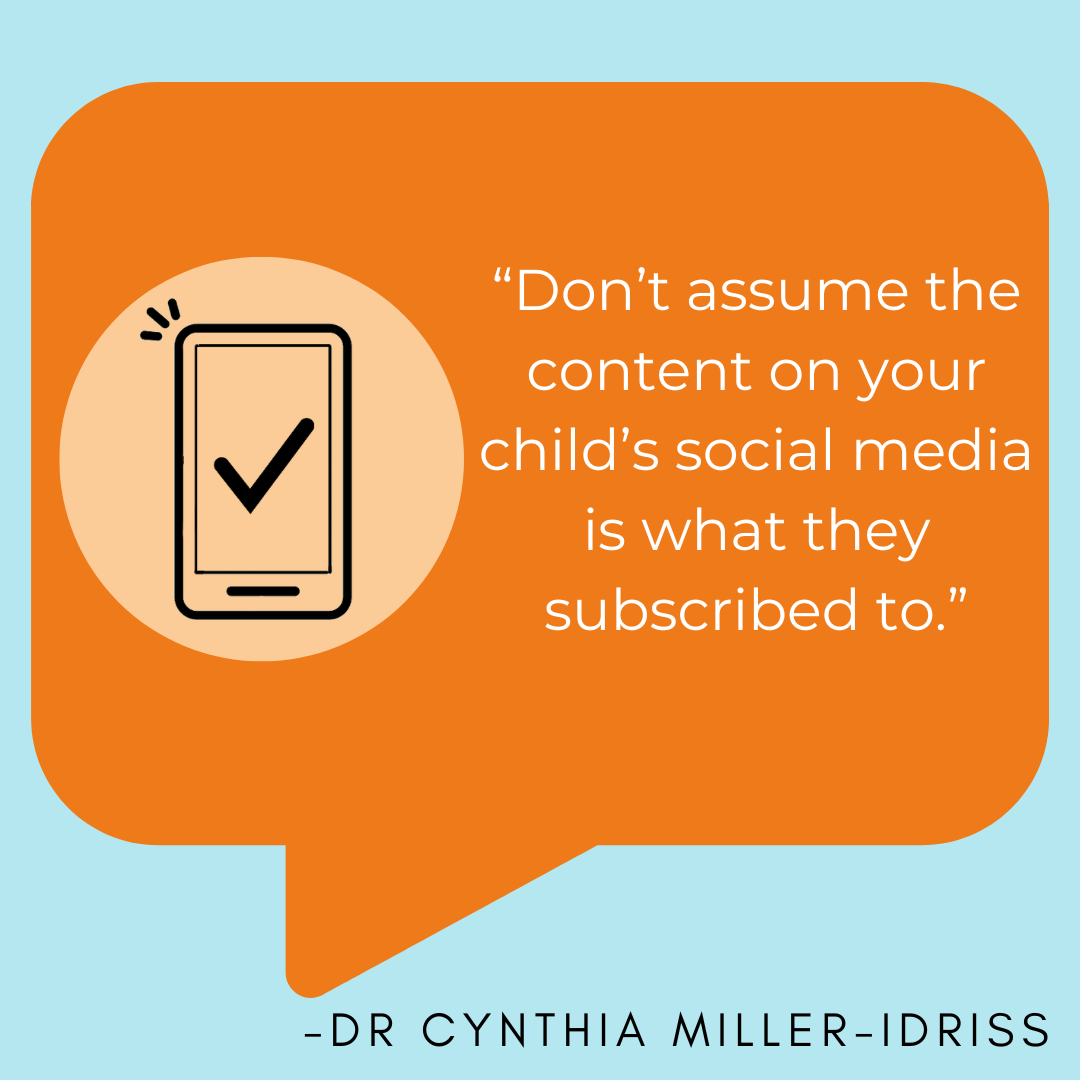
I'll give you one that I just heard from a 20-year-old young man I interviewed because I, I always ask, what, what do they think parents should know that they think parents don't know? And he said something I had not thought about, but which makes perfect sense. Of course. He said, “I think parents should be very cognizant of how much of their kids' feed is made up of content they didn't subscribe to follow.” And, um, and I think that's really important. And then help guide them to the filters you can set up on most of the platforms like the For You space or whatever, so that you're not seeing as much of the promoted and recommended content or the content that your friends are seeing, which shows up in your feed. So sometimes like I will open it up and then I'm like 10 or 12 posts in before I see something from one of my actual friends, right?
Dr. Cynthia Miller-Idriss: (34:03)
And so, you know, a lot of parents think, oh, let me see who they're following, and then I'll know if they're safe. But actually, if 90% of their content is from people they're not following, then you don't really know what they're seeing. And so really that's a place to think about and help your kids make sure their feeds are filtered depending on how old they are, or helps, you know, or help that they understand a 17, 18-year-old what that content actually might be, not something that's healthy or that draws 'em into like true crime fandom or fake, you know, content that can be really gory and violent and harmful.
Hillary Wilkinson: (34:40)
Mm-hmm . As always, you can find a complete transcript of this show as well as a link to get the book we've been talking about, Man Up: the New Misogyny and Rise of Violent Extremism and the link to all of Dr. Cynthia Miller-Idriss's books, which are fabulous, as well as the PERIL Lab and those resources we talked about by visiting the show notes for this episode. And you do that by going to healthyscreenhabits.org, click the podcast button and scroll to find this episode. And I cannot thank you enough for this conversation. Thank you. And the work that you're doing, I mean, as, as a mom and just a general member of society, you're, you're doing the most important thing.
Dr. Cynthia Miller-Idriss: (35:28)
Thank you. It's very rewarding work. And, uh, we really rely on kids themselves being super open with us to tell us constantly in focus groups and interviews what they think adults should know. And so I'm really grateful to their voices. 'Cause that's how I know what I know.
About the podcast host, Hillary Wilkinson
Hillary found the need to take a big look at technology when her children began asking for their own devices. Quickly overwhelmed, she found that the hard and fast rules in other areas of life became difficult to uphold in the digital world. As a teacher and a mom of 2 teens, Hillary believes the key to healthy screen habits lies in empowering our kids through education and awareness.
Parenting is hard. Technology can make it tricky. Hillary uses this podcast to help bring these areas together to help all families create healthy screen habits.
Recent Episodes