

S14 Episode 14: When Fun Becomes Too Much: Talking About Gaming With Your Child // Jennifer Jiyun Park, PhD
Hosted by Hillary Wilkinson
"Both online and offline games can have … gambling-specific addictive features."
~Jennifer Jiyun Park
Problematic gaming gets experienced in many households, but can be SO HARD to find any information about!
Jennifer J. Park, PhD, has been working on gaming disorder since 2018. After realizing that New Zealand had no existing programs to help people specifically with gaming disorder, Jennifer set out to study this growing concern. Therapists and people at that time were accessing pre-existing addiction programs, but had nothing to specifically help with gaming.
Listen now!
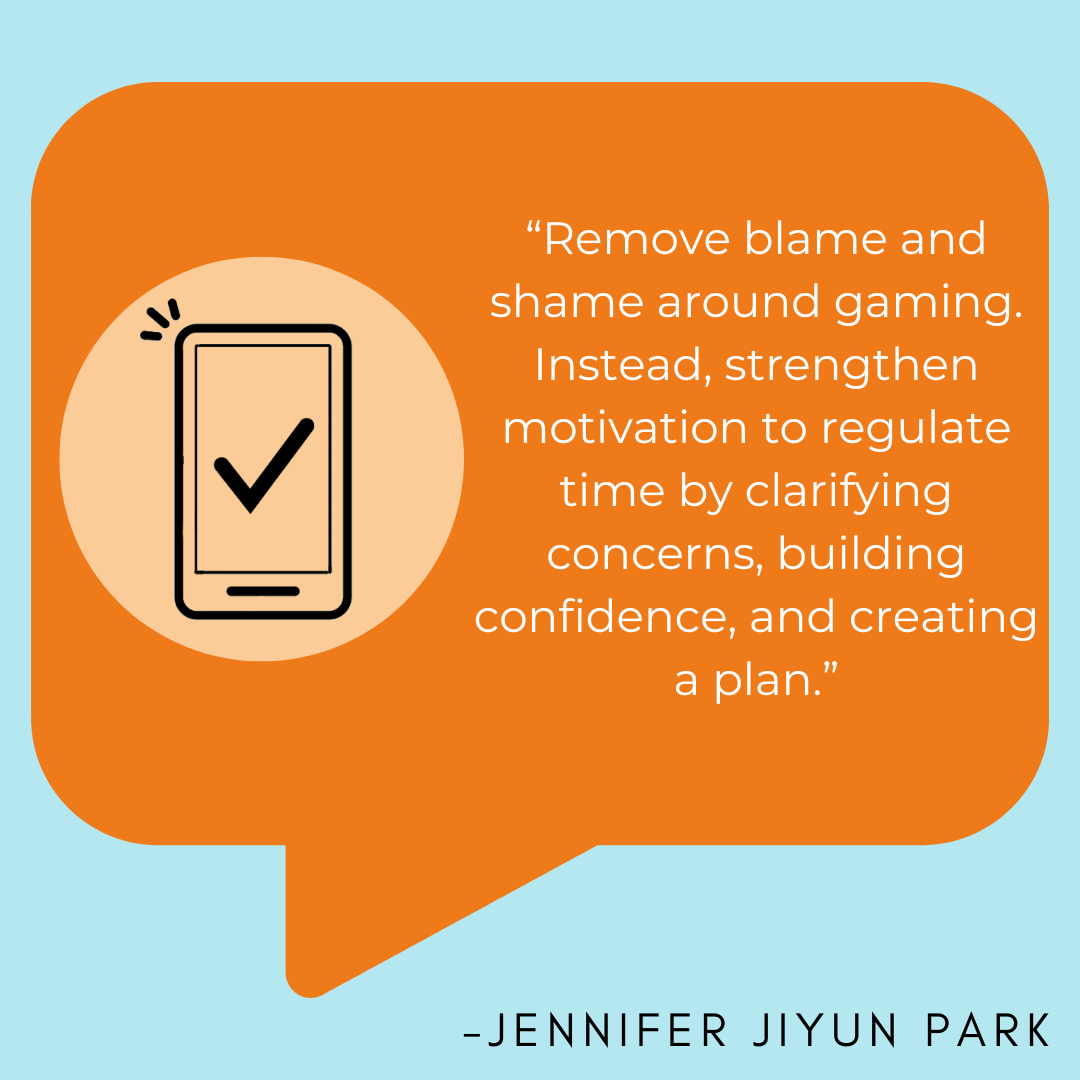
Healthy Screen Habits Takeaway
Resources
For More Info:
https://medicine.yale.edu/profile/jennifer-j-park/
Video gaming addiction: When healthy gaming becomes harmful with Jennifer Jiyun Park
Show Transcript
Hillary Wilkinson: (00:09)
Today's guest is an expert on a topic that while although it gets experienced in many households, can be really tricky to try and find information about or even find resources for help. I'm talking about video game overuse. So it gets described in the American Psychiatric Association's Diagnostic and Statistical Manual of Mental Disorders, also known as the DSM-5 TR, as an addiction to gaming is referred to as Internet Gaming Disorder, and as a postdoctoral associate at the Yale School of Medicine, her research on gaming disorder is some of the best. And I'm thrilled. We are gonna take some time and drill down on this specific area of screen use. Welcome to Healthy Screen Habits, Jennifer Park.
Jennifer Jiyun Park: (01:09)
Thank you so much, Hillary. I'm so excited to be here.
Hillary Wilkinson: (01:12)
Me too. Jennifer, when you sort of, uh, began this deep dive into gaming disorder, like straight out the gate, right? Yes. In your academic career, your research began as an undergrad student.
Jennifer Jiyun Park: (01:28)
It did, yeah.
Hillary Wilkinson: (01:29)
Yeah. Were there any keystone events that led you kind of into this field of study
Jennifer Jiyun Park: (01:35)
Study? Yes. So I actually started my research on gaming disorder in New Zealand, which is where I came from. I moved to the States last year and you know, it's a beautiful country. We have more sheep than people, but a lot of people don't realize that New Zealand as a country, we are pretty advanced when it comes to behavioral addictions research, like gaming disorder, like you talked about before, regarding the DSM-5, things like that. And I was really lucky to join this research community doing research on gaming disorder, specifically when I was 18 years old. So this was back in 2018. I was in my final year of my undergraduate degree. And it was almost exactly one year before the World Health Organization officially accepted gaming disorder as a real mental health diagnosis, which was a really positive step forward. So a keystone event for me was during that year I just happened to take a course in university regarding addiction, and it was taught by Professor Simone Rodda..
Jennifer Jiyun Park: (02:34)
She was my mentor for several years before I came. And she had one single lecture on internet addiction and gaming disorder. And I was immediately hooked because I grew up with two older brothers. And I also was born in South Korea, which has a really long history of gaming culture, but also a longer history than some other countries in dealing with the problem of gaming disorder in adolescence. So one turning point for me when I actually started my research with Simone was I came to the realization there were absolutely no specialized health services available for gaming disorder at all in New Zealand and many other countries back during that time didn't make sense to me. So people were accessing pre-existing mental health services, addiction services that doesn't always have the right tools of treatment to help with gaming specific problems. So a lot of them were being turned away. Mm-hmm. So I wanted to contribute to that change. So I started doing my research on gaming disorder and the field has grown rapidly since 2018. Lots more treatments have been studied, potentially provided in real health systems, but we still have a pretty long way to go, I'd say, as a relatively new disorder.
Hillary Wilkinson: (03:47)
How do you define internet gaming disorder? How does it differ from just say, playing a lot of games? Because certainly there are, parents who are thinking, oh my gosh, I think my son has this, you know, but that just may be simply because he, you know, doesn't wanna do the laundry or whatever, . So, so what, how, how do you define it?
Jennifer Jiyun Park: (04:21)
That is such a good question and a really important one that I get a lot of the times as well. And it's interesting to see how the classifications change over time. But I'm gonna be taking the classification in the ICD 11 and it's basically a short term for the International Classification of diseases. So basically any type of disease or disorder that you can think of, it's probably in that book Gaming Disorder was only included officially six years ago. So it's very new compared to things like gambling, other alcohol use disorders, things like that. But according to that, which was created by the World Health Organization, the first one is regarding loss of control. So a key symptom of gaming disorder is loss of control, and that should present for around 12 months or over. And a statement that's resonated with younger adolescents that I've talked to regarding gaming disorder is kind of like being swept up by waves.
Jennifer Jiyun Park: (05:17)
And imagine that you are going really deep into the ocean and you wanna go back to the shore, but the waves are way too rough, which is the external factors, and then you are also too tired, which are the internal factors. So in the context of gaming disorder, how I've seen people describe it that are younger is there are so many external factors like peer pressure to game, they might have heard of terms like, bro, just one more game before you go to sleep. And that ends up going until 3:00 AM for some people. And there are also internal factors like feelings of stress or wanting to escape that leads to loss of control over gaming. And then there are two additional key characteristics of gaming disorder in the ICD-11. The second one is prioritizing gaming over any other activities, responsibilities, or hobbies in life.
Jennifer Jiyun Park: (06:06)
So you talked about laundry, that can be an, uh, kind of routine thing that they stopped doing due to gaming. And if we think about a podium, what used to be number one is things like, you know, socializing with family or friends. It could also be doing well in school, eating well, sleeping well. But then when gaming disorder develops, gaming takes that number one spot, the winning spot in the podium, everything else gets knocked off to second place, third place, or completely off the podium. I would say Sleep concerns is one of the most studied and one of the most problematic harms resulting from gaming disorder in younger adolescents. And then that is kind of a smooth transition into the final key characteristic of gaming disorder, which is the continuation or the escalation of gaming despite negative consequences. So that can manifest in so many different ways. It's not just about sleep problems. It could also be skipping school or not performing well in school, or even dropping out. It could be losing relationships in real life, conflict with parents and even various different types of mental health problems like depression and anxiety. So those other three different characteristics that might determine what gaming disorder is in a younger adolescent. Mm.
Hillary Wilkinson: (07:26)
I appreciate the breakdown of it being like one, two, and three. And I, yeah, I imagine a lot of people are hitting the repeat button right now. . I love that. . So when we come back, let's talk about that role of outside forces, like, um, like energy drinks and caffeine. Yeah. That can play in gaming disorder as well as different types of treatment options available.
—--------------------------------------------
Ad Break: Thank you donors - Dr’s Peddie
—--------------------------------------------
I'm speaking with Jennifer Park, who along with doing her postdoc associate work at Yale School of Medicine, has also served as a news and science reporter in New Zealand for an adolescent-focused TV show. So, lots of hats on this one. Yes.
Jennifer Jiyun Park: (08:59)
,
Hillary Wilkinson: (09:00)
Jennifer, I firmly believe that one of the keys to your success is your friendliness and your approachability. Thank you so much. I mean, you and I met at this massive, like, international symposium and I just, I was drawn to You're very approachable.
Jennifer Jiyun Park: (09:19)
I can say the same. Thank you so much. Yeah, .
Hillary Wilkinson: (09:21)
Thank you. So, um, knowing that, and, and to be honest, like those are not traits that I necessarily equate with researchers. So That is true. Yeah.
Jennifer Jiyun Park: (09:34)
There are some snobby ones out there, .
Hillary Wilkinson: (09:37)
So knowing that you sort of have this like a, oh, you're young, so you have like the coolness built in factor, but you also have this like secret sauce of engagement. I, I'm looking, this is maybe perhaps self selfishly, do you have any tips for family members or people who want to begin speaking with others whom they think may be struggling with a gaming disorder, but it's like, how do, how do we just approach this topic without immediately being shut down?
Jennifer Jiyun Park: (10:10)
That is a great question, and it's quite a complex question, especially because classifying what healthy gaming is and harmful gaming is, is still debated in the literature as well as media. But I think the best approach in talking with a young adolescent is actually start talking about their reasons for gaming itself, how much time they spend on it, some benefits they see around it, and then slowly transition into what are the negative consequences that you are feeling when you're playing games, or what are the negative consequences of not playing games, like potential withdrawal symptoms of not playing games like irritability, sadness, frustration that can exist too. And when it comes to gaming, it's quite tricky to determine what a problem is. So because it is a relatively new disorder, thinking about a couple years ago, the biggest red flag for determining gaming disorder was the number of hours of gaming or increased gaming hours.
Jennifer Jiyun Park: (11:08)
But now that we are seeing that people with gaming disorder and without gaming disorder could play exactly the same amount per week, but one person doesn't have gaming disorder and the other person does. So it's completely contextual. It could depend on things like how much free time they have and how much of that free time they're spending on playing games. It could also be contextual to what other responsibilities they have in their life, like schoolwork, extracurricular activities. So regarding the diagnosis of gaming disorder and talking about gaming disorder itself mm-hmm . Can be a touchy subject for a lot of young people because labeling something that is such a popular hobby brings so many people, happiness as a disorder in that individual can incite some negative emotions too. Mm-hmm . So just thinking back to a study that was recently published by Professor Daniel King, who was my mentor for my PhD, he kind of talked about how it's complex in the sense that an adolescent might be completely immersed and spend a lot of time gaming, and over time they might withdraw from social interactions.
Jennifer Jiyun Park: (12:15)
They might fall behind academically. There might be lots of tension at home because of screen time, but the young person might see things completely differently. They'll say, I don't have a disorder. These are all the positive things of how it's changed my life. It gives me a sense of purpose. It sharpens my problem solving skills that can be applied to other aspects of the real world. It can lift my mood. And a lot of you may know that gaming is a very social activity too. So there's a social interaction component to that too. So when faced with these contrasting perspectives between the individual experiencing problems and people like counselors or parents or teachers, it's really important to approach that carefully and really make sure that what you're identifying are gaming specific problems. Sometimes it can be other problems that are playing a part too, like depression that co-occur with gaming disorder. So it's really important to kind of tease apart what the main problems are. So insights from adolescents, parents, teachers, like counselors as well and other professionals, is really important to build a comprehensive picture and reach a shared understanding of whether or not healthy gaming enters the realm of harmful gaming. And then steps can be taken for intervention if the parent or the individual is willing to take that step.
Hillary Wilkinson: (13:37)
Yeah, yeah. Yeah. I like, involving the use of outside voices as well. Yes. Because I think it can be quite contentious. It's not unlike talking to an addict of any other variety that's saying, I can quit any time. You know? Yeah. So you don't wanna get into that back and forth push, pull thing. I agree. I like, I like that, that comprehensive approach, kind of talking with community to get those things.
Jennifer Jiyun Park: (14:14)
For sure. Yeah. Getting lots of voices. I think it's super important for a behavioral addiction like this. Yeah,
Hillary Wilkinson: (14:19)
For sure. For sure. Do you have any like tipping points or red flag behaviors that, might signify to somebody like, Ooh, I think this is going beyond the realm of just healthy gaming?
Jennifer Jiyun Park: (14:40)
Yes. That's a really good point. I would say it would be the continuation or the escalation of gaming, even if they know that they're experiencing negative consequences. Mm. So escalation is a key word there, because it's not just about increasing hours of play, but it's also playing more frequently, playing more intensely and potentially playing more intense types of games. So there's a lot of evidence showing that multiplayer types of games involving role playing, involving avatars, shooting competitive aspects, they tend to be the ones that are highly addictive. So people with gaming disorder are more likely to play those types of games. It's called M- M-O-R-P-G, so massively multiplayer role playing games. So it's definitely important to also try to understand the genre of games that are being played as well. And then see if they're still engaging in games despite having problems in all aspects of life, like social, academic work, and interpersonal.
Hillary Wilkinson: (15:41)
Hmm. Yeah. Okay. Thank you. Thank you for that. Of course. Yeah. So, so now let's talk about something that I know you're kind of passionate about , and that's caffeine. Yes. Caffeine and its roles in gaming. Its role in, uh, gaming disorder. Yeah. What can you tell me about it?
Jennifer Jiyun Park: (15:57)
Yeah, so caffeine is the most commonly consumed substance during gaming. So there's evidence showing that around 30 to 80% of young adolescents and adults drink caffeine, particularly energy drinks, while gaming and the caffeine industry and the gaming industry, they kind of have a symbiotic relationship where energy drinks, they will very frequently sponsor huge eSports tournaments, or they will sponsor pro gamers or social media influencers that game online. So during an, an important developmental period for young adolescents when they're growing their identity, and they're also looking to be part of a social group, if they see people that they respect online promoting energy drinks as things like performance enhancing drugs for gaming, which by the way, there's no real evidence regarding that kind of evidence. Um, it can really lead to problematic caffeine consumption behaviors in children and adolescents because it is widely recommended that, especially for energy drinks, it should not be consumed at all for kids under the age of 18.
Jennifer Jiyun Park: (17:06)
Mm-hmm . Now, the reason caffeine needs to be targeted in the context of gaming disorder is because there is evidence showing that increased gaming disorder severity is strongly linked to problematic caffeine consumption in adolescence. So you could kind of see it as decreasing one behavior could lead to the reduction in the other behavior, like reducing caffeine consumption might lead to the reduction of gaming disorder severity and vice versa, because it's not always the best approach to directly target gaming disorder if there are other things coming into play. So one of the recent studies that we published here at Yale is we found that caffeine played a pretty small but significant role in the relationship between gaming disorder and sleep problems in US adolescents. So people talk a lot about sleep concerns and disturbances because kids are staying awake to play games. But we are, we basically found that caffeine played a role in mediating that relationship. So it's important to address caffeine 'cause it could lead to increased sleep problems in people with gaming disorder.
Hillary Wilkinson: (18:15)
Yeah. So it's kind of like the, the snake biting its own tail there, it just goes around and around. Yes, as soon as you made the connection between eSports and the major energy drinks, I'm, I'm, I'm picturing all the logos. I'm picturing Monster and Red Bull and all of those things, and I'm like, oh, yeah, I, I hear you. Yeah, yeah,
Jennifer Jiyun Park: (18:41)
For sure.
Hillary Wilkinson: (18:42)
So, um, so what type of treatment options are available for people who are going through this and looking to find some help?
Jennifer Jiyun Park: (18:54)
Yes. For adolescents and children with gaming disorder or any level of severity of gaming problems, it looks like the most common treatment is psychotherapeutic. So talk therapy, things like cognitive behavioral therapy. So in the literature we did a recent systematic review, which basically is a type of study that aims to capture every single study that has been published on a single topic. Our topic is what studies are out there regarding treatment for gaming disorder in young adolescents and children. And we found 30 different treatments. Most of them were CBT cognitive behavioral therapy, and it was pretty well supported. It was effective in reducing gaming hours, but also reducing gaming disorder severity. So that might be a pretty safe approach to go with. And the good news is gaming disorder is still a relatively new disorder, but looking back at a systematic review of the same topic, published only three years ago, there were less than half of the studies that we discovered this year.
Jennifer Jiyun Park: (19:56)
Meaning that there are several new treatments being developed very rapidly as the years go by. And there are several types of novel therapies that are available, too. Lots of online interventions, which really reduces barriers to access for a lot of people. Mm-hmm . And also very novel things like equine assisted therapy for kids who might like horses and nature, but also virtual reality therapy coming out of countries like South Korea and China as a pretty interesting and new way of delivering treatment that might be appropriate for children and adolescents. 'cause talk therapy, it does work, but it might not always be preferential for younger kids.
Hillary Wilkinson: (20:38)
Yeah, yeah, yeah. I I, I have an immediate like, ooh, pushback with the, with the VR method that, you know, I just, I, I, I, yeah, I, I hesitate to, uh, replace, in-depth screen potential addiction with a virtual, you know, I, I don't know. That's
Jennifer Jiyun Park: (20:58)
A good point. Yeah, yeah, for sure. Yeah, there's been a lot of talk around that regarding online interventions for these online behavioral addictions because we're, we are replacing screen time with screen time for sure. Yeah.
Hillary Wilkinson: (21:11)
Are there therapists who specialize in this type of disorder specifically? And if so, where would people go to? Like what, what would you look under?
Jennifer Jiyun Park: (21:31)
Yes. I believe that there are several these days, especially in Asia and in the US I'm not sure if specific people, but I know it can be quite difficult to find specific therapists that really target gaming disorder. But one approach is, I've seen one to three online interventions where people can sign up from anywhere around the world and they can still have one-to-one contact with a trained specialist. They could be a counselor, a doctor, a nurse who's trained on screening for gaming disorder, but also treating for gaming disorder. And the availability also of group-based meetings and peer support can be really helpful as well, especially for young adolescents. Talking about what they're going through, relating with others is a really important aspect of behavioral change.
Hillary Wilkinson: (22:19)
For sure. I think part of the big draw in a lot of, um, these multiplayer games is that element of social connection. Yeah. Like it stands to reason that if you could find another group that are looking to back away from the gaming, but maintain some type of social connection that
Jennifer Jiyun Park: (22:43)
Exactly.
Hillary Wilkinson: (22:44)
Yeah. Yeah.
Jennifer Jiyun Park: (22:45)
And a lot of people like to keep in touch. And I think that's the beauty of online interventions. It doesn't always have to be an intensive treatment. It can just be social contact. And that helps to people to reduce their gaming time.
Hillary
Wilkinson: (22:57)
Yeah. Yeah. Yeah. Awesome. Thank you. Well, we have to take a short break, but when we come back, I am going to ask Jennifer for her healthy screen habit.
—--------------------------
Ad: HSH Workbook
—--------------------------
Hillary Wilkinson: (24:13)
I'm speaking with Jennifer Park about IGD or internet gaming disorder. And I think it's interesting, Jennifer, that internet is included in the diagnostic label. Are other games addictive as well? Or is it simply the internet games?
Jennifer Jiyun Park: (24:34)
Yeah, so internet gaming disorder, that is a very particular term that aligns with the DSM-5, the American Psychiatric Association. I think we're leaning a bit more towards the gaming disorder criteria by the World Health Organization, which thankfully includes online and offline games. So it kind of captures everything that we can. And while I do think that internet-based games are more addictive, I do think it is also important to address that offline games can also have addictive features as well. So both online and offline games can have not only gaming specific addictive features, but gambling specific addictive features. So across various PC games that can be online, offline, around 80% have some sort of gambling-like mechanism. The most common being loot boxes. Mm. So loot boxes, they appear kind of like a treasure box and kids can play basically games and it'll come up and they can pay with real money or they can pay with in-game currency in order to open the box. What's in the box is completely randomized, meaning that it's a very gambling-like activity. And it's all desirable products, like skins for your avatars to make yourself look cooler, specific weapons so you perform better in games. So it is important to realize that those types of addictive aspects don't just exist in online internet-based games, but also offline games as well.
Hillary Wilkinson: (26:05)
Yeah, yeah. I remember speaking with another guy who had been a developer and he's, he recommended to buy your games. Yes. He said that games that are purchased are developed and written different mm-hmm . Than games that are the quote-unquote free games, you know? Yes. That are just designed to keep you on. So part of exactly. Performing in that attention economy type, you know,
Jennifer Jiyun Park: (26:33)
I totally agree. Those online play player games, they definitely have a time limitless aspect because they can always add new storylines and always add new missions. So those are the most addictive as well, looking at the studies that have been published.
Hillary Wilkinson: (26:47)
Mm-hmm . Yeah. So true confession time. What games do you play? ?
Jennifer Jiyun Park: (26:54)
Yeah, I do game here and there. I, I would say I game maybe once a week Uhhuh . And that's like the limit that I put on myself that I stick to. But I love playing Star G Valley, which is a very relaxing game, Uhhuh. And it's kinda like you take care of animals, you farm, it's that sort of game. And I also love Balloon Tower Defense, which is basically a tower defense type of game. It's strategic, it doesn't really have a role playing component, but I would say it's a little bit more addictive than Star G Valley, which involves planting and taking care of cows and .
Hillary Wilkinson: (27:27)
I love it. I love it. Uh, I think it's, um, it, it's, it's nice to hear that you have your own relationship with Yes. It, it, it lends to your credibility, you know? Thank you. That you can speak to it. Yeah. So on every episode of the Healthy Screen Habits podcast, as you know, I ask for a healthy screen habit. And this is gonna be a tip or takeaway that listeners can put into practice in their own home. What's yours?
Jennifer Jiyun Park: (27:58)
So my tip is that when you look at younger individuals with gaming disorder, many of them or all of them will struggle to cut down on their gaming and they'll feel really guilty that they can't do it themselves or even with support. So they might even feel quite discouraged to try again to cut down on gaming. So it's really important to emphasize that this struggle of reducing gaming is not a personal failing at all, because games are really carefully designed to be addictive. So games these days are sophisticated, engaging, and immersive, and it's designed in a way that will facilitate not only longer sessions, but more frequent and intense sessions of play. But also thinking about behavior change, actual behavior change, even if adolescents want to cut back on gaming, can be very, very difficult. And there's actually a scientific term for that called the gap between the intention and the behavior or the intention-behavior gap.
Jennifer Jiyun Park: (29:00)
So, I mean, not to get sidetracked too much, but my favorite snack is spicy noodles from Korea called sra. It is not good for me and I told myself I'm not gonna have it this week, but I had it yesterday . So that's my intention and my behavior completely misaligned. And that can be the same story for kids with gaming disorder, where even if they really have the intention to cut down, they just can't do it because behavior change is really difficult for anybody. Mm-hmm . So sharing this perspective first can relieve a lot of unnecessary self blame. And then it can open the door and open their heart to practical steps forward. So it can help to reassure young people that change is possible, but there are some steps that need to be taken. So change is possible, especially when they strengthen motivations by setting a clear goal for themselves.
Jennifer Jiyun Park: (29:51)
I'm gonna limit my gaming to this amount of time per day for the next 28 days. And they can also clarify reasons for cutting down that they can kind of look back on and think about. The reason they're trying to cut down the nex is building the skills and the confidence to change. It's important to increase self-efficacy when it comes to changing behaviors. And lastly, creating and following a realistic plan for gaming reduction to stick to is important. There are various different strategies that people can take depending on their needs and their preferences. Some people might go to, you know, do behavioral substitution, which is completely replacing gaming with another activity when they feel cravings. Some people might lean towards kind of changing their environment, so removing computers or access to consoles in specific rooms, or just tracking their gaming to be more aware of how much they're gaming. So it's important to stick to a strategy and a plan and stick to it. So overall, I would say that feeling that change is hard is very normal. Not just for individuals with gaming disorder, but for everybody. But with support the right plan and just persistence change can happen. And my overall philosophy is I don't want to stop people from gaming, but I just wanna make sure that games bring people happiness and not harm.
Hillary Wilkinson: (31:12)
Yeah. Yeah. Thank you. As always, you can find a complete transcript of this show by visiting the show notes for this episode. And you do this by going to healthy screen habits.org. Click the podcast button and find this episode. Jennifer, thank you so much for all the work that you're doing that is so necessary. Thank you. So, so many people are benefiting from all of it. You, you are definitely changing lives.
Jennifer Jiyun Park: (31:42)
Thank you so much for having me. And yeah, I really appreciate you having me on. Thank you.
About the podcast host, Hillary Wilkinson
Hillary found the need to take a big look at technology when her children began asking for their own devices. Quickly overwhelmed, she found that the hard and fast rules in other areas of life became difficult to uphold in the digital world. As a teacher and a mom of 2 teens, Hillary believes the key to healthy screen habits lies in empowering our kids through education and awareness.
Parenting is hard. Technology can make it tricky. Hillary uses this podcast to help bring these areas together to help all families create healthy screen habits.
Recent Episodes