

S15 Episode 10: I Survived High School With A Flip Phone // Talmage Erickson
Hosted by Hillary Wilkinson
"Connection is the cure for any disease."
~Talmage Erickson
Talmage Erickson is an author, speaker, and digital wellness expert. Having survived high school with a flip phone, he learned what it meant to live beyond the screen.
As one of the Screen Guys, Talmage believes in creating intentional balance. This week, we talked about relating to teens in meaningful ways that will help drive connection and make talking about boundaries surrounding technology use easy.
Healthy Screen Habits Takeaway
Resources
Resources Mentioned:
https://screenguy.com/
Healthy Screen Habits Takeaway
Hillary Wilkinson: (00:00)
As a digital wellness speaker and educator who believes in creating intentional balance as the screen guy, my guest today writes, speaks and presents on all things screens. Sounds familiar. Welcome to Healthy Screen Habits. Talmage Erickson.
Hillary Wilkinson: (00:40)
Talmage as someone who grew up in the digital age, you experienced firsthand what it's like to be a teenager with tech. But your, uh, origin story is a little bit different. Can you share your experience with phones and also what compelled you to work in digital wellness?
Talmage Erickson: (01:33)
Oh, that's a great question. Go back to the 14-year-old Talmage, . All my friends had cell phones, especially smartphones and social media, and all my siblings did as well, and said, dad, it's time for me to get a cell phone. And he said, " Let's, let's take a step back here. What if Talmage, you went with a flip phone instead of a smartphone?” And I said, " Okay, so how long are we doing this?” He said, “all of high school. What if you had a flip phone? All of high school? “And I was just the most perfect, obedient, kind, amazing young man. Oh, wow. And I said, " Dad, that's the stupidest idea I've ever heard.” Okay, , that's,
Hillary Wilkinson: (02:15)
That's much more like most other 14-year-olds.
Talmage Erickson: (02:18)
I know. I said, I said, dad, are you kidding me? You don't, you don't love me. You don't want me to have friends, you don't want me to be popular. You're not my father, essentially, is what I said. And we had a really good talk. We sat down across from each other and he said, “Talmage, I've, I've been seeing a lot of struggles in the community, and I don't want you to fall into that trap.” Mm. I said, " Dad, you got me.” And so after some pushing and shoving and, and pulling and tugging, he bits me. And, and when I turned 16 years old, just before my sophomore year of high school, I got a little flip phone. It's one of those slider phones. You got the screen on top and the keyboard on the bottom, slides up and down. I think it was indestructible. I chucked it off mountains. I ran over it, I lit it on fire. We, we, we shot at it with paintball guns. That thing didn't die. It was amazing. And
Hillary Wilkinson: (03:09)
So you were, you were trying to love it to death. I can tell
Talmage Erickson: (03:12)
I was trying to love it to death, and boy, boy did we, but I, I got a front row seat, like you said, Hilary, at, at some of the things that were happening around me, such as cyberbullying, sexting, pornography, all this comparison, this competition, this criticism that comes with the digital world. And I just sat back and thought, you know what, maybe, maybe this was meant to be, maybe my dad was in the right. And so that led me on a journey of understanding what digital wellness means and how we can live a life beyond the screen? How we can connect in real life instead of virtually. And, and that's where I'm at today.
Hillary Wilkinson: (03:51)
I relate to your story in that I grew up in a house where TV was really not allowed it was allowed in very like limited viewing, special events, stuff like that as a result, like I can remember watching like presidential inaugurations. Yeah. I remember like, you know, like many others of Gen X, I remember when the space shuttle blew up. I remember when the, you know, I mean, but they're very, very impactful visual images. Um, but I can tell you as a result, there were, and still are to this day, pop culture references that get made, like specific say Brady Bunch episodes, Oh, yeah. Or opening songs to, um, sitcoms of like the seventies and eighties, you know, that were popular, but I have literally no idea what people are talking about.
Hillary Wilkinson: (04:53)
knowing like our meme culture and like, you know, how saturated that is, do you have any of those pockets of like, I do not know what like Daniel's white shoes were, or do I do not know? Like, like do you have any of those?
Talmage Erickson: (05:12)
I believe that I do. And, and to name them specifically, I, I wouldn't even know where to start Uhhuh . And so you're probably right. I, I, I missed out on some of those, uh, those memes, some of those famous reels or videos that went viral. I just, I heard about 'em from my friends, but maybe didn't get to get to experience it firsthand.
Hillary Wilkinson: (05:34)
Yeah, yeah. But with a little, um, age and perspective, you're okay with it.
Talmage Erickson: (05:39)
Totally
Hillary Wilkinson: (05:40)
This is like one of the primary things that when we recommend parents, um, use like a transitional device, um, like a Troomi or a Gabb or something along those lines. Um, do you, um, did you have a challenge with, um, like making plans with friends, feeling included within, um, you know, social setups and if you played athletics how did your coaches communicate with you?
Talmage Erickson: (06:21)
Great point. And, and I would say I did, I missed out a lot, unfortunately. Mm-hmm. My family moved right after I got my little smartphone or a little flip phone. And, and so I started at a new school. I started in a new community, a new church group, a new area, a new neighborhood. And to be honest, that was the hardest part. Yeah. Was I, I wasn't in the group chats. I wasn't connected with people online. I wasn't in the Instagram DMs. I didn't have that virtual connection with some of my old friends. So I, I sank pretty low and I felt very, very alone. But what did happen was I learned that real connection isn't virtual. And I learned that people need people. And I hadn't experienced Hillary when I was - that first semester when I was at my new school. I just, man, I was in the dumps, and I was walking home from school thinking to myself, man, I just, I don't belong. I'm not one of the cool kids. I'm not the popular kid. Oh my, I'm the new kid,
Hillary Wilkinson: (07:25)
, My heart's breaking.
Talmage Erickson: (07:27)
And, and this was a life-changing moment because I had a friend come and, and he rolled down his window and I had met him somewhere, I don't remember. And he said, Hey, let me give you a ride. So I hopped in his car and he gave me a ride home. And I thought, oh my gosh, in the depths of despair, people are what matter most. And so that gave me a good insight of what it means to live beyond the screen. And what we teach in schools and in communities is connection is the cure for any disease. It's the cure for any addiction. It's the cure for any hardship that you had in life. And so, yes, I did struggle because I, I felt like I didn't belong in the digital world, but also I had a better view of real connection. Yeah. Yeah. I hope that answered your question.
Hillary Wilkinson: (08:12)
I, it, it does. And it, uh, it, it's oddly validating for choices I made with my own parenting, but also, you know, we live in such a frictionless world anymore. We live in such a world of convenience. Literally, you know, just tapping a button can bring nearly anything to our doorstep within hours or days. And I think that we've gotten so used to living in this lap of, like I said, just ease and comfort and everything that we forget that friction is necessary for growth. So that's a very good reminder. Thank you, . So let me just ask you one more, one more thing about high school, and then I'm gonna let it go. 'cause I believe me, , I, I know we got other things to talk about, but for parents who might be compelled to challenge their kids to go smartphone free through say, like, you know, just delay it until like, you know, 16, 18, whatever. How do you, how do you sell that? How do you recommend it gets phrased so that it doesn't just come across like, you know, top-down management, this is my way or the highway kind of stuff? You know,
Talmage Erickson: (09:36)
I, I wish I had all the parenting knowledge in the world. I really do. And, and , the best thing I could think of, and, and the metaphor I always come back to is sometimes there's gotta be a Grinch in, in the Christmas story. And if you remember the Grinch, he goes and he steals all the presents and he steals all the joy, so to say, from the community. And guess what happens? They wake up and they sing, and they're gathered around the tree and they just love on each other. And they're singing songs and they're connected. And I think sometimes as a parent, we're so focused on the short term mm-hmm . Of, oh my gosh, I'm gonna ruin this relationship. But take a look of a down 2, 3, 4 years, what are you building now for your kid digitally as well as socially, intellectually, emotionally, mentally, so that they can find real connection. They can, they can sing down there in Whoville the rest of their life. And that's what we always go back to is take some risks now as a parent that say, “Hey, we're gonna do this so that the rest of your life, you have a good baseline of what it is to talk to someone in real life. To have eye contact with someone, to have real connection.”
Hillary Wilkinson: (10:45)
Yeah. Yeah. Great advice from a soon dad to be.
Talmage Erickson: (10:49)
That's right. .
Hillary Wilkinson: (10:50)
That's so exciting. Okay. When we come back, I'm going to ask Talmage how to deliver hard messages to kids who just want their own phone and some other helpful hints.
—-------------------------------
HSH Workbook
___________________________
Hillary Wilkinson:
I'm speaking with Talmage Erickson, a digital wellness educator and advocate, also known as the Screen Guy. Talmage has been doing the work of getting kids and families educated in all areas of digital wellness. And I'm curious, this is, uh, you know what they always say, like, research is me-search. Well, you know, , this is, this is a little bit, a little bit me here, but when you talk to kids, what type of messaging do you find lands best? Like when you're speaking to groups, is it, is it brain science? Is it cautionary tales? Like what do you find connects with kids and makes the biggest impact?
Talmage Erickson: (12:12)
I, to be honest with you, I, I like to play music and I use music as a way to teach kids. So I play the saxophone and I play the, I play the accordion. I sing songs. I'm not a good singer, by the way, but I feel like when you get kids moving and dancing and then sing it along with you, the brain starts to turn on and they start to think, you know what, maybe this is a good message. And so when I go to schools and I present, we talk about some of the digital dangers that we can avoid, a few tips from the digital doctor, and then we sing a few songs about how to live beyond the screen. Some parodies I wrote to some popular songs. And then we ended off with an inspiring story that goes back to what I shared with you about that friend who, who gave me a ride home and inspired me to, to be better and live beyond the screen. And so our message is, how can you go out and make a difference in someone's life today by just putting your phone down and looking up?
Hillary Wilkinson: (13:05)
Oh, I love it. And I, um, I think that that type of messaging doesn't just go away with kids. I feel like when you can come from a place of help and hope sprinkled in with some humor and like, wow, you're a genius to work in that musical connection, because, I mean, it's so silly, but like, I can, I can spout off camp songs that I've learned at, like, you know, at 10, you know, so it's like those, those songs do have sticking power. I love that. Right,
Talmage Erickson: (13:38)
Right. No, I agree. And, and the goal is to also give them practical strategy. So that's not all the fluff. It's not all rah rah, rah for, like you said, the practical strategies are work, what work best with, with parents and families. And so giving them tools and tips, but also inspiration as they start their digital journeys.
Hillary Wilkinson: (13:58)
Yeah, I love that. So we know from studies that people who spend over three hours a day on social media are three times more likely to experience depression and anxiety so you got three and three. Can you kind of, because we do at healthy screen habits, we do like to be research back science-based. Okay. Can you, um, explain the kind of just this whole role of dopamine within this cycle? And for anybody who needs like a, a brief refresher, dopamine is a neurotransmitter, which is a chemical messenger within our brain that has to do with like, drive and it also follows the pleasure pathway. And it's, it's integral to learning. I mean, dopamine is like, it's kind of gone from this darling to this bad guy. And, um, I don't mean to cast it in any light, dopamine is, it's necessary for us to live a human life. But can you sort of explain the role of dopamine and the whole cycle of social media, and I'm gonna use the word addiction and, and video game addiction and all of that.
Talmage Erickson: (15:21)
Great point. And I love that you're science-based, because that's all that digital wellness is, is science-based and research-backed. Dopamine, like you said, is the neurotransmitter sense, a signal to the brain. It's used for motivation, but also movement. And so I feel like sometimes in pop culture, social media culture, we, we have this phrase, this dopamine depletion, and it sounds like, oh my gosh, everyone's gonna die, die. And I think a, a, a different phrase we could use is actually dopamine desensitization. When you say depletion, it almost sounds like the brain has a fixed amount of dopamine that you can only use. And once it's used up, you're dead. No, I don't know. But dopamine desensitization means that because you're constantly overloading that reward circuit, some of those receptors start to become numb to the increased amount of dopamine. And so they start to shut off.
Talmage Erickson: (16:17)
Now we use the analogy of, of think of a few boats on a lake and some docks, the docks are the, are the receptors and the boats are dopamine. What happens when you have so many boats on the lake? Well, the docks start to shut down and say, sorry, boats. You're, you're on your own. And so when we do these instant gratification, high dopamine activities like scrolling, pornography use, playing video games endlessly and other dopa high dopamine activities, we're overloading the lake with boats. And what our brain says is, oh my gosh, we have to regulate this. So we're shutting down some of the docks. And that's why some of the mundane tasks of everyday life, like going for a walk or conversations with a friend or doing chores are boring for most kids because they're so used to that instant. Oh my gosh, this is so exciting, so exciting, so exciting. Dopamine isn't necessarily all about reward. It's more about, Hey, this was worth it, so do it again. And that's the change we need to understand. It's is dopamine is neither good or bad. It's not like when you look at your phone, you need more dopamine. It's the fact that your brain likes and motivates you to chase things that make it feel good. And so dopamine is that motivator.
Hillary Wilkinson: (17:36)
On the Screen Guy website, there's a, there's a cautionary phrase that I immediately kinda looked at and was like, Hmm, what is that? And it's “don't be a 96er”. And can you explain what that is?
Talmage Erickson: (18:38)
There's so many different studies or, or I wish, I wish I had all the research on mine, but a 96er is someone who picks up their phone 96 times a day. Yeah. And what we've come up with is a 96 er is, is not what you want to do. So the average person picks up their phone, every five to seven minutes. And so when they use their phone every five to seven minutes, they're only using it for about two minutes, which means they don't have any purpose where they pick up their phone, they're just picking it up to pick it up. Mm-hmm . And so when you say don't be a 96 er, it means, hey, out of sight, out of mind, put your phone away in a drawer, in a desk or, or in a different room, and then be present with your family. So don't be a 96'er.
Hillary Wilkinson: (19:23)
Yeah, yeah. I, it's putting the intention behind it. Yeah. We, um, yeah, don't be a 96 er or when you, when you pick up your phone, we try to encourage parents to narrate their use of the phone. Interesting. So that, um, you know, because we apply our lived truths to what we see happening in the world. And for, for most children at a young age, the phone is used for entertainment purposes. Mm-hmm . Right? So anytime they see somebody on a phone, what they're thinking it's being used for is for entertainment purposes because that's their truth. Okay. So when you kind of can open the top of your brain and narrate what you're doing on it, it also creates that don't be a 96er friction of like, “what's my purpose?” When you have to apply, I'm gonna, I, I'm gonna look on the phone because I need to see if practice starts at 3:00 PM or 5:00 PM coach, you know, talked to me earlier and I don't know what, so it just, it, it injects into your dialogue and your use some purpose and some intention behind the phone use. So I love that. I, thanks. Thanks. It's cool. I feel like, like you and I could just sit and banter .
Talmage Erickson: (20:51)
Yeah, totally.
Hillary Wilkinson: (20:54)
Okay. So we have to take another short break, but when we come back, I'm going to ask Talmage for his healthy screen habit.
—------------------------------
HSH website
—-----------------------------
Hillary Wilkinson: (21:05)
I'm speaking with Talmage Erickson from Screen Guy! Talmage. On every episode of the Healthy Screen Habits podcast, I ask for a healthy screen habit. And this is going to be a tip or takeaway that listeners can put into practice nearly immediately in their own home. What is yours?
Talmage Erickson: (21:28)
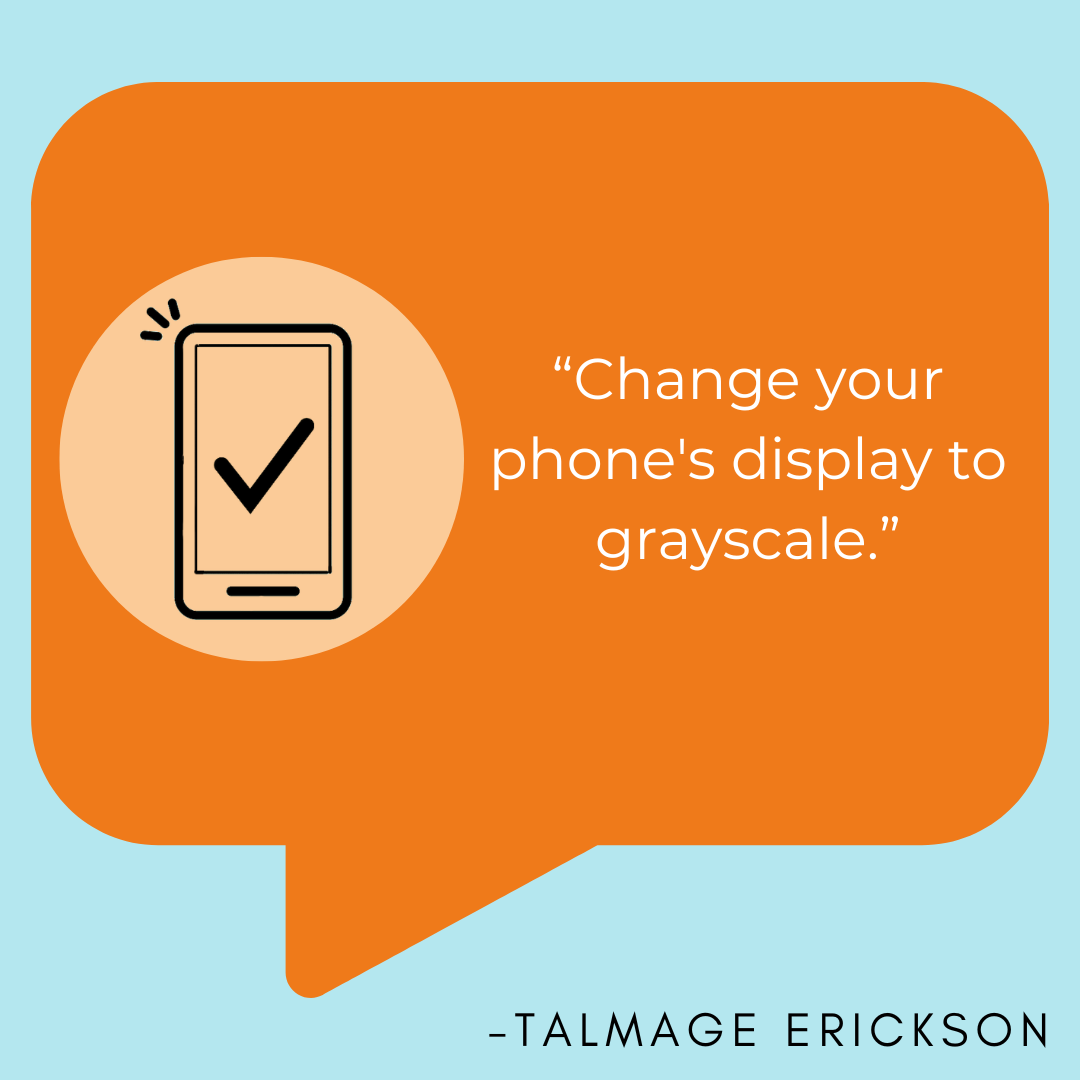
You've probably heard this before, but just to reiterate, it's, it's the process of gray scaling your phone. apps are designed to be wow, pizzazz, wow, boom, pow, exciting. And so they make us want to click. What happens when you gray scale your phone is things start to become a little less exciting and you're less likely to click on 'em. So you go to your settings, you go to accessibility, you go to display, and then color filters. And then once you do that, you're able to gray scale and that just turns your whole iPhone or smartphone gray. It's gonna be boring, but that's the point. The point is for, for it to be boring. So you're focused and you're purpose filled on your screen, and then you can get back to real connection.
Hillary Wilkinson: (22:11)
Love it. As always, you can find a complete transcript of this show by visiting the show notes for this episode, as well as a link to more info about the Screen Guy. You do this by going to healthy screen habits.org. Click the podcast button and find this episode. Talmage, thank you so much for the work you're doing today, for you just, um, sharing what life is like with the, the potential when we, uh, kind of gain control of these screens again.
Talmage Erickson: (22:47)
Thank you, Hilary. It's a pleasure to be on with you. Appreciate it.
About the podcast host, Hillary Wilkinson
Hillary found the need to take a big look at technology when her children began asking for their own devices. Quickly overwhelmed, she found that the hard and fast rules in other areas of life became difficult to uphold in the digital world. As a teacher and a mom of 2 teens, Hillary believes the key to healthy screen habits lies in empowering our kids through education and awareness.
Parenting is hard. Technology can make it tricky. Hillary uses this podcast to help bring these areas together to help all families create healthy screen habits.
Recent Episodes