

S15 Episode 9: Screen Aware Childhood // Pat Cantor, Ed.D., Mindy Holohan, MA, CFLE, Jean Rogers, M.S.Ed, CPE
Hosted by Hillary Wilkinson
"…a big misunderstanding is that young children can learn from screens."
~Pat Cantor, Ed.D.
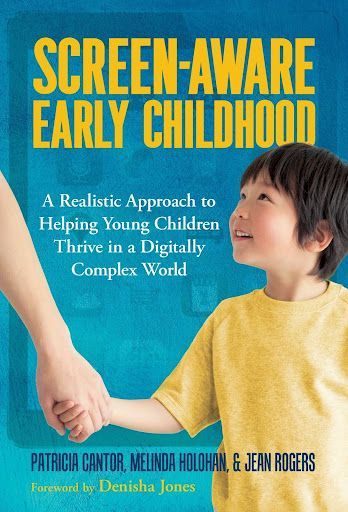
Happy week of the Young Child! The week of the Young Child is an annual week-long celebration sponsored by the National Association for the Education of Young Children (AKA: NAEYC). The purpose of this week is to focus public attention on the needs of young children and their families, and to recognize the early childhood programs and services that meet those needs. The book I’d like to honor and recognize for this is: Screen Aware Early Childhood, A Realistic Approach to Helping Young Children Thrive in a Digitally Complex World. The authors, Pat Cantor, Mindy Holohan, and Jean Rogers, walk us through the key points and tell us what we can do now to help our children thrive in the digital age.
Listen to this episode and visit the show notes on the Healthy Screen Habits website to gain access to this valuable resource.
Healthy Screen Habits Takeaway(s!)
Resources
Resources Mentioned:
Book: Screen Aware Childhood: A Realistic Approach to Helping Young Children Thrive in a Digitally Complex World
Show Transcript
Hillary Wilkinson: (00:29)
I'd like to wish everyone a big, happy week of the Young Child. The week of the Young Child is an annual week-long celebration sponsored by the National Association for the Education of Young Children, also known as NAEYC. And the purpose of this week is to focus public attention on the needs of young children and their families, and to recognize the early childhood programs and services that meet those needs. And when I think of all the programs, books, services that have come out this year to advocate for our youngest ones, there is one book that is standing head and shoulders above the rest. And this book is Screen Aware Early Childhood, A Realistic Approach to Helping Young Children Thrive in a Digitally Complex World. The authors are with us today- and Pat Cantor, it's, there's three of them. Pat Cantor is Professor Emerita of Early Childhood Studies and a former associate provost at Plymouth State University, New Hampshire.
Hillary Wilkinson: (01:48)
Mindy Holohan serves as faculty specialist in Family Science and Human Development at Western Michigan University. And Jean Rogers is the director of the Screen Time Action Network at Fairplaya global collaborative of practitioners, educators, advocates, and parents. I'm gonna jump right into it. These three powerhouses. I wanna focus everything on what they've done to create this amazing resource. Jean, I'm gonna start with you. So we know that digital media use is ubiquitous today. Can you explain why is it so important to focus on early childhood when understanding the impacts?
Jean Rogers: (02:43)
Thanks for that question, Hillary. And thanks for having us. You know, we rightly see a focus today in the news and in a lot of our online platforms, that teens and pre-teens are exposed to a lot of harm online. And that is a good focus and fine when young children had virtually no exposure to screens. And it started later in childhood, but we wrote this book to call attention to the fact that companies now target infants and parents of infants and parents are also online themselves. They are not trusting their parental instincts, putting all their faith and influences that are telling them how to parent. So it's a big, kind of confusing online world, and as you said, ubiquitous. But what we really want parents to know is that the child's brain is growing to 80% of what it will be as an adult brain by the time they're three years old. It's an incredible period of exploration and really understanding the world around them. And screens are not meeting that need. So if we think about sort of the pediatric icons like Barry Brazelton, they taught us that infants have emotions and that they need loving adults to meet and reflect those emotions and screens are just not meeting that need. And that's why it's so important to start young.
Hillary Wilkinson: (04:13)
Even in hearing you talk about that, it feels so validating as a mom, just knowing my babies and my, you know, knowing inherently these are real emotions that I'm seeing. This is real connection. And so I'm glad you gave voice to that. Mindy,what can you tell us about the approach and the tools, Screen Aware Early Childhood provides for parents?
Mindy Holohan: (04:45)
Yeah. So, um, I echo Jean’s sentiments and gratitude, um, to you for having us and happy week of the Young Child to you and listeners. And also, um, just again, like deep appreciation for all that you and the Healthy Screen Habits team do for children and families. when it comes to, uh, our book, right, we know that, and as Jean kind of touched on it, that did screen-based digital technologies and media that are, you know, delivered via those technologies are impacting all domains of child development. Um, we know they are also impacting many, if not all domains of early childhood practice. They are impacting many, if not all domains of adult child relationships, um, due to their, ubiquity. Um, and so we know also that those impacts are like really complex, um, and involve many variables and that there's no one answer or a formula or, you know, and then, and that they're, they're evolving.
Mindy Holohan: (06:00)
identifying, um, that need kind of for screen awareness in those spaces and aiming to like, respond to and address those needs has been what brought Jean and Pat and I together over time. titling the book Screen Aware Early Childhood is very intentional, um, and is a concept that we've, you know, developed, um, that has shown to be of use , um, for parents and practitioners.we define, screen awareness as both the knowledge and the practices that uphold the developmental well-being and rights of young children in a screen-based and media-centric society.
Mindy Holohan: (07:35)
The book really is anchored in those, that definition. A major goal of the book has been to really bring research into practice. Um, and we do that, through sharing like really consequential research findings, um, addressing some of the biggest questions that early childhood, um, practitioners and parents with young children have and families have about, the impacts of screen time and use and content, um, including, like Jean touched on a little bit, the like problematic industry practices and things. Um, and then also one of my favorite, um, components is, is also identifying, defining, um, protective factors.
Hillary Wilkinson: (09:55)
Yeah. I love that protective portion. It, it just speaks to this very intentional approach that you three, uh, came at early childhood with the screen awareness component. And really, the power behind this book is it serves as such a great translational piece between the research and the practice of everyday use. And I really, um, commend you for doing that because that can be so tricky. Pat, one of the things that you warn about in this book is that screens can replace essential human cues in those first critical years of life. And can you talk about this displacement? What does a child stand to lose when a device takes the place of human interaction?
Pat Cantor: (10:52)
Sure. And, uh, Hillary, I wanna share my colleagues, thanks to you for hosting us, and it's especially exciting to be here during the week of a young child. So our screen aware early childhood approach that Mindy was just talking about is grounded in four kind of guiding principles, four key areas, child development. So it's development focused, it's informed by research, it's based on relationships and the importance of relationships because we know that young children learn best in the context of their relationships with caring adults. And it's also strengths-based, kind of referring to those protective factors that you were just discussing. And we know, as I said, early childhood learning happens in the context of relationships. Uh, we know the importance of what the Harvard Center on the Developing Child called serve and return interactions. Those are the interactions that very young children have with caring adults, where they kind of throw out a cue.
Pat Cantor: (11:58)
It might be a cry or a facial expression or some body language, and the adult responds to that individual particular cue. That is a very human interaction that's really impossible for digital media to duplicate. People might tell you AI is getting there, but I don't believe that, and I don't haven't seen proof that AI can provide that kind of contingent responsive interaction that a caring, loving, fellow human being can. So we know that those serve and return interactions are really crucial for children's learning. those interactions are how children learn about self-regulation. It takes a really long time. Some developmentalists say it takes well into young adulthood for people to learn self-regulation. And in those early years, children learn about self-regulation through co-regulation. Again, an adult helps them understand what will soothe them, what they can do when they're upset, take deep breaths, whatever.
Pat Cantor: (13:06)
We also know that those interactions are the foundations for children's understanding of language and hearing language and engaging in responsive language interactions, starting when an infant can't even really form words yet, but is communicating in other ways, and then building as they form approximations of words and build vocabulary. That's how children learn language. They're not going to learn that through screen, uh, encounters. So one of the examples that we use in the book is how a, a child or baby starts to understand a concept like hot. A parent has a cup of coffee and the baby reaches for it, and the parent says, oh, that's hot. And sometimes the parent will say, you can touch one finger to the cup. So they get an understanding of what hot feels like and how it's different from not hot. They may see the steam rising from the mug, they may put their hand over the steam, and repeated interactions like that will help the baby understand what hot means.
Pat Cantor: (14:10)
It might be it's hot outside, it's hot on the radiator, lots of different ways of understanding hot. Compare that to looking at a screen and seeing a picture of, of a mug of coffee and saying hot, hot. There's no contextual understanding for that word. There's not repeated use of it in different contexts. There's not the multisensory aspect of feeling the heat, smelling the aroma of whatever it is that's hot, uh, experiencing different levels of hot. You don't get the same kind of deep learning or understanding from the screen encounter that you do from, uh, the kind of real-world interaction that's mediated by an adult. And that's kind of an example of what we mean by children learning in the context of relationships. Their learning is much deeper, much more multi-sensory and much more likely to stick than encounters with a screen. And that can be lost if children's, you know, primary encounters are with digital media rather than with other humans.
Hillary Wilkinson: (15:23)
For sure. For sure. That immersive experience of learning in real time, multidimensional, I mean, we know that just like what Jean referenced, the the rate of growth of the young brain is something that we as adults can't even imagine living in. Right? And so the importance of the input is, I don't know that we can quite understand it yet. And when you, when you blanket everything to that flat, single dimensional surface, it's, it's no wonder there's no transfer of learning. Mm-hmm . Mm. From flat screen to real life. Thank you, you guys. I, it's, I'm so glad you put together this book because you guys are masters at crafting this, this journey with screens. We have to take a quick break, but when we come back, we're gonna talk more about a screen aware early childhood.
—-----------------------
Ad Break: HSH Workbook
____________________
I'm speaking with the co-authors of Screen Aware Early Childhood, a new book that focuses on the importance of being intentional around babies and young children when on our devices that are everywhere. So I'm going to aim this one at you, Mindy. Families, your our family specialist, families and educators feel really pressured to introduce screens early. And how can teachers, caregivers, you know, grandparents, parents push back with confidence and still feel supported?
Mindy Holohan: (18:41)
This has been kind of the premise for our work is, is recognizing that every, you know, parent, you know, grandparent, you know, wants the best for the, the, their children, you know, for sure grandchildren. And, um, as do early childhood practitioners, um, early childhood practitioners are also, you know, navigating so much already and responsible for so much already as are families. Um, and, you know, some of, you know, and that's kind of gotten more complicated. And that's probably like the understatement, you know, of the century in terms of, the onslaught of these technologies and the, the noise around them. so lots of claims of, their effectiveness or, you know, and, and, and, and I, I, I frankly like empathize so much, you know, with, with families that are just wanting to do the right things mm-hmm .
Mindy Holohan: (19:56)
You know, wanting to do what's best for their kids. And then, having to navigate all kinds of c onflicting, um, claims, especially from, you know, profit based, um, fronts. And, and increasingly, you know, educators too are are navigating facing those, um, in terms of, technology in the classroom we hold very steadfast, you know, and, and I, it's something that Jean has said since I met her and something that, you know, we, okay, I, I've taken up the refrain and, um, believe that the book, um, also, you know, addresses, which is that, technologies are gonna change but child developmental needs do not change.
Hillary Wilkinson: (21:15)
I love that. I quote Jean Rogers on that all the time.
Mindy Holohan: (21:22)
Same. And, um, you know, this book, you know, really, you know, anchors, you know, just, it's always coming back to child development. We've called it like our, the North Star. You know, it, it is one of those, um, key, you know, principles in our, in our framework, and it is knowledge and expertise that practitioners have and, families have, they know their children the best. we also know that parents are increasingly stressed. They have, you know, a lot of shame around, like, they're like screen use and getting it right. They, there's a lot of, um, judgment and, our approach is we don't wanna add to any of that.
Mindy Holohan: (22:34)
And practitioners too feel like they're, it's hard to keep up. We don't know the best things what we do is we, really emphasize the fact that, you know, families and educators and practitioners,, are vital. They play vital roles in, um, both, you know, nurturing and also safeguarding, um, child development. We include re research from big national, you know, polls that, you know, show that practi early childhood practitioners are some of the voices that families trust the most. Um, and so that gives a really unique opportunity for, for, um, force promoting, practicing screen awareness and, and, and many are already.
Mindy Holohan: (23:59)
This work grew out of years of of our, you know, both individual practices with children and families, and our collaborative work. Um, and I think it's better for it, you know, because it's, it's really integrates the perspectives of practitioners on the ground, the, the pressures that they're facing, and, and then gives very concrete, um, strategies, information, resources,to promote that core, like objective of child wellbeing, these, you know, family wellbeing, you know, child rights, um, in this, you know, like we say in our title, like digitally complex world, right? Yeah.
Hillary Wilkinson: (25:49)
Yeah. Um, so I feel like if, um, if those teachers, caregivers, parents need that, um, that pushback and they have with, you know, with confidence to know that they're feeling, right? I, I feel like you guys really have boiled down some of those, um, science-backed research-backed nuggets, uh, for, for which they can stand on, you know? Yeah. That they can feel confident with their messaging moving forward. So, yeah. Yeah.
Mindy Holohan: (26:18)
And I mean, in the book too, it's, it's even the way that we organized it, you know? Mm-hmm . You know, we've got two parts. Part one is cultivating screen awareness. And then the second part is advancing it, advancing screen awareness. So what we can do, and strategies and practices for doing that.
Hillary Wilkinson: (26:53)
Mm-hmm . Right? Pat, um, within the book, you describe ways that screens can influence children's development before parents even realize what's happening. what do you find is the biggest misunderstanding caregivers have about early screen use?
Pat Cantor: (27:28)
Well, kind of building on what we've talked about before, what we've talked about already. I think a big misunderstanding is that young children can learn from screens, including very young children. You used the word before Hillary, Transfer of learning. And there's actually a phenomenon called video deficit or transfer deficit that has been researched for decades, starting with television that actually shows that very young children under the age of about two and a half or three can't actually learn from a two dimensional screen. They can't learn from it till it's transferred , till they have an understanding of three dimensional. So they can't transfer what they see on a two-dimensional screen to their three-dimensional reality. So my example before of learning about a concept like Hot mm-hmm . Just doesn't transfer from that. Seeing it on a screen to a 3D world, they need real world experiences. But parents and grandparents are so bombarded by advertising messages that, you know, early encounters with screens make children smarter.
Pat Cantor: (28:42)
This app is educational, this program will support their understanding of academic concepts, and they'll do better in school. There's no basis for those claims. We know that. I think a lot of families assume that when an app is labeled as educational, some board or other has held it up to a set of standards and said, “okay, this is educational.” Anybody can say their app is Ed educational. There's no set of regulations governing that. Uh, researchers have described apps as the digital Wild West. There's just no clear agreed upon set of guidelines about what makes an app educational. And so many parents are motivated as, as Mindy said, by the desire to do what's best for their children. You know, so many parents, so many teachers, we make the assumption that everybody is motivated by that. So of course, they're vulnerable to that kind of advertising that says, " This is the best thing for your child.
Pat Cantor: (29:46)
This will help your child learn.” And I feel that that's a, a misunderstanding that's so shaped by advertising that it's, it's really exploiting right, family's goals and desires for their children. And I'm thinking about, again, how a poet is that we're doing this during the week of the young child, because when I was a preschool teacher and a director of a childcare center, the week of the young child was such a great week for, you know, one day is devoted to music and one to art. I went to cooking, I went to math, early math experiences, and one to discovery. Those are the ways that children learn. And screens are not part of that whole rollout of the week. It's such a great week for trying multi-dimensional, multi-sensory ways to promote children's deep learning and understanding. So that would be my number one misunderstanding. And again, I feel like it's just so shaped by advertising associated with screens.
Hillary Wilkinson: (30:50)
It's predatory practices aimed at children.. I completely agree with you , and I know Jean does too. Jean, in your opinion, how can society, how can we all collectively support children's rights in our digital age?
Jean Rogers: (31:12)
That's a good question, Hillary, when Pat was talking about, um, now marketers are, are, you know, promoting that these apps and digital devices are educational. I was thinking about when my kids were little, it was the Mozart effect. Parents always want their kids to be smarter. And you're always like, we were buying DVDs of Mozart, and I would put 'em on while the kids were doing homework. And so it's so easy to get duped, uh, by these marketers. And I think parents and educators make hundreds of little decisions about children's digital lives every day. And the first thing I'm gonna say is, don't blame parents. Let's put the blame where it belongs. Mm-hmm. On these profit-hungry companies. That's a whole other topic. We would be happy to come back and speak about that sometime. Um, but realize that educators who we really speak to in this book, we want you to know that you're in a unique position of trust.
Jean Rogers: (32:18)
Uh, they, they realize that children have rights to begin with as human beings that we've evolved to, um, understand that they are helpless to stick up for those rights, but they are people. And, you know, educators play a significant role. You are trusted. You have the children so much of their little lives. Um, so to have the courage to really dive into a book like this and use it as a tool for those daily decisions and then share that information with parents in a non-judgmental way, I think is a great way. And then, you know, we are here representing the Screen Time Action Network and - join the network. We would love you to come join us, where we empower you with tools and scripts and support resources, and to be able to go to your administrations and your legislators and change this currently screen-saturated landscape to one that will serve children and help them to grow naturally with all of their developmental needs met.
Jean Rogers: (33:27)
So I think you know, that combination of trusting yourself as an educator and taking that power, and then also, um, joining us with other like-minded individuals. If you're listening to healthy screen habits, we know that you care about this topic. We know you care about how children's lives are being shaped by the digital environment. And, um, and we would love to have you join us,
Hillary Wilkinson: (34:14)
When we come back, I'm gonna ask our experts for their healthy screen habits. —------------------------------------------
HSH Parent Presentation - moms group
—--------------------------------------------
I'm speaking with the authors of the great new book, Screen Aware Early Childhood, A Realistic Approach to Helping Young Children Thrive in a Digitally Complex World. As you know, on every episode of the Healthy Screen Habits podcast, I ask for a healthy screen habit. And this is a tip or takeaway that listeners can put into practice in their home, hopefully, nearly immediately. Let's start with Jean. What is yours?
Jean Rogers: (35:00)
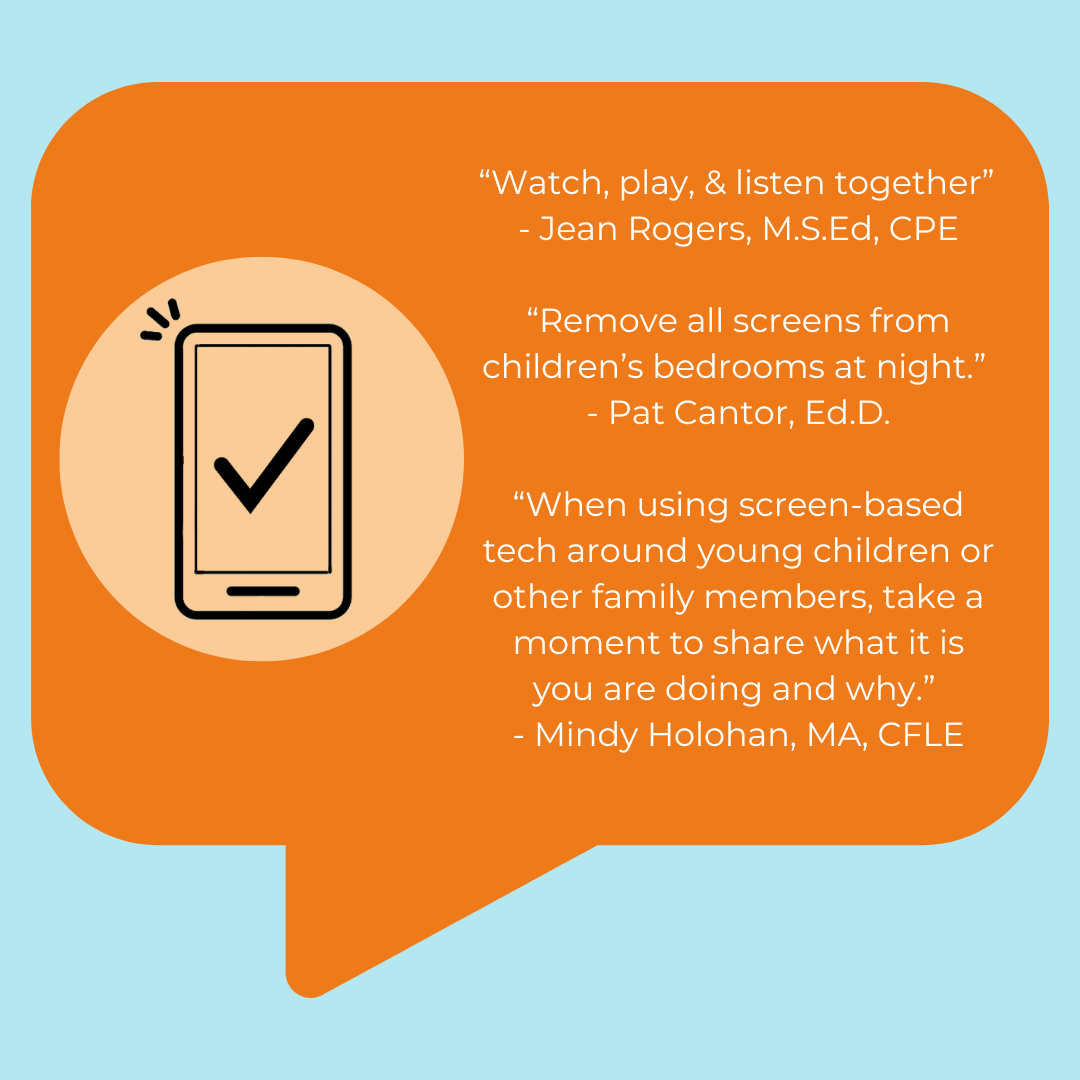
My favorite healthy screen habit, Hillary, is watch, play, and listen together. One thing we don't have as much in this world is that shared digital reality. Because we're not watching things together. The isolation is dangerous, and it also prevents children from feeling that they can talk about their digital lives, that they can share it with their family, and that it's something positive. It can feel like it's, uh, something that they can, they might be scared about alone. And so what we wanna do is bring it into our families, our friendships, and when we use it, use it together.
Hillary Wilkinson: (35:42)
Excellent. Great way to foster those conversations. Pat, can you share your healthy screen habit?
Pat Cantor: (35:49)
It was something that really struck me when we were doing the research for this book, is the impact of screens on sleep. It's had a massive impact on sleep from the youngest infants, right through people my age, . And so my recommendation, and it is a recommendation I've given to all my children for their children, , is remove all digital devices, all screens from children's rooms and from your, your habits before bed, no screens before bedtime, and no screens in bedrooms because of the negative impact on sleep. It's a habit I've had to learn, and I think it's a really important one.
Hillary Wilkinson: (36:34)
Yeah, it's one of our top five core habits, so thank you for bringing it up to the forefront. Mindy, do you have a healthy screen habit for us?
Mindy Holohan: (36:46)
Yes. So, um, one of my favorite kind of terms coming out of the research, um, and that we examine in the book, um, it's, it, and, and that's really resonates with readers so far and with, um, families and practitioners we've been working with over the years, is the term technoference. And that is, in a nutshell, kind of, uh, utilized to describe the ways that that screen-based technology, digital technology disrupts, um, interpersonal relationships, you know, disrupts, interrupts, and maybe even, you know, displaces. So, you know, the way it, it interferes with these really important fronts, So, um, you know, one habit related to tech interference is, you know, totally understanding that screens aren't going anywhere. , you know, like so much of our lives are organized around them, but something that can make such a huge difference. And again, I think this is an adult practice when children are younger, but then hopefully through that modeling, um, children, um, learn to, to consider it themselves over time is, is just communicating what we're doing. Mm-hmm . You know, when, when, when, when we're on our phones, you know, I think it can clear up so much, um, uh, potentially like problematic, um, interpersonal, confusion so just the simple thing of like, oh, shoot, you know, this email came through, you know, I have to answer this, I'm so sorry.
Mindy Holohan: (39:26)
I'll come back, you know, to what we're doing in however many minutes, or, you know, I'm on my phone. You know, children don't know the difference, especially young children, you know, if we're using it for a recipe, if we're using it to talk, you know, carry on a important, you know, text message conversation with other family members, if we're, or if we are, you know, doing something, using it for entertainment, they all they see is like the adult, not responding or, you know, prioritizing this device. You know, so just taking that step to say what we're doing, why we're doing it, and, um, it's, it's, it's a little thing, but it can make a huge difference, um, in terms of, clarity. And, you know,
Hillary Wilkinson: (40:45)
I think communication is critical. Every aspect, every stage, every age, and every stage
Mindy Holohan: (40:54)
That's right, every age.
Hillary Wilkinson: (40:55)
I could not agree with you more in communicating what we're doing and why we're doing it also sets that intention for ourself as a reminder. So I think you get the benefit of really, you know, kind of doing a little self-check also of like, what am I doing on this? Why am I, why am I doing this? Why am I this right now? Am Exactly.
Mindy Holohan: (41:17)
We all had that moment.
Hillary Wilkinson: (41:17)
Exactly. As always, you can find a complete transcript of this show, as well as a link on how to purchase this amazing book we've been talking about by visiting this show notes for this episode. You do this by going to healthy screen habits.org. Click the podcast button and scroll to find this episode. Jean, Mindy, Pat, thank you so much for being here today and all that you're doing, not only for this week of the young child, but for all weeks, for all families everywhere.
Pat Cantor: (41:53)
Thank you, Hillary. Thank you Hillary. Yeah.
About the podcast host, Hillary Wilkinson
Hillary found the need to take a big look at technology when her children began asking for their own devices. Quickly overwhelmed, she found that the hard and fast rules in other areas of life became difficult to uphold in the digital world. As a teacher and a mom of 2 teens, Hillary believes the key to healthy screen habits lies in empowering our kids through education and awareness.
Parenting is hard. Technology can make it tricky. Hillary uses this podcast to help bring these areas together to help all families create healthy screen habits.
Recent Episodes