

S15 Episode 4: How to Live an Analog Life in a Digital World // Frank Possemato
Hosted by Hillary Wilkinson
"More is less."
~Frank Possemato
In 2020, during the COVID shutdown, Frank Possemato found himself to be a new dad and an online professor. He had time to reflect on the life he wanted for his daughter, as well as take note of the changing world while it moved increasingly online. Inspired by life as he knew it before the digital revolution, he purchased a notebook (with actual coins) and started writing about the importance of offline life. He wanted to remember to be present, to connect with friends and family, and to be tolerant of different versions of shared memories. In this episode, we talk more about life offline and how to appreciate analog moments. Listen now!
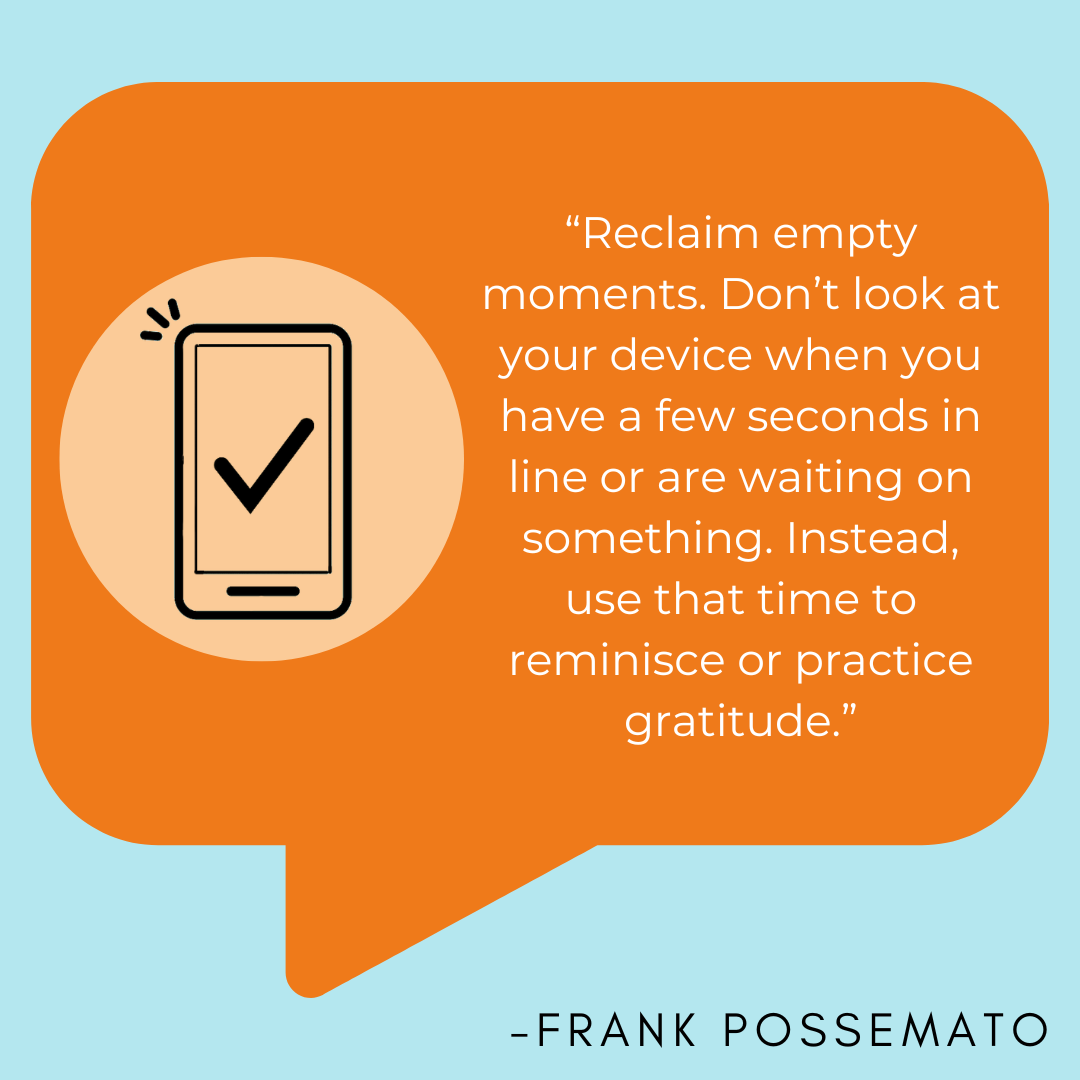
Healthy Screen Habits Takeaway
Resources
Frank's 2025 Tedx Talk
Frank's Book: How to Live an Analog Life in a Digital World: A Workbook for Living Soulfully in an Age of Overload
Show Transcript
Hillary Wilkinson: (00:02)
As a writer and teacher at Cosumne River College and Boston University, my guest today is the first generation of his family to attend college. He writes poetry, fiction, and a new workbook titled, How to Live An Analog Life in a Digital World, A Workbook for Living Soulfully in An Age of Overload. This is something that I find increasingly to be both difficult yet so satisfying, and I have also found myself drawn towards those who seem to have figured it out. So I'm hoping he has, and that's why I invited him to come and chat with me today. Welcome to Healthy Screen Habits, Frank Possemato!
Frank Possemato: (01:21)
Hi, Hillary. Thanks for having me on here. I'm, I'm really glad to be here. I wanna say right at the beginning, I haven't figured it all out, but I'm figuring it out, which is what we're doing, right? So I'll share with you what I know and it's adapting. It's like a practice. It's something that I'm working on day to day.
Hillary Wilkinson: (01:37)
You're very humble having read your book, I, I feel like you're further down the path than, than at least I am . So Frank, what, at what point did you decide you kind of wanted off the, uh, the digital hamster wheel, if you will, and lead a more analog life?
Frank Possemato: (01:58)
Well, I think it's something I latently wanted for a long time, but the, the moment where I really realized it, and this is not gonna be surprising to a lot of your listeners, it was during the pandemic, but it was very early in it. My daughter was born March 20th, 2020. That is the week that COVID lockdown started in California. Right? So a week before life was still relatively normal, and then everything was closing up. All these changes were happening. I was, my wife and I were worried that I'd be able to be in the hospital with her when, when, when my daughter was born, because all these things were happening, right? So just as a lot of people's work is either going away or going remote. So I, I'm a teacher and all of a sudden it was all work from home and I've got my daughter, all of these changes are going on.
Frank Possemato: (02:47)
I'm spending more time probably than ever on the screen. 'cause now, instead of teaching in the live classroom, I'm teaching at home online, in addition to all the other reasons why we use our devices. And I was overwhelmed by historically, I've not really been that good at managing my screen time. I'm one of those people that, that gets addictive or whatever word you want to use, where it's concerned on certain things online. But under those circumstances, I figured I'd do something about it. And, um, I've always liked to write by hand. That's kind of my antidote to the screen time. I, I, I can remember growing up, like my mother would bring home notebooks from work that she got for free. And even if I couldn't afford a new video game or I couldn't afford the musical instrument, I had that notebook and I could make stuff in it and imagine stuff in it, right?
Frank Possemato: (03:35)
So, and so I went back to those roots and I bought a notebook with change, actual physical change. I walked to the supermarket in my neighborhood and I bought a notebook. And I started writing. I started writing down different ideas about the effects that internet life, digital life has on me and things that I can do about it. I worked on this for off and on for about two years, and then it came time to type it all up and put it all together. And I realized I had something, you know, that I could share with people.
Hillary Wilkinson: (04:10)
You start off your book, recognizing that tech has given us so many things. You point out, we can contact almost anyone, anywhere on the planet. We have access to more information than libraries can hold, and in some ways it's leveraged certain fields of privilege. Others not so much clearly, but it sure it some in some areas. But the world being both at our fingertips and only 13 inches from our face is not necessarily a good thing. What has tech provided that you're most grateful for?
Frank Possemato: (05:03)
So, in the book I mentioned, I do say something like, um, we can do things on our device that the richest, most powerful people in the world couldn't do not very long ago. So that's, that's true for anyone that has a device. For me specifically, I mean, I met my wife online, although it was through a pen pal website, so that's kind of somewhere in a gray area between analog and digital. But I still, I met my wife online. I wouldn't know her. I wouldn't have my daughter or for the internet resultingly, if we wanna follow that through. I work online mostly. I, I pay a lot of my bills working online. So those are big, huge things that digital life gives me that I'm not ignoring. So the cost is huge too, though, or else I wouldn't be thinking this. Right? So, I mean, obviously in so many ways, has enriched my life, and yet if I'm not careful in the day to day, it'll take away a lot of my volume of life. It'll take away a lot of my joy. It'll take away a lot of my thoughts, a lot of my personality, a lot of my happiness. Those are big things to give up. So, um, you gain so much and you lose so much from it.
Hillary Wilkinson: (06:08)
When you talk to others about approaching this sort of analog life, what, what's the primary reaction you get?
Frank Possemato: (06:21)
People are really excited about it, and I, and especially young people, right? Mm-hmm . So this, this is the fear that we might have because I know I am aware. So I grew up, I'm of a certain age, so I work online now. I'm reasonably techie because I work online, but I, most of my coming of age, I didn't have the internet, certainly didn't have it at home. And in the earlier years, it essentially didn't exist, right? So I've lived really in both eras. If you took my life right now and split it in half, it was like first half, no internet, second half internet, right? So I really do know what both looks like. And so of course there's a tendency to think if I'm talking about living analog or, you know, being screen-free, people might think that I'm being nostalgic. I want, I'm trying to go back to when I was younger, and who knows, maybe there's an element of that.
Frank Possemato: (07:12)
But when I talk to younger people who grew up only in the digital era, they are actually some of the people that are most enthusiastic about what I'm talking about. And they'll say something like, I, I feel the same way, or I've always thought that, or I, I, you know, I, I I notice how much the device affects me and I wonder what, you know, life would be like if I used it less. So young people are really excited by it. And I, and I, and I mentioned, you know, I i, I try to make that point as clear as possible when I'm talking about living analog, I'm really not talking about being retro or old school or something like that. Um, I'm talking about a way of living that for some people, would be something they've never done.
Frank Possemato: (07:53)
Younger people I think has been the ones I think where, where my talk and my, my book resonates with almost the most, and I really have tried, I don't know if I succeeded, but I have tried to strike a tone that is anything but, oh, kids these days, they just don't have it like we did. Or, you know, they're phone zombies. I am a phone zombie at my age when I'm looking at, at a screen. It's not about criticizing younger people. And I think they recognize that, and I, so I think that that resonates with them.
Frank Possemato: (08:43)
But of course it also resonates with, you know, Gen X people of, you know, who maybe lived in the both eras like I talked about, or maybe people of the older generation than that as well. So it actually a pretty universal subject the struggle between, screen time and the benefits and drawbacks of using your phone is something that virtually everybody in our society dealing with.
Hillary Wilkinson: (09:17)
Yeah, I agree. And, um, I, uh, you and I haven't shared shared ages, but I, but I gather we're of the same generation . It's okay. There was a point in time where I feel like parents who are of our age zone were, they were really the kind of resting hard in this spot of “nobody's done this before, we're the first, we don't know what we're doing”, you know, all of this. But I kind of like to flip that and point out, yeah, we may be the first generation and millennials may be the first generation to be parenting alongside screens, but also we are the last to remember the before.
Frank Possemato: (10:08)
Right?
Hillary Wilkinson: (10:09)
That's right. And, and that's what your book speaks to is the before and the power in really diving into sensory living or just truly, you know, contemplative space.
Frank Possemato: (10:27)
That, that's totally true, Hillary. And of course, one day there'll, there'll be nobody that remembers the before, and so we kinda have to create a new before. How are people who have only lived in the digital era going to have a sense of self and sense of surroundings and sense of connection that doesn't involve screens? I'm not saying it's impossible, but I'm saying that our before is a dwindling resource, right? Eventually there's gonna be nobody around that remembers the before. So we've gotta create some kind of new version of what screen-free life looks like.
Hillary Wilkinson: (11:04)
Yeah. And I, and I recognize that it more and more it seems as though, uh, pockets of screen-free living is viewed as luxury. So I think whenever there's an element of luxury attached to it, it becomes kind of, uh, romanticized . So,
Frank Possemato: (11:29)
Uh, that, that's such a good point that you're saying earlier. And I, I really think about this a lot. So when you mentioned something like luxury, I tried to keep all of the activities in my book, things that were free or cheap. There's one that involves,
Frank Possemato: (11:41)
There's one that involves buying a disposable camera. And I felt bad 'cause that's what, 20 bucks or whatever. So I didn't want people to spend money at all with these activities. With that being said, you know, one of the things I talked, one of the challenges I have in there is, you know, challenging a person to have a two or three-hour face-to-face conversation with another person where you agree that it's gonna be face-to-face. You get your phones turned off except for an emergency, otherwise you're not gonna use it. And I'm really torn because that costs absolutely nothing. And yet it does seem like it's kind of luxurious, almost kind of decadent. Like, I'm gonna spend two or three hours not doing anything but talking to another person. So it is actually kind of like a luxurious thing, but it's also a free thing, right? Other than time, which is the most valuable thing we have, and somebody might say, well, I don't have two or three hours to spare, who has two or three hours to spare, and you're not wrong, but when's the last time you spent two or three hours scrolling yesterday? I mean, so we do have, in a way, we do have that time. We just don't think we have that time.
Hillary Wilkinson: (12:44)
We have to take a quick break, but when we come back, we're gonna talk more about those analog life choices and applying this whole concept of less is more to our digital life.
—------------------------
Ad Break: Thank you donors!
—-------------------------
Hillary Wilkinson: (13:31)
I'm speaking with Frank Possemato who grew up in Boston. He's taught at some of the nation's most diverse community colleges and enjoys writing poetry and fiction. His latest work, however, is nonfiction, a workbook called How to Live an Analog Life in a Digital World. And we're talking all about it today. So Frank, can you discuss how this concept of less is more applies to analog living?
Frank Possemato: (14:11)
Yeah, so we hear less is more so much, and it doesn't mean it's not true, but we hear it so much, it, it kind of loses some of our meaning. And I actually kind of like to think of it almost reversed. More is less, let's think about that for a minute. So more is less and what does that look like? It's as simple as, have you ever been frozen trying to on a streaming service trying to figure out what to listen to or figure out what to watch, right? So we have all these options, but when those options get into the millions, that's really kind of different than how our, how we experience the world as humans, right? We're, we're experience the world on a scale that's not really like that. So when we have unlimited possibilities, like unlimited things to watch, unlimited things to listen to, potentially unlimited jobs to apply for, potentially something more interesting, always going on in your device than what's in front of you, potentially unlimited romantic partners that might have something that yours doesn't.
Frank Possemato: (15:06)
When we have all these possibilities that, you know, that the digital world opens up to us, that's where it gets into kind of more is less. Because first of all, all those choices are, immobilizing second of all, all those choices can make us really ungrateful for what we do have, right? And also sometimes they can, I think, pull us out of what's closer to us. So I, I mean, I, like I said, I work online, so I'm not saying that that, you know, of course it's, it's possible to pursue dreams and, and, and make a living through the help of technology, certainly. But sometimes when you do what, when you, whatever it is that you're pursuing, you can get so lost in the digital world that you don't realize that there might be resources of people that you know in real life or things that are closer to you that maybe are more tangible that you could use to start whatever it is that you're trying to do. So the idea is less is more. Coming back to this, um, there's a quote that I mentioned in, in, in the book from Lautsu where he says “those with, um, those with less become content, those with more become confused.”
Hillary Wilkinson: (16:25)
That is me in every grocery store, which is why I go to like, I shop Farmer's Market or Trader Joe's because like, I don't, I don't need 15 brands of say peanut butter. I like, I need oh, crunchy, salty, or like, okay, that's it . So I, yeah, that infinite choice kind of leads to decision paralysis.
Frank Possemato: (16:49)
Yeah. So when we think about analog, right, it's a straight line. That's the present, that's today, right? But digital is movable, right? You can move things around all over the place, but you can't really move, oh
Hillary Wilkinson: (17:52)
My gosh, I'm having like a moment.
Frank Possemato: (17:55)
Can't really move next week into today, right? So we live kind of more analog than that. And that digital way of doing stuff and planning and thinking in eventually I think, you know, cause a lot, a lot of unhappiness. And I think it comes down to again, that more is less type of idea, right? Instead of the left is more what's the left right now what we have in front of us.
Hillary Wilkinson: (18:22)
Yeah. Yeah. No, when you describe time that way, I've never applied it to digital life, but you're absolutely right.At least in the western world, we view time as a, as a linear construct. But you're right, we add in this digital component and it becomes multidimensional and yeah. Wow. Frank, you're blowing my mind here. This whole thing of infinite options has become a huge issue, I think in the land of, I mean fortunately, you were able to connect with your wife online, and you say like, it was a kind of a hybridization of online offline connection. But when I speak with friends who have entered the land of online dating, it seems the options there are greater than anything, but the loneliness quotient is soaring.
Frank Possemato: (19:34)
I think that for somebody looking for a partner, looking for whatever, um, the idea that the internet opens up more options is a good thing, right? I mean, if you, if you're going to wherever your bar or church or whatever in your neighborhood and there's nobody there that's a match for you, that's very limiting, right? So this idea that, you know, you can open it up to wider, why can't you fall in love with somebody or whatever, or have a connection with somebody that lives in a place that you don't live or that you've never lived yet. That's a powerful thing. And I, I, I, I think a good thing. Um, but again, it comes with it a lot of challenges. It comes with it that discontent that you might think that the person you're with can be replaced by somebody that has some other quality. 'cause if, if the whole world out there, how do you know you didn't miss your soulmate somewhere else, right?
Hillary Wilkinson: (20:28)
Oh my gosh. And Hollywood has taken that idea and is currently running with it. Like, there are so many shows that are based upon this whole idea of a platform where you find your soulmate. I mean, it's very like black mirror type stuff where people are, even if they're in a happy relationship, they're, they're almost unable to avoid that temptation of finding someone else.
Frank Possemato: (20:56)
And I talk about that in the book and, and I admit that there's a huge temptation, a huge fear of missing out. And what I, what I say, the antidote to it, if there is one, is basically what you have, what you and your partner have that those other potential ones don't, is your time together. Is the, is the experience that you've had together, think about it like this. Let's take romance out of it. Let's think about it with friendship, right? Theoretically I could find a friend anywhere in the world that has these exact number of matches with me, but I didn't grow up with that friend. I, they didn't go to school with me. I didn't live in the neighborhood with them. We didn't walk down those roads together. So they're not gonna take the place of my childhood friends because we have that, which you can't take away, which you can't replace just by with another person. And so I, I guess I would say that, you know, if you're a year in or five years into your relationship and you're thinking, well, what if there's somebody else? And I can't speak for that person in that relationship, but I will just say, don't underestimate that one year or that five years, those roads you've been down together with that person. 'cause that's something you have that those all those other online options don't have together.
Hillary Wilkinson: (22:01)
Yeah. You're, you're preempting my next question that I had lined up, but I just wanna ask it because I, I loved, I really liked the, the whole idea of this where in chapter six you talked about facts and memories and why you should still trust your memory and source kind of shared moments with your friends instead of just googling something or looking it up. And I think that speaks to that investment in personal relationships.
Frank Possemato: (22:34)
Sure, sure. Totally. I basically say that our memories are imperfect, right? If I'm trying to remember when something happened, I could look at my pictures on my phone and find out exactly what, but if I use my own memory, first of all, I'm flexing that muscle in my memory. But second of all, there's just a value to that. There's something to like asking another person versus just going online and letting AI answer it for you or whatever, right? So talking to somebody about that and even your own imperfect memory, there's, there's a value to that. It's not something you want to give away, right? I mean, you and your friend or you and your family member can discuss and debate what something meant or when it happened or whatever, without looking it up. And that's connection. That's time that you had together, right? That that you, you know, if you have a choice between, uh, I can look this up online or I can ask my friend or knows the answer or even text my friend, go with the second one. 'cause it might be a chance to get in touch with somebody or talk to them or whatever.
Hillary Wilkinson: (23:39)
Yeah. And I think I, I, I love that like taking these, these kind of micro moments to moments just connect because it also, it does so many things. It reinforces relationship, but it also, um, allows moments where that person feels needed, you know? Yeah. And I think, so
Frank Possemato: (24:03)
Yes,
Hillary Wilkinson: (24:04)
In this time of isolation that we live with, we're all kind of siloed in our own little pods of, you know, I can look up anything, I can do anything. Like we have ultimate independence, but it's not making people happy. And so it, um, there's great value in just that reaching out to connect with someone, even if only for a, a, you know, a hot minute of just like, Hey, what was the name of that restaurant that we went to with so and so that had that amazing bean dip that was right down? And, you know, I mean, yes, you probably could use Google and figure it out, but I, I like that idea of just connecting with people.
Frank Possemato: (24:48)
What if that text you sent to that person is the first time you've talked to 'em in a few weeks or months or whatever, and you know how easy, easy it is to lose contact with people or friends or whatever, with everything that's going on in life. And now you've just opened it back up again. Instead of looking it up online, you, you open the door back up to talk to that person.
Hillary Wilkinson: (25:07)
Yeah. Yeah. Okay. So also you mentioned these activities that you have at the end of each chapter that I really like for people to challenge themselves. And one of the activities is come up with some questions that you couldn't ask Google. So I feel like we, we just came up with some, a variety of those, but for those who might need a, uh, a little primer, , can you give an example of one or two of those types of questions?
Frank Possemato: (25:39)
Sure. Well, let's really think about that. Like what, what is a question that Google couldn't answer or that AI couldn't answer or whatever it is, right? It's probably gonna be either a really personal question. Like, I mean, if I said something like, um, I don't know, what do I feel like eating tomorrow? Right? I mean, I guess your text history could come up with an answer to that, but it can't actually read your mind. So it's probably, probably a, a very personal question like that. Or it might be a very big question, the type of which nobody's ever really answered. Like, um, I don't know, uh, what happens after you die? Or, or you know, um, what, what should I, um, what should I do with my life or whatever, you know, these type of questions are, you know, Google or AI can't really answer those questions for you.
Frank Possemato: (26:26)
So, but it can answer all kinds of other questions. I mean, if the question is, you know, um, what time is this restaurant open till? Or, you know, what, what year did this movie come out? It's, you know, that's, it's gonna be able to answer those for sure, but it's not necessarily gonna be able to answer questions that are either very personal to you and the people that you know, or it's not gonna be able to answer questions that are so big that they aren't answerable, but they're still things that we, you know, that we still think about. You know, I've got a daughter, you know, she's five or six years old, she's five years old, it's gonna be six very soon. And, you know, she's asking and thinking about the big questions for the first time because she's that age, right? And we still think it's not really like at a certain point in life we necessarily answer those questions.
Frank Possemato: (27:05)
We still think about them, right? We still think about, you know, meaning to life or meaning to our own lives or things like that. We, we think about those things throughout life, and I still think that's unanswerable by Google or AI or whatever. You know, they're big questions, they're personal questions, you carry them with you. Um, and so, uh, tho those are, those are the kind of things to think about. Uh, I mean, I go, uh, trying to, I'm trying to go a month without letting AI answer any questions for me. We'll see how it goes, but that's my little personal task. In front of me right now.
Hillary Wilkinson: (27:38)
Nice. Nice. Yeah. So we have to take another short break, but when we come back, I'm going to ask Frank Possemato for his healthy screen habit.
—----------------
Ad break
—---------------
Hillary Wilkinson: (27:58)
I'm speaking with Frank Possemato, who truly believes in the power of an analog life. And I think when I read your book, one of the most powerful paragraphs was the very last one. And I was wondering if you could share that with us.
Frank Possemato: (28:28)
Sure. Here we go. Here's the very last paragraph:
Digital life isn't going away, but analog life survives in your soul if you make room for it. This isn't about the good old days, this isn't about going back in time. This is about giving your life more attention than your device. This is the earliest it will ever be. There is no time better than now.
Hillary Wilkinson: (28:50)
I love that it's both reflective and a call to action. It's so beautifully put. Thank you for sharing that. So, as you know, on every episode of the Healthy Screen Habits podcast, I ask for a healthy screen habit. And this is gonna be a tip or takeaway that listeners can put into practice in their own home, hopefully right away. What's yours?
Frank Possemato: (29:15)
So my healthy screen habit I suggest is during empty moments, like those moments when you just check your phone just because you're in line or you're in an elevator or whatever, when those moments when you're not doing anything, especially important but you're just take checking your phone because you have a spare moment. Don't check your phone during those moments. Instead, during those moments, um, take a second to think a positive thought. Take a second to think about somewhere that you like or to remember somebody that was in your life or somebody that's passed away. Take that moment to pray or meditate or reflect. Put yourself in a good place in that spare moment. So instead of, I'm gonna check my device and potentially be disappointed when I don't get the email I was looking for, or the analytic I was looking for when I, when I looked something up, instead of that, in those spare moments, I'm gonna think something happy. I'm gonna think something positive. And it makes a big difference because we ha we have a lot of those little moments throughout the day. And I actually think that those moments are a big part of, uh, where our personality comes from and a big part a a big part of our self-development. And you don't wanna give those away. So instead of having, just checking your phone, 'cause you have nothing else to do, check in with yourself during those moments.
Hillary Wilkinson: (30:35)
Yeah, I love that. Sometimes, um, people refer to that type of moment as being mindful, you know, I mean like the mindfulness portion of it, but also I just, I love that idea of it being reflective and kind of leaning into your humanity.
Frank Possemato: (30:57)
Thank you
Hillary Wilkinson: (30:58)
As always.You can find a complete transcript of this show by visiting the show notes for this episode, as well as a link to purchase How to Live an Analog Life in a Digital World, a workbook for Living Soulfully in an Age of Overload. You do this by going to healthyscreenhabits.org, click the podcast button and you can scroll to find this episode. Frank, thank you so much for your time today and for just keeping things real.
Frank Possemato: (31:30)
Hillary, thanks so much. I appreciate this conversation. I feel like we still have a lot more to say, but I, everything that we said here, I think, um, re really made an impression on me and, uh, you're doing great work. Thank you.
Hillary Wilkinson: (31:42)
Thank you.
About the podcast host, Hillary Wilkinson
Hillary found the need to take a big look at technology when her children began asking for their own devices. Quickly overwhelmed, she found that the hard and fast rules in other areas of life became difficult to uphold in the digital world. As a teacher and a mom of 2 teens, Hillary believes the key to healthy screen habits lies in empowering our kids through education and awareness.
Parenting is hard. Technology can make it tricky. Hillary uses this podcast to help bring these areas together to help all families create healthy screen habits.
Recent Episodes