

S16 Episode 10: Teen Screen Time: How Gen Z Is Fighting Digital Distraction
Hosted by Hillary Wilkinson
“You're never gonna beat social media.”
~Riaan Sanghani
What if the next generation didn’t just complain about screen time… they created a solution?
Meet Riaan Sanghani and Dilan Bhimani, two high school juniors and co-founders of Drift, an app designed to help teens manage screen time, reduce distractions, and build healthier digital habits.
On this episode, we explore teen screen behavior, social media distractions, the science of attention, and why willpower alone isn't always enough. Plus, these inspiring Gen Z innovators share practical tips parents and teens can start using today!
🎧
Listen now and discover how the next generation is rethinking our relationship with technology!
Healthy Screen Habits Takeaway
Resources
Drift (app)

Show Transcript
Hillary Wilkinson: (00:02)
This season, I've had more guests than ever who represent our generations that have grown up with tech, and today is no different. Today, we're meeting two 11th graders who have co-founded Drift, an iOS app that locks distracting apps until you earn your screen time back by doing real tasks. Drift is now being used by a Johns Hopkins research team in a study on teen mental health and sleep health. And this is a prime example of how we're seeing Gen Z and even Gen Alpha run towards tech as a solution builder and a problem solver rather than previous generations whose tools and tendencies have been to run away from tech and, you know, trended towards more non-tech solutions. So they've studied attention extensively, and we're gonna talk all about it today.
Hillary Wilkinson: (01:16)
Welcome to Healthy Screen Habits, Dilan Bhimani and Riaan Sanghani
Riaan Sanghani: (01:24)
Hello, how are you? Thank you for having us. Thank
Hillary Wilkinson: (01:26)
You for having us. Okay, so you guys are juniors in high school, and quite honestly, that's an age where like many parents are actively battling their teens over screen time. And instead, you two are creating ways to manage it and control it. And so how did this come to be?
Riaan Sanghani: (01:50)
It started with Dylan and I actually in a friend's basement. At the time, we were doing kind of like a competition between each other, like who could stay off Instagram the longest. And we were in a friend's, uh, basement for a birthday party, right? The celebration was supposed to be all about them. And we kind of look around, right? Everyone's just kind of on their phone and Dilan and I are here kind of like, we're kind of like seeing who can stay off the phone longest and we're in this competition. So only two are kind of like looking around the basement, like walking around kind of. And we see, we kind of like make this observation of like, wow, we're celebrating somebody's birthday, yet here we are with all these people like on their phones, not really like in the moment celebrating who we really want to celebrate.
Riaan Sanghani: (02:31)
And it was one of our closest friends too, right? So Dilan and I were kind of like, after that night, we were just talking about the party the next day. And Dilan and I had this observation of like, why is everyone on their phone at a time when we're all together? And we're all sending each other each other, we're all sending each other videos, right? So what's the point of being together if we're just gonna have sending each other the same videos? So what we ended up doing was we were kind of talking about like how this whole screen time thing, um, was kind of like the biggest part that was affecting was our social lives, but also in school, right? Like up until this year, for reference, we live in New Jersey, right? So we're experiencing the phone ban right now. But up until, um, this year, a big problem in school has kind of been having the phones during class and, um, teachers not being able to necessarily control, um, the phones.
Riaan Sanghani: (03:20)
And even if they are able to, the students kind of go home and relapse, right? So we go, we go home and we end up scrolling for two, three hours and we end up missing out on like time that we can be using to rest and we miss out on the social interactions. So Dilan and I kind of talked about it and we were like, "We should make an app that you complete your work first and you should do something real first before you kind of just go ahead and start doomscrolling."
Hillary Wilkinson: (03:44)
It's interesting to me the primary motivation started out of social reasons, right?
Riaan Sanghani: (04:02)
I believe so.
Hillary Wilkinson: (04:03)
Yeah. And that's like, that's, I, like I said, that's, I mean, you look at, and like you're at a stage in your life where it's like your friends are the most important, like, they're, they're the top level of hierarchy, you know? So that's really interesting to me that it's like, oh, like it totally makes sense to me that you're like, "What are, like, I, I'm here to hang out with, with my buddies and, like, what are we doing?" Is this conversation of, "I wanna put my phone down," sort of, like, common in circles around you or, like, I'm just, like, getting into that phone ban a little bit or are you guys outliers in your friend group?
Dilan Bhimani : (04:51)
Oh, no, I think it's very common, even amongst our peers and amongst other friend groups as well. Like, everyone just says it as a joke, but people will show their screen time like it's a score. Um, I'm seven hours, like, today, or I'm eight hours today, and then everyone laughs, but, you know, it's really not that funny if you think about it on a larger scale. And no one's really proud of seven hours, and even ever - even though everyone just laughs it off. Um, I also think it hits our age harder because we really never had a version of life without our phones. I mean, we've, we've had our phones since beginning of middle school or some of us even elementary school. Mm-hmm. And now a lot of us are trying to build the habits after the fact, after we've already, you know, been hit by all the addictions that all these apps are designed to create.
Dilan Bhimani : (05:39)
Um, so you see all of us, uh, are a little bit rebellious as well to the rules and the standard expectations of what our parents expect and what our parents might want us to do, especially if our parents are less technologically savvy or, um, unable to, um, figure out a good system to get their children off their phones as well. Um, and, you know, even people, like, delete their social media before final exams or, um, before a big test, but at the end of the day, they'll just, they'll just re-download it right back afterwards, and it doesn't really solve the problem. It's just a temporary solution.
Hillary Wilkinson: (06:18)
Yeah. Guilty as charged. I do, I do the same thing. Like, I go on vacation, I delete my social media because I wanna, like, enjoy it and be present. And I'm literally on it, like, from the moment I get home. And then it's almost like a, like a full-on binge afterwards, you know? It's like you're getting caught up, but you're never gonna get caught up on social media, right?
Dilan Bhimani : (06:38)
Oh, yeah. It's so true. And I honestly don't think that people even hate their phones, but they wanna, they want to feel like they're in control of their usage of their phone. And that's the thing that most of my friends would agree on.
Hillary Wilkinson: (06:49)
Yeah, I totally agree. So it's just like, um, I love that you're using... So you guys are at this, like, really great time in your lives where you have this superpower of challenging the status quo. Like, that's what you guys are doing. And you guys are amazing because you have the know-how to create these tools. I don't want this to, turn into, an infomercial, but I do want to understand what Drift, your app, does. And, like, because I'm sure people are listening and they're like, "Gosh, that probably sounds like something that I'd be interested in," you know? So can you explain, can you give us a, just a brief walkthrough of what, what Drift is, what it does?
Dilan Bhimani : (07:45)
Of course, yeah. So in a nutshell, uh, Drift blocks the apps that distract you, and you earn them back by getting stuff done. Um, so when you set it up, you pick out the apps that pull you in the most, say Instagram, TikTok, games, and Drift uses Apple Screen Time tools to pl - put a block over them. So if you try to open one, it just won't let you. Mm. Then you add the things that you really need to get done, like your homework, assignments, chores, or even some rest. when you finish your f - assignment or whatever task you had at hand, you have to send in proof, like a photo, a video, or a quick description. Then we have our own AI, which checks your work and sees if it was completed sufficiently. If the AI deems that your work is just kind of lazy, or it isn't thoughtful enough, or it doesn't actually fulfill what you just, like, set out to do, it'll still reject that and won't even unlock your time.
Dilan Bhimani : (08:48)
So, uh, we really care that the user has completed their work and done it fruitfully, and not just kind of done it halfway through.
Dilan Bhimani : (08:57)
So let's say I've got a chem test Thursday, and I, I study for 45 minutes, take a picture of my notes. When I'm done, my apps come back, and it's weirdly satisfying. You know, you feel rewarded; you feel like I actually get this, I deserve this time to rest, and not just I'm using this as an escape to escape my assignments.
Hillary Wilkinson: (09:17)
It's super interesting to me because you're, um, you guys are really sort of, like, tapping into, uh, motivation tendencies, whether, like, you're, you're using the extrinsic reward to build kind of your intrinsic desire of wanting to get that thing done, you know? I'm fascinated to hear that you're using AI. Um, do you ever run into, have you ever seen any glitches come up with, with AI not recognizing things or, like, I just, I'm just wondering about, like, frustration factor?
Dilan Bhimani : (10:00)
Um, I would say that in our initial development, we faced some glitches. Mm-hmm. But we've able, we've been able to fine-tune those and kind of get those out. I mean, so from time to time, we do experience some glitches, but we're able to resolve them pretty quickly. And, um, I would say the biggest struggle for us has not been so much glitches, but it's been the fact that sometimes our AI detector is too strict or it's too easygoing. Yeah. The, the hardest part for us was finding the best middle ground where it would actually require fruitful work, but it wouldn't just be so strict to where it would reject everything.
Hillary Wilkinson: (10:33)
Okay, so when we come back, I'm gonna ask Rian and Dylan more about the science of distraction.
—-----------------------
Ad Break : HSH moms night
—-----------------------
I'm speaking with the co-founders of Drift, who made this app to help combat the addictive tendencies of social media. And like we were talking about, there was a description before the break. So many times I set out with, like, my best intentions of limiting phone usage for the day. I'll set my intentions to do that. And then inevitably, if I check my screen time, I am shocked at how much time I've actually spent engaged with my phone, uh, because I, it's just become the go-to for everything. And so, can you guys discuss, I mean, just on a layman's level, why, why am I checking my phone almost involuntarily?
Riaan Sanghani: (12:26)
Right. So, a lot of that really isn't a decision that you make. It's kind of a habit that you've built, right? And you know, it's, it's much easier to build a habit than to break one down, right? So, there's... We've been trying to get rewards for the smallest of tasks, right? So, for example, that could be as simple as coming home from school after maybe a not so heavy day and still believing that you deserve a break. That's fine, right? But there needs to be a balance, right? So, we believe that just because we came home or just because we did a small task, we deserve that, we deserve that break, we deserve that reward. So, what makes it hard is that, um, the reward isn't really a set time for many people, right? So, that craving kind of builds up throughout the day, and it's very hard for people to kind of, you know, have a set schedule and have a set time for them to have this reward, and that builds up the craving for them quite a bit.
Riaan Sanghani: (13:22)
I think it's kind of the system that, uh, we've been trained to, we've been trained in, and the system that kind of we've built and that we've been a part of for so long, especially how Dylan mentioned before, how, uh, a lot of teenagers have not seen, um, kind of like, they've not experienced life without the whole screen and without, of course, dopamine and instant hits of dopamine. So, the biggest thing is that it doesn't mean you're weak; um, it's the accessibility of the phone and it just always being with you. So, I think the biggest thing that people should try to do is change the system that they're in and make it physically harder for themselves.
Hillary Wilkinson: (14:01)
Okay, so we've talked about why willpower sort of isn't enough. You have to kind of, you know, break the cycle, so to speak, and unlearn a habit. Can you get into the idea of attention residue and what that is?
Riaan Sanghani: (15:28)
Right. So attention residue, it's actually a term from someone named, uh, Sophie Leroy, right? The idea is that when you switch from one task to the other, uh, your attention doesn't necessarily follow the switch that you made, the physical switch that you made. It stays on the first task for a long time, right? That's also the same reason why people say that when you get a phone notification while you're working, it often takes 15 to 20 minutes just to refocus, right? So say you're doing homework and you kind of check a text, right? It takes five seconds to check the text, but then when you come back to your work, you're still kind of thinking about the text, you're thinking about what it said, uh, whether you should reply, all these kind of things, but you're not fully back on the tasks you had before, right?
Riaan Sanghani: (16:09)
And the thing is you don't notice it. It kind of feels like you went back to work. You just put your phone down and that automatically means you went back to work, right? So there's research suggesting that it can take a while for you to gain your focus after you're interrupted. So those quick checks that people believe are kind of, um, one check and put the phone back upside down, they take often a lot longer than people think they do, and that's why we end up wasting, like, 30, 45 minutes after just trying to check our phone once.
Hillary Wilkinson: (16:37)
Yeah. It's kind of the, I don't know, it's like the lie of multitasking, right? People think they can do a lot of things at once, and it's like, no, actually, it's, you're, you're ahead if you stick with one thing. Um, so it's interesting to hear you talking about all of this stuff. Is this stuff that's, like, common knowledge amongst your friend group, or is this just stuff that you guys know because you wanted to build this app and did your own research?
Dilan Bhimani : (17:16)
So, um, this is not common knowledge, um, amongst our friends, but we, we did do a lot of research and just, like, overall habit learning or, and tendencies of people to know that what would really work, um, when we were making our app, because we didn't really want to put a bunch of features together and call it an app, you know, that doesn't really function, it doesn't really serve a purpose, and doesn't really solve the problem at hand. So we really needed to find something that worked, and something that solved the problem. So we ended up, uh, learning a new, a lot of new things such as, uh, attention residue, and it helped us understand, like, the better ways to combat, attention draining, things.
Hillary Wilkinson: (18:02)
For sure, for sure. Okay, so if we've established that, like, you know, willpower isn't the answer, what actually helps us hold our focus?
Riaan Sanghani: (18:20)
The biggest thing that, um, we can rely on besides willpower, right, obviously, uh, willpower is great, and, um, it is, it is helpful, but it's not...We're never gonna beat social media, right? There's a lot of papers, uh, proving that social media was designed to essentially work like a slot machine, right? So you're gonna pull, you're gonna pull that lever, you're gonna scroll, and you're gonna get a hit of dopamine, and it's gonna keep pulling you back in, right? And, uh, the most useful thing is, uh, obviously, not relying on willpower, uh, but also putting a physical barrier. So, what works for me is putting my phone in another room when I'm doing my homework. Mm-hmm. And when I want that break, I move to the other room, but the work is in the other room.
Riaan Sanghani: (19:11)
So you have to put the phone down in order to go to the other room, and having something at the end of your task helps quite a bit as well. Uh, a lot of people think that, uh, just because they've finished a small portion of the task, they deserve this long break, and that really isn't the answer. So you need to have a physical barrier to make sure that you're kind of putting, you're making it even harder on yourself, right? And that's what we do in our app. We have a physical barrier, which is proving that you've completed your task and proving that you've done it fruitfully, as Dilan said before, and then you're going to your screen time, and then you're going to your reward.
Hillary Wilkinson: (19:54)
Yeah, yeah. So what you're calling a physical barrier, I think also we can use the word friction, right? You're just - Exactly. Yeah, you're, you're kind of designing some friction to be put in there, and it, um, it's amazing how, how little we can stand it, even when, when you think about, like, when your battery starts getting really low on your phone, if you're scrolling, and it's like things start getting glitchy, it's like all of a sudden - Yeah. It's really easy to put it down where you're just like, "Ugh, you know, I can't, I can't do this, and this needs to be charged or whatever." So it's that, that, yeah, that building in a friction is so, is very interesting. So, um, I'm just wondering if you guys had, say, you know, if you were sitting in the room with a bunch of, say, 10-year-olds, which I, I tend to find that fifth grade is really when a lot of kids start just being absolutely convinced that they need the phone, you know?
Hillary Wilkinson: (21:02)
"What, what would your advice be?" And please be honest, don't, don't give, don't, just because this is a primarily parenting podcast, give the answer that you think parents wanna hear. Like, what, what advice would you give to 10-year-olds?
Riaan Sanghani: (21:23)
The biggest piece of advice is that I would give would be to kind of keep it in moderation. So, uh, yes, there's going to be times where all your friends are on your phone and you're gonna end up on your phone. It kind of happens, right? We have times where we're super tired at the end of the day. Uh, we have a hangout with our friends, and, we're tired and we want the presence of our friends. However, um, we still want that kind of, like... We still want the feeling of being with each other.
Riaan Sanghani: (22:12)
And of course, there's gonna be times where you really do have to hunker down. Maybe not in fifth grade, but there's gonna be times coming in the future, high school, uh, college. There's gonna be times where you're gonna wanna do things, especially on the phone. The screen is addicting, but you're going to have to kind of put the phone down and focus sometimes. Uh, of course, what's there, it's still gonna be there when you come back. So put your phone in the other room, let whatever's happening happen. I promise you're not missing anything. Come back. Um, make sure you've done something successful, make sure you've done something fruitful with the time that you're spending away from your phone, so you're not having kind of, like, this double negative.
Riaan Sanghani: (23:00)
And the overall piece of advice would be, uh, not to stress about what's happening while you're gone, because again, these messages are not disappearing after two minutes. You're gonna see them. You're gonna be able to read what's happening.
Hillary Wilkinson: (23:13)
Mm. How about you, Dylan? Do you have anything?
Dilan Bhimani : (23:18)
Um, I would say that... Uh, Riaan hit the spot, but I would say that to the, to the fifth graders, it's not wrong to enjoy being on the screen, and it's not their fault that they enjoy being on the screen. And it's, and it's perfectly okay to want to play games, to watch a show, to relax. But I would say that they should prioritize, um, being productive, or even, even at the early ages, to understand that there are priority of things. And having rest and relaxation on the screens for, you know, a short amount of time isn't, is not really a priority compared to the other things. While it could be necessary for some people to have that short break between sessions or after everything is done, they shouldn't let it consume their lives and kind of overpower everything else that they're doing.
Hillary Wilkinson: (24:17)
Mm. Interesting. Thanks for playing, guys. Okay, we're gonna take another short break, and when we come back, I'm going to ask Riaan and Dylan for their healthy screen habit.
__________________
Ad break: HSH Workbook
__________________
Hillary Wilkinson:
On every episode of the Healthy Screen Habits podcast, I ask for a healthy screen habit, and this is gonna be a tip or takeaway that listeners can put into practice in their own home, hopefully right away. What is yours?
Riaan Sanghani: (26:16)
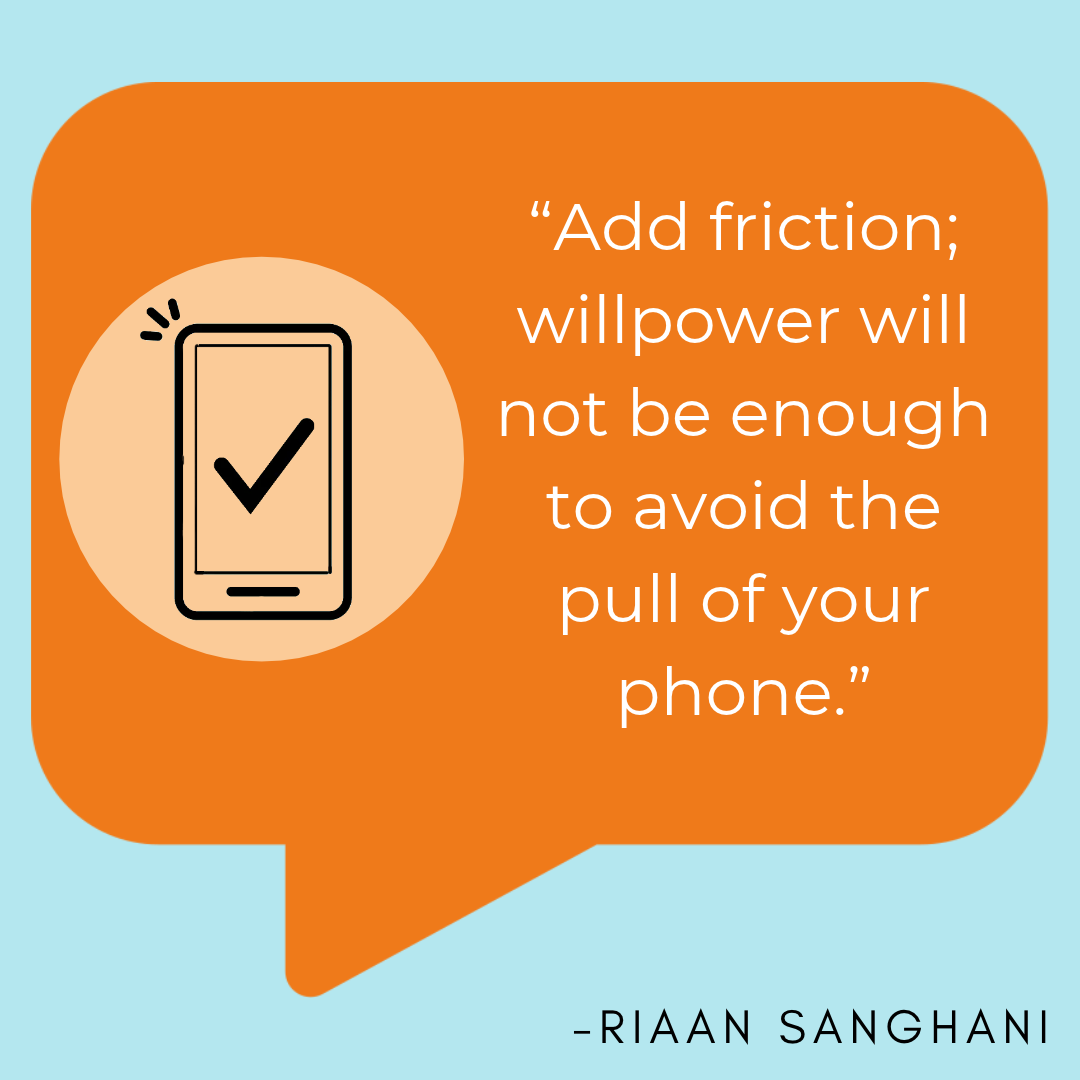
So, my healthy screen time habit would be to add friction. Uh, it's very hard for you to kind of put, put the entire thing on yourself, right? Willpower is never gonna be able to beat, how we mentioned before, these companies who are spending millions of dollars, sometimes even billions of dollars, researching how to beat your willpower. And the best thing that you can do is you're not gonna beat them on a willpower scale or on a mental scale, right? You're gonna have to put some sort of frictional block. So, the biggest thing is, um, make it very hard for yourself physically. While you may not be able to kind of, um, put the, put the phone, uh, right next to you and work, uh, there's always that option of putting the phone in another room, uh, taking 30-minute, 20-minute work sessions, going to that room and checking the phone, but setting the rule that that phone doesn't leave that room until you finish the task.
Hillary Wilkinson: (27:18)
Okay. As always, you can find a complete transcript of this show. By visiting the show notes for this episode, you do this by going to healthyscreenhabits.org, click the podcast button, and find this episode. Riaan, Dilan, thank you so much for being here and for being great examples of all the good things we have to look forward to as Gen Z rolls out better innovations in tech.
Riaan Sanghani: (27:56)
Thank you so much for having us.
About the podcast host, Hillary Wilkinson
Hillary found the need to take a big look at technology when her children began asking for their own devices. Quickly overwhelmed, she found that the hard and fast rules in other areas of life became difficult to uphold in the digital world. As a teacher and a mom of 2 teens, Hillary believes the key to healthy screen habits lies in empowering our kids through education and awareness.
Parenting is hard. Technology can make it tricky. Hillary uses this podcast to help bring these areas together to help all families create healthy screen habits.
Recent Episodes