

S16 Episode 2: Protecting Aging Parents From Today’s Online Scams // Chad Rychlewski & Kae David
Hosted by Hillary Wilkinson
3 main concerns of older relatives:
Money
Identity
Independence
… all of these are pain points targeted by online scams.
Scammers are getting smarter—and unfortunately, our older loved ones are increasingly being targeted online.
Chad Rychlewski and Kae David, the duo behind Cybersecurity Parents LLC, wrote the new book Cyber-Smart Caregiving: Protecting Your Parents in the Digital Age—a practical guide to helping older generations stay safer from online scams and digital threats.
Learn which scams to watch for, how to help parents and grandparents protect their devices and personal information, and—perhaps most importantly—how to have these conversations without making anyone feel embarrassed, overwhelmed, or afraid of technology.
Staying safe online isn’t just about passwords and security settings. It’s about looking out for the people we love.
Protect the people who protected you. Listen now!
Healthy Screen Habits Takeaway
Resources
https://cybersecurityparents.com
Book: Cyber-Smart Caregiving: Protecting Your Parents In the Digital Age
By : Cybersecurity Parents LLC
Show Transcript
Hillary Wilkinson: (00:04)
Grandparents' Day in the United States was on Sunday. So this is a day that, uh, goes under the radar in many houses. But I personally am a lover of a hidden holiday over the years. We've celebrated Grandparents' Day in a variety of ways with tea parties and goodies and more. And this year, I would like to encourage all of you to extend Grandparents' Day with a gift near and dear to my heart. Of course, we're talking about healthy screen habits, keeping our loved ones of all generations safe. And that's where a fantastic new resource specifically written for those of us with aging parents or loved ones comes into play. I am so excited to welcome back the authors of this new book, which is the resource I'm talking about, Cybersecurity Experts, Chad Rychlewski and Kae David.
Chad: (01:08)
Hey there. Thanks for having us again.
Hillary Wilkinson: (01:10)
Yeah,
Kae: (01:11)
Awesome to be here.
Hillary Wilkinson: (01:12)
of course, the resource I'm talking about is your newest book, Cyber Smart Caregiving: Protecting Your Parents in the Digital Age. And when we talk about cybersecurity in older adults, what are the biggest risks you want families to understand?
Chad: (01:35)
So the first book that we wrote was Cyber Smart Parenting, and we're, we're pairing them together in the Cyber Smart Family series. That one really talked about how your five-year-old and your kids need to look at cybersecurity. You can look at your aging parent. It's all the same things that we talked about with kids and their identity being stolen and manipulated online, but now there's money tied to it. So the biggest risk that's out there is really that financial risk. So they, they spent years building up their credit scores, years building up these accounts that they have to draw down on in retirement. And with one scam, they can be completely emptied out. They're lonely folks, right? Um, we, we try to engage them as much as we can.
Chad: (02:22)
Some are in nursing homes, some are by themselves and don't have a significant other anymore. They're lonely. They're looking to connect and that generation had a lot of that. But they're more willing to reach out to someone that they don't know just to have that connection point. So that's, that's the scary part is that financial risk behind that loneliness tied together, instant scam. Mm.
Hillary Wilkinson: (02:45)
Is that, are you identifying kind of that as part of what makes our older generation more susceptible to online scams?
Chad: (02:55)
Yeah. Um, before the internet, right? My, my grandparents, um, uh, they're resting now, right? They're no longer with us, but the, I remember my grandfather used to send money to someone like cash in an envelope because he got scammed through the mail. It's just 10 times more easy for folks to reach out on computers or cell phones with text messages and using AI to make those things scale to a broader audience to engage with those lonely folks. So that's totally the, the sticking point here is that loneliness. Yeah.
Kae: (03:27)
I think also just, uh, it was a, a different mindset growing up and what you have now is a younger generation that grew up with technology in their hands, right? And a, a generation of like millennials and, and more that have adapted to the technology still all like being relatively young. But with an older generation, they're really net new to this tech. Um, and there's a steep learning curve to it. And so because of that, it's a lot easier to, uh, trick or have a level of urgency or being able to scam someone who's not necessarily familiar with the technology and not as familiar with what can go wrong with the technology, but has a rather innate trust of it at times when trying to adopt it. Mm-hmm. So there is kind of a mindset too of an older generation that didn't grow up with this tech in their hands and, you know, had a, a different culture growing up where, you know, people, people might have been a little bit more truthful for, for instance.
Kae: (04:29)
Mm-hmm. Or there was a more inherent trust kind of culture that occurred when you were, uh, growing up in a, in an older generation.
Hillary Wilkinson: (04:37)
Yeah. And I think a lot of things like the, the media used to be vetted quite a bit - uh-huh. As opposed to all of the user-generated content now and all of this stuff that, um, no longer has those stipulations - Yeah. About it. And yeah. So I, I know I'm, this is kind of a topic that is near and dear to my heart. My own parents have moved to a graduated living type, like, with option of assistance when needed type setting. And, um, I know from talking within their community, their tech support guys, uh, the residents of that community have absolutely been targeted by several scams. Mm-hmm. And I mean, these are people who managed massive corporations; they're retired doctors and lawyers of the community. And I just, I want to remind people that being vulnerable to scammers does not have anything to do with life experience or intelligence.
Hillary Wilkinson: (05:46)
There are incredibly bright minds in that community who are dealing with a lot of scamming right now. Do you guys have statistics on, like, how big is this problem?
Chad: (06:03)
Yeah. Um, I'll give you a stat from a couple years ago. Um, you know, these stats, they don't pull them so frequently, but 2023, I think the number for 60 and older scammed was 3.25 million. It was a billion K.
Kae: (06:18)
It might have been a billion. It's quite large.
Chad: (06:21)
It's, it's insane.
Chad: (06:23)
Yeah. Yeah. Yeah. So, and it keeps growing too, just because of the simple fact that one in five older adults tend to reuse passwords, right? Uh, the, the cyber hygiene isn't quite there. Um - uh-huh. Yeah, that, that number is daunting. Um, the grandparent scheme was a thing in Japan, like, 30 years ago before AI was used, before people were actually able to, you know, clone someone's voice with three seconds of audio. The government got involved in Japan to shut that ring down because it was millions and millions of dollars back then. But that, that's why that number just keeps growing, because with AI right now, it's, it's really easy to trick someone into thinking that they, your grandkid needs, needs help. It sounds like your grandkid, right? Or, like, a government official says something. Uh, they're gonna, they're gonna trust the government. Mm-hmm. First and foremost.
Chad: (07:14)
That's that generation. That's what they do. They trust authority. So those scams, um, just, it's, it's a daunting number, to be frank.
Kae: (07:22)
Yeah. And speaking of, uh, media and, and fact-checking, so to speak, I just fact-checked us while we're online as well. And one of the other, uh, interesting statistics that Chad is pointing to is specifically for the FBI's Internet Crime Complaint Center, so the IC3, uh, 2025 Internet Crime Report. It basically stated that adults age 60 and over had filed more than 200,000 complaints with a reported loss exceeding 7.7 billion. So it is billion with a B. A B. Um, and compared to 2024, those number of losses had actually increased by about 37%. So you're seeing an increase and a rise of losses when it comes to, um, attacks or scams for an older generation of 60 and over.
Hillary Wilkinson: (08:12)
Wow. Yeah. Mm-hmm. Wow. I, I, that, that's a, that's a little bit of the doom or gloomer part of this episode. We wanna get into the help and hope part because that's what, that's what I like to focus on and that's what you guys really, truly excel at. So let's take a quick break. When we come back, I'm gonna ask Chad and Kay about how to sort of start this conversation, open the, uh, cybersecurity questions with family members and which scams to look out for.
—---------
Ad Break - HSH Parent nights
—----------
I'm speaking with the power duo behind Cybersecurity Parents, LLC, Chad Richlewski and Kay David. Their new book, Cyber Smart Caregiving: Protecting Your Parents in the Digital Age gives tools and talking points to cover a multitude of concerns. And I think that sometimes the hardest part of so many conversations we have to have in life in general is simply how to start them, you know?
Hillary Wilkinson: (09:30)
Where, how do I open this? So you guys are clearly the experts; you've written the book on this. What is the best way for adult children to talk with an aging parent about scams without making them feel embarrassed or incapable or any of those things?
Kae: (09:51)
Yeah, it's a great question. And I think it can be dependent on the relationship sometimes with, uh, your parents of, you know, do you feel comfortable enough to just kind of start the conversation naturally saying, "Hey, I've been noticing an increase of, uh, scams and phishing that's occurring and they're specifically targeting an older generation. Do you, um, have an idea of, like, what they look like," et cetera. Um, and if that gets them immediately or you feel that that might make them more defensive immediately out the gate, then a, a way that you can kind of start the conversation is talking about a recent friend that you know that this happened to, even if it's hypothetical, or candidly, even using yourself as an example, right? "Oh, yeah, I actually, um, they're getting really, like, you know, um, very mature in how they're targeting people and I don't know exactly how they get information, but I actually just got a text message the other day that I almost clicked, uh, related to my doctor, uh, and then I learned that it was a scam.
Kae: (10:51)
"So, uh, that, being able to put yourself first as the use case, so that way maybe they feel comfortable opening up to you, being able to bring up, you know, recent news articles where it's a trend across an aging population, and just being able to have that conversation from the start, using a hypothetical friend scenario, um, and being able to talk through what happened to a friend or a friend's mom or a friend's dad or someone just to be able to say," Hey, it is happening. Do you know what to do? "And, and maybe, like, do you mind me asking, like, do you have any tips for me?” Um, just because if they're like," I know what to do, you don't need to tell me, "um, that's when you can say," Hey, well, actually, I'm trying to do some research myself, so what have you come across?
Kae: (11:37)
Like, what do you do? "Um, so that way they can almost, like, teach you, and then you can go," Oh, that's actually a great idea. Yeah, I had been reading that you can also do X, Y, and Z. "Um, so that way you inform them in a more conversational way, um, so it's almost like they're the expert that's talking to you, and then you bring up new information that they'll listen to, um, all to try and avoid embarrassment or shame or anything of that sort. Um, so that's, that's our tips, uh, for how to start the conversation.
Hillary Wilkinson: (12:09)
I think it's really good, and I think it's really interesting how reflective that is of the same, same advice that we give to, you know, talking to your tweens and teens about coming from a place of curiosity and, you know, connect before you correct and all of the things. Um, the other thing that you get into in your book that I really appreciated was to talk about what matters most, the money, identity, and independence. Do you guys have, uh, a list or are you aware of what the most common scams or risks targeting aging adults are?
Chad: (12:55)
Financial scams, first and foremost, right, a text or an email that says, "Hey, you forgot your password," um, or, "Click this link to reset your password," that might not be a legitimate bank. There has been ones around tolling, that's my favorite, because I have an area code from the state that I grew up in, not the state that I live in now, and I have never driven on a toll road in that state, so I immediately knew it was a scam. Not the same for everyone, right?
Chad: (13:39)
Like, a lot of our parents have that area code that they live in, and they would probably click on a scam like that. Um, there's others that have said, you know, "You have to come into court immediately or click on this link immediately, or you're going to be arrested, or there's gonna be a financial penalty." Uh, fear, right? The same things that we talk about in general phishing scams are out there. The misspellings have kinda gone away because of AI. They're more well-written. Um, you could even get a phone call from someone that sounds like a legitimate person and not have, you know, um, any kind of accent whatsoever and sound like someone that's right down the road from you, but there's still that sense of urgency. There's still a link that you can click. There's still a repercussion that they talk about in that email.
Chad: (14:22)
So the, the fear is really there in all those different scenarios.
Hillary Wilkinson: (14:26)
Mm. You know, um, another one that I'm sure you guys are aware of, because you're the experts, but just because this is something that I'm kind of living right now in the, uh, community that my parents live in, one thing that's going around, and this really speaks to what you were referencing earlier, Chad, with, like, the need for connection that we all have, and it's, um, emails that contain an invitation link. So it's like a social thing. And I would not think twice about if I was receiving an invitation for somebody from something, you know, I, I received an email from somebody I knew, and it's the, the link is an invitation. You're aware that there's, like, e-vites and everything else, and it's, um, yeah, it's wreaking havoc is
Chad: (15:32)
What it is. Depending on where their mind is, too, like, they're gonna say, "Who, who's Jimmy? Who's Susan?" I'm not - uh-huh. That must be someone that I know, right? Like, otherwise, why would they send me an invitation? So, of course -
Hillary Wilkinson: (15:42)
Well, this got, this was even more insidious. This is, uh, actually emails from people who you do know - Yeah. Who are sending invitations. So it's almost like. I mean, it's ridiculous. It's to the point where I've received invitations, uh, via email, but because this happened within our own family, I, um, like, I'm now resorting to calling somebody saying, "Hey, I got this email from you. Is this really what it is?"
Kae: (16:09)
And that's exactly what you're supposed to do. I think, uh, I know I myself have also had that, where I get an email; they've either spoofed the person that I know, or they actually have hacked the email address of the person and are sending out additional, uh, additional fraudulent emails. And so, for me, it was someone that I hadn't talked to in years. Uh, so, and it was, like, an invitation for a party, so I knew, I was like, "There's no way." Um, but I was able to message them separately and call them and say, "Hey, by the way, I think your email's been hacked unless you intended to invite me to this party, even though we haven't spoken in over three years just because we fell out of touch, so to speak." Um, so it's always good to, uh, trust, but verify situation where, okay, before I open this invite, before I click yes, or do anything of that sort, let me just reach out to that person and say, "Oh, I saw your invitation for this party.
Kae: (17:07)
I just wanted to confirm, like, do you need anything from me?" Um, and then just making sure that this is from you. And if they're going, "I never sent you an invite," then you already know right then and there that it was a malicious actor trying to get you to click on something. Yeah. Yeah.
Chad: (17:21)
I think another one is the, that you're probably seeing in the nursing homes too, is tech support. Mm-hmm. So people are listening to these things. “You have to update your machine. You have to make sure the patches are installed.” The bad guys know what we're telling folks to watch out for, so they come at them with a message around, "Your computer's out of date. The software's out of date. Just click this link and we can help you." Hollywood has shined a light on this with the movie Beekeeper. Jason Statham, if you haven't seen it, if you'll have
Hillary Wilkinson: (17:48)
Actually - No, not yet. I haven't. We'll have a
Chad: (17:49)
Good Jason Statham movie. But he is a beekeeper on this woman's property. Um, spoiler alert, he's also an assassin because he's Jason Statham. But she gets an email for tech support. Um, another, another spoiler alert, sorry, it's still a good movie, but -
Kae: (18:06)
Chad, you're giving away the entire plot. We're gonna get sued by this movie.
Chad: (18:10)
They, um, they get into the woman's computer and wreak havoc, essentially, right? So it's just that easy with tech support and people are worried that something's gonna happen to the computer or they're gonna lose access to something. So again, with that fear, um, they're more likely to click on something like that.
Hillary Wilkinson: (18:25)
Mm-hmm. Yeah. Yeah. So how do you recommend, like, empowering and eq- equipping families to deal with these things rather than just going by the, on the case by case? 'Cause you kinda get into this whole digital whack-a-mole situation. Yeah, right. You know? Mm-hmm. Are there - are there any more blanket areas that you can -
Chad: (18:47)
In the kids' book, the CyberSmart Parenting, we had a contract to fill out with your kid. Different, right? You're an authoritative figure with your child. Uh, not - you don't wanna do that with your parents. You don't wanna be that authoritative figure because that's their job, right, in this relationship. It's more of a checklist to go over. So there's things in that checklist that help with the conversations, help keep them on track to start playing the whack-a-mole and, like, going down the path of hardening their security practices and thinking about things a little bit better. But it ultimately gives you conversation points to bring up, so you're making it less of an awkward forced conversation.
Hillary Wilkinson: (19:26)
Mm.
Kae: (19:28)
Yeah. And I think in our - in our previous book, we had talked about the statistic that on average, parents spend about 45 minutes talking to their child about digital safety throughout their childhood. So from ages zero to 18 only spending about 45 minutes talking about digital safety. And so we don't have the statistics for how often parents are talking to their parents about digital safety, but in general, it's always good to just bring it up maybe once a quarter, once a month, just being able to check in with your parents to say, "Hey, I've noticed, like, this increasing trend where, you know, again, so-and-so is getting targeted and they're starting to send, uh, text messages about toll ticketing, um, being able to say, you need to pay for this toll right away, or we're gonna revoke your license." Um, so being able to bring up specific topics every month or every quarter, depending on when you wanna check in with your parents to say, "I've noticed this trend," or, "I've heard about this," or, "I've seen this.
Kae: (20:32)
Just wanted to let you know," like, just to be on the lookout for it, so that way you can have continuous conversations throughout the year, and it doesn't have to be a, a big or major event, right? It's just a, "Oh, hey, mom and dad, how are you doing? Yeah, we're planning for a vacation. Yeah, no, we haven't been posted any- anything online because I- I've been noticing that our neighbor actually, they posted something and now they're having a lot of issues with their information online, so we've really, uh, you know, reduced that because we've seen an influx of X, Y, and Z." So just being able to casually bring it up as a conversation starter or in the conversation that you're already having, um, that way it doesn't have to be like a once a year, okay, we have to sit down as a family and talk through cybersecurity and it becomes very daunting and serious and, and it's more embarrassing versus, uh, just a casual conversation every now and then, once every month, once every other month.
Hillary Wilkinson: (21:30)
Yeah, yeah. And I like also, going back to your book, I like one of the things that you say on page 40. I'm gonna remind everybody, this is Cyber Smart Caregiving that we're talking about, the book for everyone who loves and cares about older relatives' needs. One of the things that you say is for your parents, privacy is not just a setting, it's about protecting a lifetime of information, and one of those areas that you cover is healthcare data protection. Mm-hmm. And what are things. When I, I gotta say, when, when that, when I read that, I kind of had a, like, “Oh!”, moment, because honestly, I, I, uh, maybe I'm very naive. I. What do we have to look out for with healthcare scams?
Kae: (22:27)
Yeah, no, it's a, it's a great question because I think a lot of times you're thinking about financial scams in the sense of they want your credit card information, they want your bank account information, and there's a lot more ties when it comes to pension plans, for instance, for financial scamming of, like, an older generation. Um, but it's. When we're thinking about, uh, medical scams or insurance scams or healthcare scams, part of that is tied back to finance, and I'll give you an example. Um, so scammers might pose, uh, as Medicare or insurance agents, um, over the phone or via text, and they need you to quote unquote verify or, or upgrade, uh, your card to main coverage. And they use this tactic to steal your Social Security number or Medicare number for identity theft. Mm. So it's directly tied to, like, um, you know, leveraging a healthcare scam to get to Social Security information or very personal and identifiable information.
Kae: (23:31)
Um, there's also, for instance, just from a financial impact of, there's a lot of healthcare scams of, uh, you know, fraudulent or, uh, quote unquote, miracle cures, right? So for someone who's in constant pain or chronic pain, um, if you're able to basically say, "If you take this, or if you do this, or you give this information to me, I can help, um, make sure that, you know, we'll, we'll help cure the disease or, uh, provide pain relief." And so they're specifically targeting the vulnerability of pain and trying to reduce pain, um, from your parents in order to get information from them and continuously potentially scam them for a long term. So there's a lot of different indications from a healthcare perspective of what scammers are now doing in order to have this sense of urgency. Uh, so for instance, like, again, for the Medicare scam of, "If you don't click now or verify this now, we might have to revoke your, like, Medicare card or your coverage," or, for instance, that, um, we're gonna be able to, uh, need, need information from you right now, and then when they get that information, kind of, like, blackmailing you to say, "Oh, yes, we're gonna make sure everyone knows about this healthcare disorder that you're suffering with unless you pay us this ransom, so to speak," or just those kind of tactics to really get someone to be scared about, you know, paying out any type of, um, requirements from the threat actors to make sure that they either don't have personal information that they don't want the broader public to know, or maybe even family to know, right?
Kae: (25:09)
Um, and then being able to have the scare tactics of, "If I don't do this now, they're gonna revoke my coverage for my health insurance." So those are some of the scams that we're seeing. Mm.
Chad: (25:20)
Mm. They're gathering data points, too, right? I know that you have some kind of very specialized problem that's in your per- personal health information, PHI, that I've discovered as a bad actor. When I try to legitimize myself as someone that you should be talking to about something, I'm gonna bring that up, because it's a data point that I have, and how would I know that if I wasn't a legitimate person that you should be talking to?
Hillary Wilkinson: (25:42)
Mm, good point. Thank you for all of that eye-opening stuff. Uh, we have to take another short break, but when we come back, I'm going to ask Kay and Chad for their Healthy Screen Habits.
—--------------------
AD Break: HSH workbook
—--------------------
On every episode of the Healthy Screen Habits podcast, I ask for a healthy screen habit, and this is a tip or takeaway that listeners can put into practice in their own home. What's yours?
Chad: (26:26)
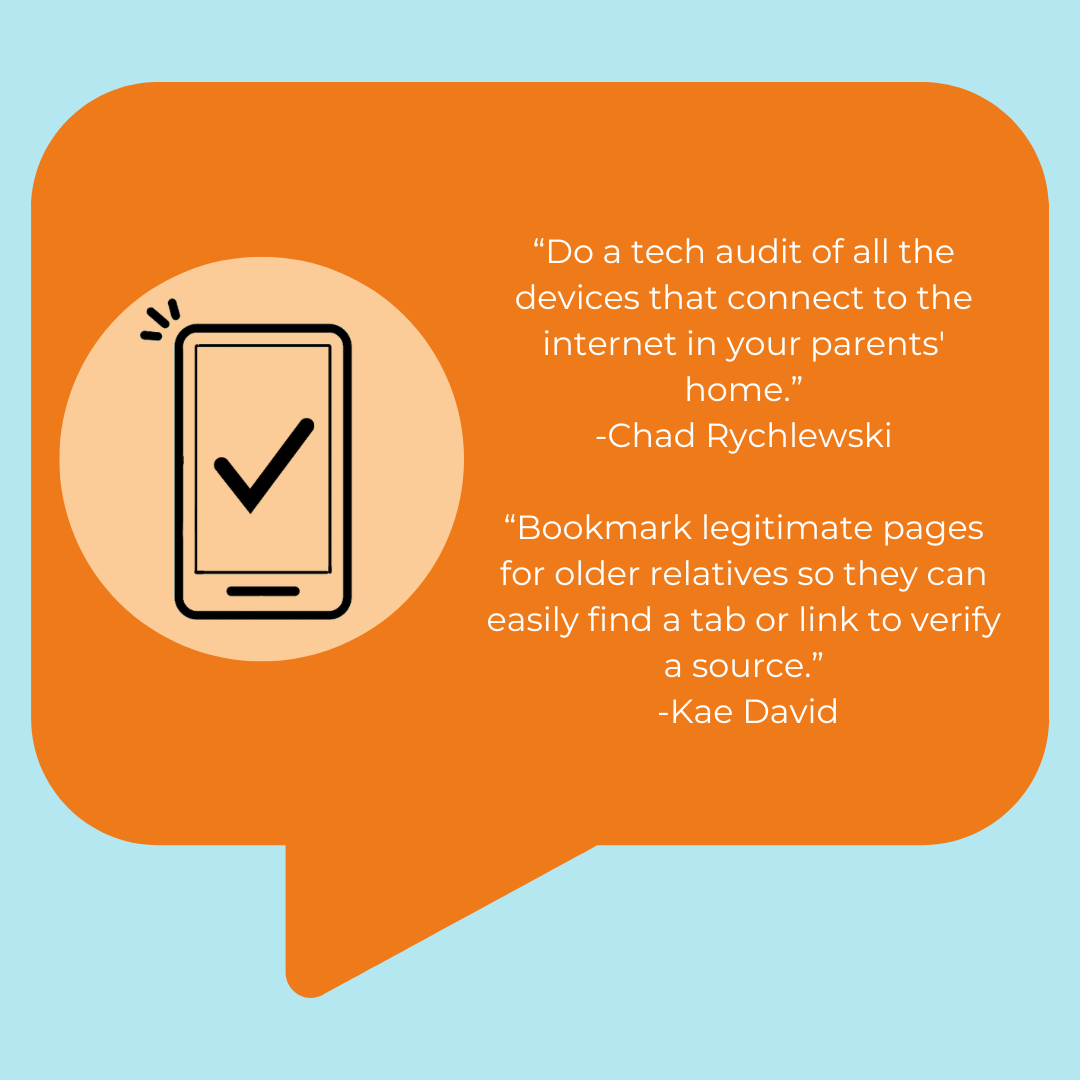
It's the tech audit. So we have this, a similar one with kiddos to look at what's around your house that has access to the internet, what's in the nursing home that has access to the internet, being able to understand every device that your parents engage with that could link to the internet or expose data or be hacked, right? So just going around and understanding what has access. So do they have a laptop? Do they have a, a Google Home device with a screen on it? Um, what information is being recorded? What information are they sharing? How are they sharing it? These are all things that you can go into on the settings of these devices and protect your personal information, just because you could ultimately go out to the internet and Google your name, that's part of this tech audit, and see what, uh, what information exists about you out there.
Chad: (27:16)
Mm. A lot of that could be from forms that you filled out. Uh, some of it could be from a device that you're sharing data from and you're not even aware of it, right? You know,
Hillary Wilkinson: (27:25)
Just that act of going and Googling the name and seeing that, I think that's a very convincing play, you know? Yeah. Because sometimes it's, uh, uh, you know, just relationships being what they are, you're gonna be billed as the alarmist or whatever of the family, you know? And I think, it backs your play and it shows your, shows your receipts, so to speak.
Chad: (27:55)
Yeah. You can see photos when you do that, too. That's another topic to talk about with grandparents, is everyone wants to be proud of their family and share photos. Every single photo that you share on Facebook, if shared improperly, could be existing on the internet forever. If you don't make it something that's shared directly with someone, it's shared to the public. Google your, your child's name, see if that's out there. That's the even scarier part. When you Google your name, it's one thing, but when you Google someone else in your family and see that they're out there because of a picture you posted, that kinda helps that conversation a bit of like, "Hey, grandma, hey, grandpa, let's stop sharing every little detail about the family
Hillary Wilkinson: (28:31)
On the internet." Yeah, for sure.
Kae: (28:33)
Yeah. I guess for me, my tip would be is if your parents are still very much, like, uh, getting tech-savvy and still comfortable with, like, using their devices, being able to actually bookmark the legitimate pages that they like to go to. So, for instance, having that, like, favorites tab on your computer where you're able to bookmark, "Okay, if you have questions about your bank, mom and dad, here's the link." Um, and it can be the favorites directly to the customer information, right, where call this number if you have a customer support question, save that number in their phone, so that way you can say, "Hey, if, like, your bank is calling you or your bank is texting you asking for information unprompted, please hang up from them and call this number. Go on this bookmark tab," and just do that for a lot of the different sites.
Kae: (29:26)
It can be a bank, it can also be their favorite restaurant; it can be, for instance, Uber Eats. Um, like, it can be whatever they, they like to do or are curious about, but being able to vet the website with them and bookmark it so that way they know, "Hey, um, I'm getting an info - a call from my doctor, but they're asking for information that my doctor has never asked me for, I'm a little concerned for them to be able to say," All right, I'm just gonna hang up from this number that called me and go on the website to my doctor's office and call this number here or pick up my phone and I'll just, um, I have it under favorites or a saved contact and I'm just gonna call them directly. So that way you already know there's a, a trust layer that has occurred and you validated who they're talking to and you still give them that independence and freedom to go out and talk to them on their own without always having to be like, "Oh, this number's calling me.
Kae: (30:20)
Let me have to call my son or my daughter or whoever to verify that this is right and then call them back and then do this." It's more of a level of independence you can give your parents while also helping to reduce risk exposure.
Hillary Wilkinson: (30:32)
Yeah. You know, the bookmark idea, I think I could apply to myself, so.
Kae: (30:37)
The same.
Hillary Wilkinson: (30:40)
I, I, I actually like that. I think it's a, a good, a good, uh, kind of digital hygiene type technique. Mm-hmm. As always, you can find a complete transcript of this show by visiting the show notes for this episode. You do this by going to healthyscreenhabits.org, click the podcast button and find this episode. In these show notes, you will also find a link to Cybersecurity Parents LLC and a link for the book that we've been talking about, that Cyber Smart Caregiving book. Chad, Kay, thank you so much for being here and thank you for looking out for all of our digital citizens of all ages.
Kae: (31:28)
Yeah, thank you so much. It was great being here.
About the podcast host, Hillary Wilkinson
Hillary found the need to take a big look at technology when her children began asking for their own devices. Quickly overwhelmed, she found that the hard and fast rules in other areas of life became difficult to uphold in the digital world. As a teacher and a mom of 2 teens, Hillary believes the key to healthy screen habits lies in empowering our kids through education and awareness.
Parenting is hard. Technology can make it tricky. Hillary uses this podcast to help bring these areas together to help all families create healthy screen habits.
Recent Episodes