

S16 Episode 3: How To Stop Scrolling (While Being Kind to Yourself!) // Ruby Ryba
Hosted by Hillary Wilkinson
Be Kind to Yourself
(As outlined by Ruby Ryba in How to Stop Scrolling)
Scrolling is a signal, not a setback.
Design over willpower.
Never leave a vacuum
Screen time strategist, mom of three, former math teacher, and author Ruby Ryba shares a refreshingly guilt-free approach to healthier screen habits in her book: How to Stop Scrolling. Ruby understands the importance of being kind to yourself while realizing that every day looks different.
Sometimes the goal isn’t to use your phone perfectly… it's to have more choice about where your attention goes.
Listen now!
Healthy Screen Habits Takeaway
Resources
Book Link:
How To Stop Scrolling by Ruby Ryba
Show Transcript
Hillary Wilkinson: (00:02)
My guest today is a former high school math teacher turned screen time strategist and an author of a great book called How to Stop Scrolling. Drawing from her personal experiences and background in education and psychology, today she helps people reclaim their time, attention, and sense of self in a tech heavy world. The path from phone dependency to digital empowerment is not often a clear one, as we all know. But I do have to say, she's really kinda, I, I feel like she's like this cracked this code in a blame-free, shame-free way that can enact really true change in your digital use. And I'm delighted she could take time from her busy fall to spend time with us.
Hillary Wilkinson: (01:35)
Welcome to Healthy Screen Habits, Ruby Ryba.
Ruby Ryba: (01:40)
Hey, Hillary. Thank you so much for having me today.
Hillary Wilkinson: (01:43)
Ruby, how did you come to recognize the sort of need for a book like this, how to stop scrolling? What brought you kinda to this space?
Ruby Ryba: (02:02)
So I think I've been interested in habits, optimization, for really as long as I can remember. It's really interesting because there are some of us that are just a little bit more in tune with noticing when we are being pulled by something other than our own intentions, you know? And I really don't like that. I just, I wanna live my own life. I don't want my life to be drawn up by someone or something else. And so it's always been an interest of mine, but I think with having kids, having a family, I started to really feel this need to clarify my own sort of digital philosophies.
Ruby Ryba: (02:58)
And that's what made me really need to take a look at them. And when I started doing that, I was thinking, well, okay, if technology is being designed in a way to make it as appealing and engaging as possible for us, then there must be some sort of best practice in terms of how we respond, how we engage back with it. So that's what started this project. I wanted to kind of crack that. And I think that there's a real want for this. I think there are a lot of people that want to change how they interact with their phone, but they don't know where to start. So that's where my book comes in.
Hillary Wilkinson: (03:54)
I totally agree. It used to be in the space of digital wellness, we spent a lot of time for, um, convincing people that tech overuse was problematic. Yes. And now I, I do believe that most of the free world is, is aware that yes, indeed, overuse of tech is problematic. So now what? Like what do we do? And that's one of the things I love about your approach is you have these three pillars to help people stop scrolling. Mm-hmm. You spell them out super clear. I'm just gonna refer to them. You have one - Yes. Be kind to yourself. Scrolling is a signal, not a setback. Then two: design over willpower; improve your environment and phone settings. Three is never leave a vacuum. Replace scrolling with something even better. And I kinda wanna start with taking this deep dive into number two, that design over willpower. What does that even mean?
Ruby Ryba: (05:07)
Yes. Great question. So one analogy that is easy to make is with food. So let's say that you were meeting a friend for lunch or breakfast and they're meeting at this cute coffee shop and they have your favorite chocolate croissants and all morning you're telling yourself like, "Okay, I'm gonna go meet her there, but I'm just gonna get a coffee and I'm not gonna get the chocolate croissants. I'm not gonna get the chocolate croissants. Don't do it. Don't do it, don't do it. Oh, they smell so good. Don't do it." That's trying to use willpower, right? But instead, wouldn't it be so much simpler to be like, "Hey girl, I can't go to that place because those chocolate croissants, they just call my name. Can we go somewhere else to meet up? Or can we go for a walk?" So that's using design over willpower and saying, "Okay, my goal and my values are to not eat that chocolate croissant this morning." And maybe sometimes you want to, but today you, you don't want to.
Ruby Ryba: (05:57)
And finding a way to make that more achievable for yourself. Um, so when we go to design, I kind of like to think of it in two spheres. There's the physical environment and then there's your phone settings themselves. The physical environment includes where your phone is day-to-day, but also where other things are. So it's basically about keeping your phone further away from you and keeping replacements closer to you. And then when we talk about phone settings, we're talking about your use of haptics. Do you need all the vibrations and the sounds? Do you need the bright colors? Do you need your beautiful family photos, the background that makes you wanna pick up your phone and look at their smiling cute little faces, you know? So all these little things that can make your phone more appealing, um, are actually gonna act as on-ramps to going onto your phone.
Hillary Wilkinson: (06:56)
Yeah. And that on, that reference towards on-ramps is kind of your. You also have this. I really like how you, you take stuff, you break it down. You're, you're very mathy on this. I am, yes.
Ruby Ryba: (07:10)
I used to be a high school math teacher at shows. Yeah. I had to teach quadratic equations to kids who did not wanna learn it. But
Hillary Wilkinson: (07:16)
I love how you have like, okay, here's the formula and then all of the explanation. And then here's another small chunk of the formula. 'Cause you have these, um. I'm just, I'm looking at your book right now. Thank you. On page 12. You have, you have the four domains of design, and that first one is what you refer to as on-ramps. Yes. And can you kinda take us through the, the remaining?
Ruby Ryba: (07:43)
Of course. So your on-ramps are your reasons for picking your phone up, and we can go into it a little bit more later as well, but they can be internal, like uncertainty or boredom, or they can be external, like a notification or seeing someone else go on their phone. So one is on-ramps, two is slippery slope. So that's what keeps you on your phone once you've gotten there via an on-ramp. Number three is proximity. So how convenient and close to you is your phone? And finally, number four is appeal. So how engaging, how attractive, how fun your phone feels.
Hillary Wilkinson: (08:15)
Mm-hmm. And, you know, I love that you touched on the, um, the how attractive and engaging your phone feels. Mm-hmm. Because that importance of just what you're saying about keeping your phone as, like, an appliance. Yes. Not a personal connection. Yeah. And I never realized how those pictures, just like you said, your.
Hillary Wilkinson: (09:22)
Those pictures of keeping your family as your lock screen or, you know, Apple, I have an Apple phone, and Apple does such an amazing job of just, like, on this day, however many years ago. And you know what, Ruby? I get sucked into those all the stinking time. I'm like - You're like, "Oh, these
Ruby Ryba: (09:41)
Photos are so cute." And then an hour later, you're still on the couch and you're like, "What? What have I been doing?"
Hillary Wilkinson: (09:46)
Okay. Yeah. A, scrolling through them, and B, then, like, sending them to people. Remember this? Yes. No, I'm the worst. So I, I totally agree with you as far as, like, if you can just depersonalize it, keep it as boring as an iron. uh-huh. Exactly. Pick it up when you need it. So - uh-huh. I, I completely agree with you. When we come back, I'm gonna ask Ruby Ryba more about habit change and organizing your home for success.
—--------------------------------
Ad Break: HSH workbook
—-------------------------------
I'm speaking with Ruby Ryba, screen time strategist and author of How to Stop Scrolling. As a mom of three, Ruby certainly knows how bedtime routines can set us up for success or something else. Something, a night you didn't intend. So- So true. When we talk about changing a habit, there are kind of like a few key ingredients to this recipe. And can you explain what they are?
Ruby Ryba: (11:12)
Yes. So when you're thinking about a habit, there's going to be the cue, which is what makes you do the thing. Then there's the routine, the thing itself, and then the reward, which is the consequence. So I, for some reason, I must want a chocolate croissant today. Let's say you smell chocolate croissants; that's the cue. Mm, smells good. Then you eat the chocolate croissant; that's the routine. And then the reward is the dopamine rush you get from the sugar or how great it tastes or the flakiness or whatever. Um, so when you're thinking about changing your habits, you have two choices, really. There's only two ways to change your habits. One is you need to remove the cue if you wanna get rid of this habit, if we're talking about eliminating habits, or you can keep the cue and the reward the same, but replace the routine.
Ruby Ryba: (12:03)
So let's talk about those one at a time. So when you're talking about removing the cue, one of the strongest cues to using your phone is just the phone itself. So when you see your phone on the table, when you feel the weight of it in your pocket, or when you see someone else go on their phone, that cues you to use your phone. So first, being aware of this trigger can be helpful because when I notice someone go on- onto their phone, it's a reminder for me, I do not actually need to use my phone right now. They might need to use theirs, but I don't. Um, but when you're at home, it's really useful to just not have your phone close to you unless you need it. So I talk about drop zones in my book, and there are two important ones. There's one when you get home and one when you're sleeping.
Ruby Ryba: (12:45)
So I like to remind people that they usually have a place to put their car keys and their wallet when they get home, but do you also have a place that you put your phone when you get home? Because if the answer is no, that probably means that your phone is following you around the house all day, which I really don't think is necessary. And it's okay, you know, it's not your fault. Like, phones have kind of crept up on us. They have existed for a lot less time than keys and wallets, but now that we know that they're here to stay, we probably wanna find a spot for them when we get home, right? And the same with bedtime. Does it need to be on your bedside table, because that means when you wake up, you're gonna be cued right into using it first thing in the morning.
Ruby Ryba: (13:22)
So when you're thinking about cues with the phone, a lot of times you can actually remove that cue itself. But then what about the times when you can't remove the cue, right? So if we're thinking about bedtime, when you, when you crawl into bed, I think a lot of people, they get into that comfortable feeling at, like, comfortable, that comfortable position, and then they're, like, ready to pick up their phone, you know? Mm-hmm. Even just being in a physical position, uh, a lot of people have, like, that most comfortable physical, uh, physical arrangement that they create out of their bodies on the couch or on the bed. It's like their phone posture, you know? So just, like, the feeling of the pillow, just being tired, um, the fact that it's nighttime, all these things can cue you into using your phone at night. So short of, like, checking into a different hotel room every night, there's no way that you can eliminate this cue, right?
Ruby Ryba: (14:14)
So what we can do is replace the routine instead. And this takes some thinking. So you wanna think about why am I reaching for my phone right now? Am I bored? Am I looking for comfort? Am I anxious? When you think about what you are actually reaching for your phone for, then you can think about how to replace it. So if it's that you want something comforting, maybe you can drop a bath instead. If it's that you want some indulgence, maybe you get some celebrity magazines, maybe you love that stuff. And honestly, it's so much more fun to look at, like, print magazines when you're used to looking at the tiny phone. Like, it's, it's fantastic. It's a luxury. It's, it's, it's so fun. Um, so thinking about what you are needing in that moment and how something else can fill that instead is really helpful.
Ruby Ryba: (15:09)
It takes some planning and it takes trial and error. And so I, I also really encourage people to remember that it takes trial and error, because even if you have the perfect setup for tonight, then maybe tomorrow you're looking for something else, and that's okay. And even not having what you need is okay, because now you know that for next time, and that kind of goes back to my third pillar of, um, be kind to yourself, because scrolling is a signal, not a setback. The signal is, "I didn't have what I needed tonight, but I can get it so that I, I'm ready for tomorrow night." So that was replacing the behavior. So if, if the cue is unavoidable at bedtime, as it probably will be, then we can change the behavior and still reap the reward that we were going for by looking at the phone.
Hillary Wilkinson: (16:08)
Mm-hmm. Excellent. Yeah. And I think, um, you brought up this whole concept of, like, you know, an automatic kind of sense of relaxation is kind of dissolving into digital media. Yeah. And I think it's also helpful to remind ourselves that when we reach for, like, just digital distraction, that's simply all it is. It's just distraction. It's not true relaxation. In fact, I mean, we know, we know a million and 12 studies on blue light, on, you know, all the - Yes. Cortisol levels of it being spiked after you scrolling on social media for whatever, whatever those stressors may be. But for some, somehow, we kind of come to convince ourselves that this distraction is comfortable. Yes. And I think remembering distraction is not the same as relaxing. Relaxing is not just being distracted. Mm-hmm. So I, I like that.
I like that really intentional bend and the suggestions that you offer.
Ruby Ryba: (17:26)
I agree. I think that that's such a good point. And I also think that it's important to note that sometimes relaxing is not comfortable. And I think that that's okay. And what I mean by that, I mean that mentally, because I think, I think one of the reasons that we love digital distractions is because they're a way for us to sort of escape, right? So you don't have to think about today, you don't have to think about tomorrow or what's going on. Whereas when you're doing something relaxing, like taking a bath or doing some knitting, or I make bracelets sometimes with my six-year-old, your mind can wander, and sometimes it wanders to uncomfortable places, and that's okay. And we need to do that. We need to process. And so we're also really losing all of those opportunities to do all, all this little processing here and there.
Ruby Ryba: (18:12)
We're losing all these spaces, and then I think we can become really overwhelmed. So I think it's also important to note that even the act of relaxation can be a practice. Like, if it's something that you haven't done in a long time because you have always been scrolling every night for the past couple of years, it might take a little bit of time to kind of feel comfortable in this new routine. Yeah.
Hillary Wilkinson: (18:35)
Yeah. And I think kind of chasing those fast and easy dopamine hits on, say, soc- social media or gaming has kind of trained us for wanting quick rewards. Um, one of the things that I have picked up recently: I've been working on building my own, what they call a dopamine menu, you know, where it's like - Yes, I love that. Yeah. Mm-hmm. Yeah. And, uh, one of the things that I picked up, uh, because I, I just felt gross after spending too much time on screens this past summer. Mm-hmm. And I was like, "Okay, I need to be really intentional. I need to really focus." And one of the things I did was I picked up, um, an embroidery kit. But here's the key, Ruby. Uh-huh.
Ruby Ryba: (19:22)
Tell me.
Hillary Wilkinson: (19:24)
It's kids embroidery. So it's like super, like, small projects, quick wins. Like, I, I can imagine
Ruby Ryba: (19:32)
Step
Hillary Wilkinson: (19:33)
Away. But, like, yeah, like, the age range for my current embroidery kit, which is adorable. It's this little, like, pencil pouch, and I've been work…. I was stuck in an airport. I was stuck in the Denver airport last night, and I, I was, uh, you know, embroidering away, and it was cute how many people were, like, wanna talk about it, wanna see, you know? Yes. Yes. And so, um, yeah. But honestly, I think the age range is, like, you know, ages, like, eight to 12.
Ruby Ryba: (19:58)
No, I am so glad you brought this up, because I also bought myself an embroidery kit a few weeks ago while I was traveling, or last week. And I think I made the mistake of buying an adult one, because it just, it's, like, a little overwhelming. Like, I'm just like, I'm doing this at night, like, in the dim light, and I'm like, I can barely see the hole where I'm supposed to put the needle, and I'm like, this is not - Oh, no.
Hillary Wilkinson: (20:18)
Drop it back.
Ruby Ryba: (20:19)
Yeah.
Hillary Wilkinson: (20:19)
Drop it back.
Ruby Ryba: (20:20)
Yeah. I need to start, like, the six-to-nine age range or something. Exactly. I know. I'll table the project. I'll come back to it. Thank you. I love this.
Hillary Wilkinson: (20:27)
Yeah. No, and it's, like, exactly. It's small. It's com - it's, like, completable. It's, you know? So, uh - And
Ruby Ryba: (20:34)
I love that you brought this up because I think when you're creating your menu, it's also really important to think about your energy levels and also the amount of time you have. Mm-hmm. So you need to have. So the tricky thing is that we're competing against a phone, which can fill 30 seconds, and it can also fill three hours, right? Mm-hmm. So we wanna think about, like, what would I do if I had an hour? What would I do if I had five minutes? But then you also wanna think about what would I do if I have an hour and I'm, like, caffeine in my veins, ready to go versus, like, what would I do if I have an hour for some reason in the middle of the afternoon? I'm, like, pretty tired and I just kinda, like, wanna chill. Yeah. Um, so, so that's also something to take into consideration is, like, meeting yourself where you are. Yeah.
Hillary Wilkinson: (21:13)
Yeah. And what I love about the, uh, the act of doing something of creation over consuming is when I walk away from it, I feel better. Yes. Whereas when I've spent too much time online, I feel. I don't feel better, you know? As mindful as I am of trying to set my algorithms, as trying to. All of those things, I still, when I spend too much time online, it's like making dinner out of Doritos, you know? Yes. It's just, ugh. I agree. So, okay. Let's go back to those original three pillars we talked about. They seem to be kind of, like, foundational in your practice. Yes. And the last one, number three, is never leave a vacuum. Replace scrolling with something even better. And I kinda feel like we were talking about that just a little bit with, like - Yeah. The embroidery and stuff like that. But, um, that's not gonna be it for anybody, you know, for everybody. I know Legos are a really big thing for a lot of people, you know? So that kind of, like, hits in that same thing. Mm-hmm. As well as the, uh, the whole, like, dexterity component of it - uh-huh. Is so, as it turns out, it is so important to us as a species. I agree. I mean, we have these very specially designed utensils called hands at the end of our arms, and as it turns out, when, you know, we, we get a charge out of using them.
Hillary Wilkinson: (24:14)
So - Yes. So let's, let's go back to never leave a vacuum. And one of the things you kind of tease apart and talk about is this difference between aspirationally better versus experientially better. Mm-hmm. And I, I love that idea because I am one who makes a to-do list that can be, like, 60 items long. And it's like - Same. "Come on, Hillary." Same. Yeah. So can you talk about that?
Ruby Ryba: (24:44)
Yes. So one good example would be, um, when I, when I'm trying to help people decide what to add, one question that I sometimes use to get the juices flowing is, "What would you do if you had an extra 10 hours a week?" Okay? And, you know, you can answer that however you want. You can say, "For one hour, I would do this," whatever. But one response that I got from a client when I was doing research on this book that I found kind of funny was she said, "I would learn more about the electoral college." And that is an example of aspirationally better, because it s - it sounds great in theory, and it's kinda like it's something that she might wanna get around to at some point. Me too, I should at some point. But if you have 20 minutes at the end of a day and you're relaxing and your choices are to read up on the electoral college or scroll funny Instagram reels for 20 minutes, like, I don't know about you, but I'm picking the reels, okay?
Ruby Ryba: (25:39)
So we want to choose something that we'll actually do, and something that we will really enjoy the experience of. I think that we. There's also a little bit of an obsession right now with being productive and informed, and so we burden ourselves with that, and with the 10 hours a week, people can get really aspirational and say, "Okay, I would work out for four, four of those 10 hours, and I would, like, organize all the closets," and, like, would you really do that with 10 hours? Or, like, would you want, like, the clone version of you to do that? You know, you would not enjoy that experience, right? You just want the result of that. And so I think that that's really important to think about when you're choosing what you're going to be filling the vacuum with.
Hillary Wilkinson: (26:24)
Mm. I like it. Yeah. And also making it something that is, um, just kind of fun. Like - Yeah, totally. Yeah, so that you're motivated to, to, to want to do it. So we have to take this, another short break, but when we come back, I'm going to ask Ruby for her healthy screen habit.
—------------------------
Ad Break - Thanking donors: Dani Waters
—--------------------------
We're back! On every episode of the Healthy Screen Habits podcast. I ask for a healthy screen habit, and this is going to be a tip or takeaway that listeners can put into practice in their own home. Ruby, what is yours?
Ruby Ryba: (27:09)
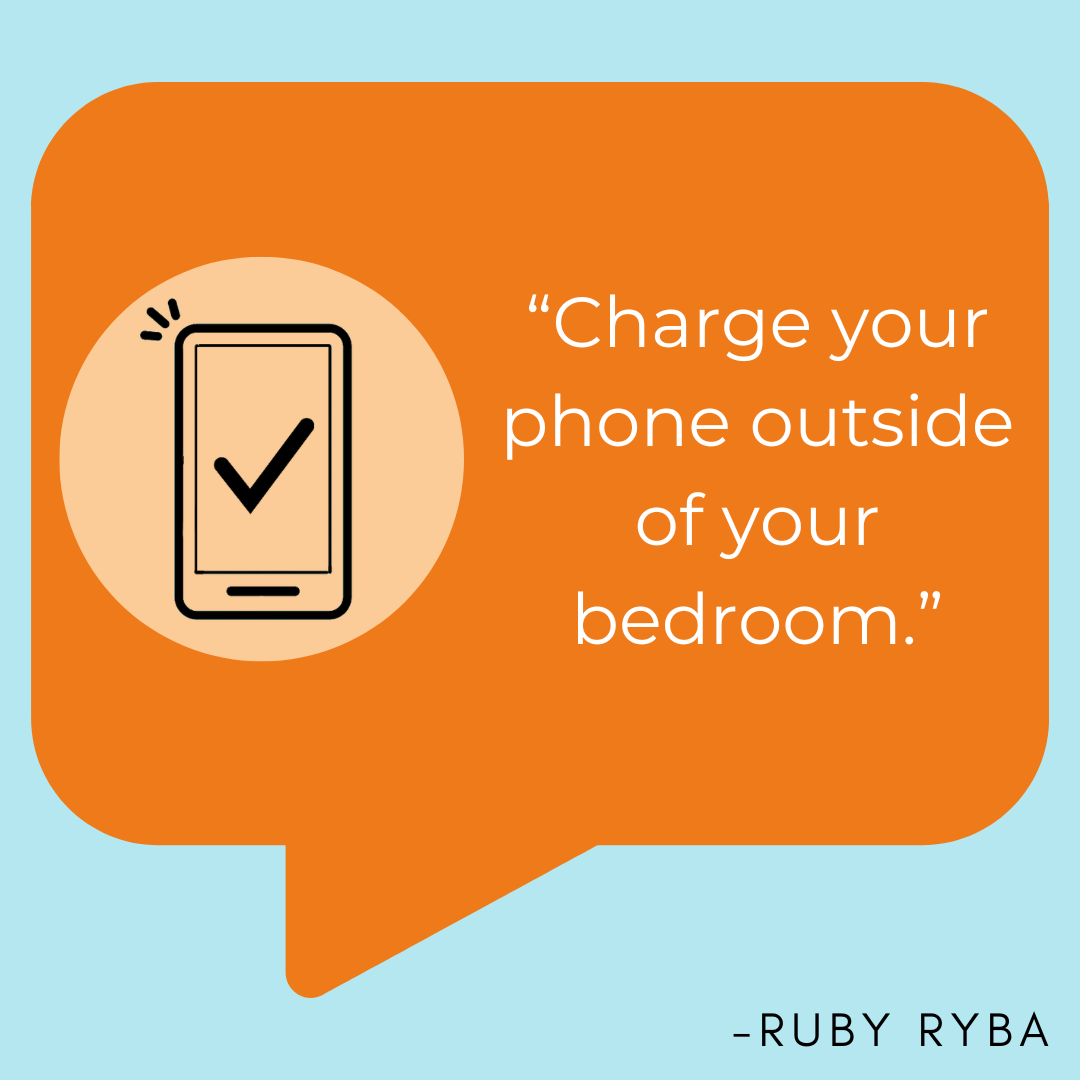
So if I can only give your listeners one piece of actionable feedback from today's episode, it would be to please not charge your phone in your bedroom. So when your phone is not living in your bedroom, it's going to help you in two parts of your day, because it helps you in the evening when you're going to bed because your phone is not there, so it is not an option. You can't choose it; you've got to do something else. And it's also gonna help you in the morning, because if your phone is on your bedside table when you wake up, you're gonna reach for it when you wake up. It's there. Like, of course, you will. If you. So the nice thing about choosing where to put your phone is you get to choose when it is going to enter the scene of your day.
Ruby Ryba: (27:48)
So if you put it in the bathroom and you go to the bathroom first thing in the morning, then you're gonna use your phone when you get to the bathroom. If you put it in the kitchen, you're gonna use it when you make coffee. So you can think, like, "What is my ideal morning? What does it look like?" And then add the phone where you want it to come in. So that is my one takeaway, because I think it's just one action that is really powerful in terms of what you get out of it. For
Hillary Wilkinson: (28:11)
Sure. I can't agree with you more. In fact, keeping devices out of bedrooms and bathrooms - in general.
Hillary Wilkinson: (28:18)
Is our core habit number five of our five core healthy screen habits. It's, uh, for a variety of reasons that we could take a super deep dive into, and, um, that would take us a whole other episode. Yeah.
Ruby Ryba: (28:35)
Agreed. Agreed. That's a whole episode: number five. Yeah.
Hillary Wilkinson: (28:39)
Okay. As always, you can find a complete transcript of this show by visiting the show notes for this episode, and you do that by going to healthyscreenhabits.org. Click the podcast button and find this episode. You will also find a link to Ruby's book, How to Stop Scrolling. It's a super helpful handbook on kind of getting you through the process and, like, helping your family along the way. Ruby, thank you so much for being here and for sharing great screen strategy techniques.
Ruby Ryba: (29:14)
Thank you, Hillary, for having me.
About the podcast host, Hillary Wilkinson
Hillary found the need to take a big look at technology when her children began asking for their own devices. Quickly overwhelmed, she found that the hard and fast rules in other areas of life became difficult to uphold in the digital world. As a teacher and a mom of 2 teens, Hillary believes the key to healthy screen habits lies in empowering our kids through education and awareness.
Parenting is hard. Technology can make it tricky. Hillary uses this podcast to help bring these areas together to help all families create healthy screen habits.
Recent Episodes