

S16 Episode 4: Healthy Screen Habits Meet Digital Childhood!
Hosted by Hillary Wilkinson
1 Conversation
+
2 Podcasts
= New Perspective on Childhood with Technology
"Chloe Parsons Cohn is the 13-year-old host of Digital Childhood. She created this podcast to explore how technology affects the way we grow, learn, connect, and how to become the best versions of ourselves—with technology and without it.
This week, Healthy Screen Habits joins Digital Childhood for a special co-release that brings BOTH sides of the screen-time conversation to the table. 🙌"
Healthy Screen Habits Takeaway
Show Transcript
Hillary Wilkinson: (00:00)
I've got something new for you this week. This week, I'm actually doing a co-release or a co-drop with a fellow podcaster. Her name is Chloe Parsons Cohn, and she is the host of Digital Childhood. I think you're going to really enjoy our conversation. Chloe is 13, and she started this podcast, and she and I kind of have a very interesting conversation on both, uh, kind of both the parenting side of digital wellness, as well as what it's like to be a teen growing up today. I think you're going to enjoy listening to it. It's a little bit, um, different format than regular, but, you know, change is good. Change is exciting. We'll switch it up from time to time. Uh, enjoy it, and I can't wait to hear what you think about it.
Chloe Parsons Cohn: (01:01)
Hi, everyone, and welcome back to Digital Childhood. I'm Chloe, and today we're talking about one of the biggest challenges facing families today, building a healthy relationship with technology. Technology can help us learn, connect, and create, but it can also create distractions, conflicts, and habits that are really hard to break. That's why I'm so excited to be joined by Hillary Wilkinson, founder of Healthy Screen Habits. Hillary started Healthy Screen Habits after seeing firsthand how difficult it was to navigate technology as both a teacher and a parent. Today, she helps families develop healthier relationships with screens through education, awareness, and practical strategies. Before this interview, I listened to your financial incentives and motivation app episode, and one thing that really stood out to me was your discussion on motivation. On my podcast, I talked a lot. I talk a lot about motivation, discipline, habits, and becoming your best self.
Chloe Parsons Cohn: (01:59)
I thought it was interesting because sometimes people genuinely want to do something, whether that's studying, exercising, reading, or just spending less time on your phone, they don't always have the motivation in the moment. Your episode explored how incentives can sometimes help bridge that gap, and I'm so excited to talk more about that today. Hillary, thank you so much for joining me.
Hillary Wilkinson: (02:22)
Oh, I'm thrilled to be here, Chloe. And just to make sure, I, I'm flattered that you think that I'm the, the founding member, but there's actually 4 co-founders of Healthy Screen Habits. I could not do this without the other three, so I just wanna give credit where credit's due. Okay,
Chloe Parsons Cohn: (02:42)
Perfect. So before we dive into technology and parenting, I'd love for listeners to learn more about Healthy Screen Habits. Can you tell us about your podcast, the organization, and your role in it, what your main, what you usually do
Hillary Wilkinson: (02:58)
With that? Absolutely. Absolutely. Thank you for asking. So Healthy Screen Habits founded in 2018, we're a 501 and our goal as the four moms that I just talked about was we were really looking to create, um, at that time, at 2018, we were raising our own kids. Like I said, there's four moms, we have 14 children amongst all of us. Wow. And so we were really in it, right? And we were looking for, um, the resources that we needed, which was exactly like what you're providing, which is telling people like, "Gosh, like what, you know, what's the research behind this? How do we know what's happening to our brains, et cetera?" And so we really looked to create the, the platform that we couldn't find anywhere. And, um, we do that n - we do that with kind of, we have like a four-pronged approach, in-person presentations, typically at schools and youth groups and stuff like that.
Hillary Wilkinson: (04:06)
Uh, and we also talk to parents. We do, we've talked in, in some, um, businesses, corporations, et cetera. So we do presentations. We have our website, which is healthyscreenhabits.org, and that has a variety of, um, resources, free downloads, and, you know, just a, a treasure trove of things you can use to help your own family, as well as we have the podcast, which I host, the Healthy Screen Habits podcast, and that is a 30-minute episode where I talk to experts, I talk to researchers, families, you know, I mean, just it runs the gamut. It's everything from, like, your neighbor across the street to literally the leading researcher in infant brain development. So I'm, I'm proud of myself that I keep it to 30 minutes because I figure that that's the only time that busy moms have, have time for listening to. Yes, exactly.
Hillary Wilkinson: (05:12)
And, uh, and then we also have the Healthy Screen Habits workbook, which is a tool that, um, can be purchased online. It is a book that serves as kind of like a driver's ed for your first device. So, and that is ages, I mean, I think the ages are like eight to 13. So we always recommend that parents visit that first before handing it over to their kid. Just some of the content that you run into online, that's the reason why it's so important to pre-launch with them and discuss. But, um, some of the, the content's a little gritty, so.
Chloe Parsons Cohn: (05:55)
Yeah, that makes sense. I think that's really cool. I love that you have different ways of doing it, not just a podcast, but you have so many different ways of spreading the word, kind of.
Hillary Wilkinson: (06:07)
Yeah. Yeah. I'm realizing you d - I, I didn't fully answer your question. You asked what my role is. My role is the podcast host as well as I do presentations. So I, yeah, I kind of stay in that lane of education because that's my, my background. I love that. And yeah, with a focus in intrinsic motivation. So just like you were talking about. That's
Chloe Parsons Cohn: (06:29)
Really cool. Well, starting with motivation, do you think motivation is sometimes overrated compared to systems, habits and the environment? Or do you think motivation is actually a really important part?
Hillary Wilkinson: (06:43)
Ooh, that's a really good question, Chloe. So I, I think that they're intertwined. And I think that without systems and organization, it's easy, particularly in today's world, to get distracted and lose focus, as well as it's incredibly easy to hit kind of that wall of overwhelm. And when you hit that wall of overwhelm, I feel like we all can relate to this, how you, you try something and, you know, the first time you try something, it's, you are not going to be good at it. And it's so, yeah, it's so hard to remember that, right? Because we, um, you know, particularly if you follow anybody on social media, it looks like they all have, like, you know, got - They're perfect lives. Exactly. Yes. And gotten the paint color right the very first time when they're redoing their, what, their kitchen or whatever. Or, or like at the perfect braid in their hair.
Hillary Wilkinson: (07:46)
And I'm like, "Oh my gosh, how are they doing this?" So yeah. So there's kind of the learning process is this, for this kind of like stumbling forward of trying to get to your end goal. But that being said, one of the things that technology has kind of robbed from us is that, um, that resilience and that tenacity of being patient with yourself while you're learning and while we're doing that stumbling forward. And so the, the process of learning and, you know, how it holds hands with motivation is you try, you fail, you try, you fail, you try, you fail. At some point, you try, you fail and you don't care. And that's when that wall of overwhelm or that wall of apathy hits. And that is a really tricky place to, uh, persevere and get through. And that is where if you have a plan or a schedule or something along these lines that is just, or an accountability partner - Yeah.
Hillary Wilkinson: (08:56)
It can really help you move through that period.
Chloe Parsons Cohn: (09:01)
I think that's really a smart way to put it, is that the motivation can only take you so far, but you still need the habit and you need the discipline to be able to do everything, to be able to take it to that last step to the point of where you want to succeed, but having the motivation, I mean, having the discipline to actually succeed even when you don't always have the motivation. Is there a way that parents can help kids stay motivated without creating a system where they expect rewards for everything? Because to some extent, rewards are incredible in the sense of it will give the kids the motivation to start. But how can parents help them create the discipline to keep going? Because as an adult, you don't always have that motivation. And maybe that motivation can be money, but you don't always have that for doing your laundry, for cleaning your room.
Chloe Parsons Cohn: (10:09)
The motivation isn't always there. Working out, especially as an adult. What would you say is a way that parents can help kids stay motivated but still create those disciplinary actions that they need to take without always giving them money or a sort of reward?
Hillary Wilkinson: (10:28)
Right. And that is, I, I, you're asking such great questions regarding motivation. It's like, it's my favorite thing to talk about. Um, because what we find when you're talking about that type of a system, like, uh, um, you do something, you get a, a sticker, you get do something, you get a d - you know, everybody has these different types of systems that they've used, that they've known throughout their, their life, right? Or that they've been introduced to. And what typically happens is I'm gonna use like , you know, when you go to the dentist as a child and they're, uh, or you go to the pediatric dentist and they give you a floss chart and the, the kids are super motivated to color in like each tooth of the floss chart on that, you know, alligator mouth or whatever the graphic is as they, uh, you know, as you go through the day.
Hillary Wilkinson: (11:23)
And for the first about three nights, they're remembering themselves, okay, yeah, great. That's the way we do it, you know? But eventually those token systems rapidly lose efficacy. They rapidly drop down in their ability to enact true change in behavior. You know, people just get used to it and it's, it, the novelty is gone. So something like that would be an extrinsic motivator. And so what, what, it sounds like what you're looking to build is intrinsic motivation, which that is like the, the desire to do something simply for the, the internal output, right? Like, you know, like the staying healthy or the feeling better or whatever. And for that, what I really recommend parents focus on is, and don't get me wrong, these token systems can be a great launchpad. Of course. In fact, they're a really good way to introduce something, but don't think that you're gonna, you know, be able to rely on that system beyond that little, like, window of novelty.
Hillary Wilkinson: (12:43)
So that's when you have to start enacting a little more conversation and flipping it back on, you know, on the person who's doing the task. So, you know, I mean, just commenting like, "Oh, we spent this morning picking up your laundry or, you know, cleaning your room." Like, let's, let's walk out of the room and walk in and just, ah, admire it, you know? And, you know, and really, like, ham it up. I think one of the delightful things of working with kids is they really enjoy play and humor, and anytime you can enact those things into it, that becomes its own motivator. And what you're really wanting to do is that feeling of wellbeing and regulation in, like, managing your life. But building that, what would be called, like, an internal filter, it, it takes some outside coaching. So that's what, that's what I recommend parents really help, you know, so that they have that little voice, so your kiddos have that little voice in their head of, like, "Oh, this feels so good.
Hillary Wilkinson: (13:54)
Oh, this," you know? So they,
Chloe Parsons Cohn: (13:56)
So they like doing it so that later they can do it themselves?
Hillary Wilkinson: (13:59)
Yeah. Yeah. And the thing I say, I mean, my kids have heard this statement, oh my gosh, I mean, probably a thousand times a year, not even just a thousand times in their life, but, like, uh, whatever happens, I'll say motivation comes in many forms. Like, I mean, it just does. Whether it's, "Oh, I'm waiting to eat that chocolate chip cookie until I get the vacuuming done," or, you know, you can play, like, little games with yourself like that, and we all do, but it's just a matter of, um, working out what works for you. And like you said, as adults, I mean, sure, that everybody can recognize that a paycheck is a great motivator but, but there are other things as well, right, that, I mean, we work out because we wanna feel better, not just in our body, but in our mind.
Hillary Wilkinson: (14:48)
But having those things pointed out explicitly then helps that internal intrinsic, like, bridge. At what
Chloe Parsons Cohn: (14:58)
Point do you think the incentives should stop? If, like, at what point do you think the kids should find the motivation to do it themselves and the parents need to start letting them do it themselves? Or should the parents keep giving these incentives until they're 18, or does it really depend? I
Hillary Wilkinson: (15:23)
Think that it's a case-by-case basis. I think it's really going to. You're gonna have some kids that remain very motivated on a certain, you know, for whatever extrinsic reward or whatever, but you're also going to have. I have one of each, okay, at my house. I have someone who, with extrinsic motivation, really, uh, was never interested in it. And I have somebody else who was highly motivated and found jobs in the neighborhood and did all of the things, you know? And that has continued through their young adult life. So some of it is personality. And to work with the personalities who are growing and thriving within your house, how does, you know, how does one individual in my house respond to something over another? And you really, like, if you can communicate using the language or using the method by which you're going to get your desired results from that child, then lean in, right?
Hillary Wilkinson: (16:34)
Right.
Chloe Parsons Cohn: (16:35)
Almost like, how do you think parents can realize their child's love language? Like, how can the parents give each individual child the motivation that they need to start doing the things that they need to do, because each child is so different.
Hillary Wilkinson: (16:51)
Yeah, they are. And that's part of it, right? That's the beautiful part of being a family, is just, I mean, we're, we're not all carbon copies of the same, the same thing. So, uh, so my challenge for parents is to, you know, really know your kid, really, you know, take the time and, you know, talk to them about, you know, what this versus that, and as far as what, what really makes them tick.
Chloe Parsons Cohn: (17:22)
Right. Okay. That makes sense. I like that. I think that's really important is to have that healthy relationship with your child in the sense of you're able to know what works for them, because what works for someone probably and maybe doesn't work for someone else. I like that. Completely. And on the topic of having healthy relationships with your children so that you do what's best for them, I have a couple questions on setting limits without damaging those relationships. Mm-hmm. Because one thing I hear from both kids and parents is that setting limits can sometimes create arguments, resentment. What is a way for kids to respect boundaries instead of resisting them? Like, what can a parent do to help their kid understand or to set a limit in a way that their kids respect it and understand it instead of resisting them? Yeah. And I know that it is different for every child, of course, but is there any advice you would give to parents on that?
Hillary Wilkinson: (18:31)
Yeah, absolutely. I think that when you are trying to enact behavioral change in anybody, the best way to start is through, um, a s - you know, A, self-assessment. You have to find out what your own, what your own tick is, right? And B, really involving your child in the br - in the blueprint of the plan. Now, that doesn't mean that you're handing over the total control, right? But you are letting them design. And just, um, if we're, if we're swinging it back at all to healthy screen habits, that is something that comes up again and again, is the, the limit setting, limit setting boundaries. And now you have, you know, if kids are not involved, if you don't have buy-in from the whole family with this, what you're doing is you're setting up kind of a culture of sneakiness where kids feel like, "Oh, my mom's never gonna let me use, you know, my tablet or whatever." And so they go and they try and sneak and hide it, you know?
Hillary Wilkinson: (19:48)
I mean, there's a bajillion workarounds for whatever - Right. Whatever filters you have in place. And the kids, I mean, the kids will, will always find them. I mean, they're the digital natives. So it's , I mean, it's, it's going to happen. So my recommendation is you use something like what we have. I'm going to use ours as an example because that's just what, what I have. But that being said, the important part is to have a plan, not our plan. I mean, I, of course, I recommend our plan.
Chloe Parsons Cohn: (20:24)
What is your plan?
Hillary Wilkinson: (20:25)
Oh, thank you for asking. We have, uh, it's a free downloadable resource on our website, and it's called a Family Technology Plan. And it is, uh, it's like a seven, five to seven-part process where you go through, you take an inventory of all the technology in your house, and you decide, as a family, through conversation and through input of every person, like, what role do we want tech to have in our lives? Like, what areas of the house are we going to designate as tech-free spaces? And of course, we've got, you know, I, I have big opinions on that. I do not allow tech in bedrooms, but, um, keeping devices in, in public family areas. But you can set expectations for things like, "Oh, we wanna have device-free dinners. We wanna enjoy each other." And it's all about building that, like, putting that connection and that relationship first.
Hillary Wilkinson: (21:29)
Because honestly, that will be the best thing that parents have, the best tool that parents have in their pocket when navigating the, you know, the. I, I don't wanna use the word battles, but, like, the discussions surrounding technology is, you know, kids need to understand the why that their parents want to do things a certain way, but they also deserve their own voice. And so, even just being heard and saying, like, "Oh, okay." And recognizing that, like, we're not gonna do this yet, but, like, you know, at some point, you will get a phone. It's just not when you're 11, you know, so the power of yet, the power of , you know, and, and making sure that everybody feels heard, I think, is something that, um, lessens resentment.
Chloe Parsons Cohn: (22:24)
Do you think there's a certain age that children should get a phone, or does it really depend on the person and their situation?
Hillary Wilkinson: (22:32)
Okay. So this is hard because everybody always wants hard, fast, like, numbers, right? Right. So I'll give you the numbers, and then I'll give you the, the, the - Explanation. Yeah, yeah, yeah, yeah, yeah. So the numbers are w- we really recommend that parents hold off on giving internet-connected devices, i.e. Smartphones, until the summer after eighth grade. There's, uh, there's a wait until eighth program that you can sign a pledge. There's all, you know, there's a lot of research background and support on that. So prior to that, there's a variety of devices that are available for families that need. I mean, every family has different needs, right? For me to come in and say, "Don't give your kid a phone until," is the same thing as me saying, like, you know, "Oh, all families must drive minivans," you know? Well, if I only have one kid, I don't want a minivan.
Hillary Wilkinson: (23:29)
I'm not gonna, you know, it's, I, so it's, e- e- every family gets to tailor their, their tech needs. But that being said, these are guidelines, right? And like I said, there's a lot of transitional devices out there that are very good at providing non-internet connected ways to communicate. Um, we have some of them on our website if people want, if people wanna look at it, but I recommend things like Trumi, Gab, Pinwheel, those types of businesses. Uh, um, as far as social media goes, we recommend not giving social media until at least 16. Uh, there's a ton of research that'll back me up on that as far as waiting until later. There's even research to suggest that social media shouldn't be accessed by kids until age 18. Um, I personally don't think that's very realistic as i- in today's culture. But, um, there are countries that are enacting social media bans.
Hillary Wilkinson: (24:40)
The data that's coming out about that is they haven't been, they haven't been entirely successful, but I go back to the old days of, like, big tobacco and the lawsuits that were coming out then. Yeah. It took a long time before we stopped having smoking sections and airplanes and restaurants and all of this stuff. So I think all of this push forward is all forward movement. And the, the best thing that's coming, I think, from, like, the social media bans and from stuff like that is that it really, it gives parents a leg to stand on where they can say, like, "I know this because, you know, Australia's not allowing their kids to have it." And so the, it gives them some credibility. Right. But yeah, so the, so summer after eighth grade, before, for internet connected device, and when you do that, make it a slow step in.
Hillary Wilkinson: (25:44)
We have a four-part step-in where it's, you know, I mean, you go to, from a strip-down phone to a phone with few apps, and just, like, a slow step-in. We don't want to hand the 14-year-old the keys to the Ferrari and say, "Make good choices," you know? So, um, yeah. And, you know, you know your child better than anyone else. If you feel like, sure, that's the recommended, you know, that's the recommended age limit, but I know my kid. I know, you know, they are all gas, no brakes. I know they are, you know, there's, there's a really great organization called Better Screen Time with Andrea Davis, and she has a checklist of, like, responsibilities for, like, can your child complete their homework without being asked? Are they respon - do they have other responsibilities throughout the house? And so, if you are questioning whether your child is ready for a phone, um, and it's a self-assessment, which, so the parent can read it, but also the, the child is asked to do a self-assessment.
Hillary Wilkinson: (26:58)
And most people think, like, "Oh, they're just gonna lie. They're gonna say," you know? But honestly, I don't find that to be true. I find, if anything, I, I, I find kids to be really hard on themselves, you know, like, "Oh, I, I don't really do that." And it's like, no, I, I think kids know themselves very well, and I think they can be trusted. So, 14 for phones, 16 for social media.
Chloe Parsons Cohn: (27:24)
What about, um, you talk about phones, but what about devices like iPads and Apple computers where you can still text and call? Do you think being able to text and being able to call, does that need a really high age limit, or is that different because there are good things that come with that?
Hillary Wilkinson: (27:46)
Sure, sure. Yeah, absolutely. There's good things and there's just convenience, right? I mean, if you're at a sports practice and it's getting out early and you need a ride, you need to be able to contact, you know? Um, so that, that would be something that I'd call a non-internet transitional devices that offer, um, calls, texting, like, camera options, even music, but are just not, are not internet connected.
Chloe Parsons Cohn: (28:17)
What about an Apple Watch?
Hillary Wilkinson: (28:19)
Um, so that's a really fuzzy area. Yeah. And this, um, the reason why I'm saying it's a fuzzy area is because, I'm just gonna say it, Apple is notoriously terrible about updates and it canceling out, it wiping any, um, parental limits and anything. The, if you, if your child has an Apple device and you feel like it ha - it is locked down, you've got, you know, parental controls in place, you feel like you're on top of things, and two weeks later you go back and you check it and you see everything's been removed and you're like, "What is happening here?" Uh, Apple is notoriously tricky about their updates coming through and wiping out time limits and e- e- everything that has, has been previously set. So I know that there are other wearables that would, um, that are Apple Watch adjacent, but I don't know.
Hillary Wilkinson: (29:22)
I, I, you know, I, I feel like this is where, because my kids are beyond the age of the, the targeted need there for the, for the watch, I, I, yeah, I'm really, I'm not giving you a good answer. Sorry about that. No,
Chloe Parsons Cohn: (29:39)
That's totally fine. I think that's very fair. Like, I got an Apple Watch when I was in fifth grade. Uh-huh. But I did have limits that sadly did not come off. And, um, for me, I needed that because I live in a very safe area. Yeah. So my friends and I, after school, would walk around alone. And we would. And I had volleyball a lot, so we, and we'd all carpool. So I need to text my parents. And for my family, that was the best way to be able to call and text without having apps. I wasn't allowed to download any apps on it besides like calling, texting, and I think I had a heartbeat. But, and a workout app. I still have it. I love my workout app. Um, but I agree that it really depends on the situation. Because for certain people, if they're with their family all the time, they don't need to text them.
Chloe Parsons Cohn: (30:42)
That's not a safety concern. I had it for a safety concern to track my location, to be able to do this. So I agree with that answer of like, there's not a set limit for that.
Hillary Wilkinson: (30:52)
Yeah. Yeah. And just in the interactions that you and I have had and in knowing, in listening to your other episodes, I would venture to say that you're not the typical 13 year old. So I think you are probably very good at knowing your own limits, knowing yourself. And, um, I think, I think that all works very well. You're, you're the like poster child of success for that, right? So - Yeah. But yeah, that's, so let me ask you, did you find prior to your Apple Watch, like what was the reason why you felt like you needed to get it? Was it, was it safety related or was it communications? Was it convenience? So I
Chloe Parsons Cohn: (31:49)
Felt I needed an Apple Watch at that, at such a young age because I was doing a lot of things alone. And I would make plans during school for after school because my best friend and I were neighbors. All of my friends and I would hang out. I live on a small island off of Miami Beach and super safe, very hard to get to without knowing where it is and super hard to get to without living on it. So it was super safe so they'd let me walk around alone. And I felt they would need to text me, "Come home now. Dinner's ready." And without that, I wasn't able to have that freedom. And I feel that freedom gave me a lot. I really loved that freedom. I really wanted that freedom.
Hillary Wilkinson: (32:35)
For sure.
Chloe Parsons Cohn: (32:36)
So I think the Apple Watch was a great way for them to say to me, "Okay, you can get that freedom because there's a way in an emergency for you to contact me, for you to contact 911, for us to track your location." So for me, I felt I needed the Apple Watch for safety. And I agree that it was for communications as well with my friends, but I had an, I had an iPad, not one that I used a lot. Um, it was very old, didn't use it that much. But if I wanted to make plans with my friends, that's how I used to do it. Or I'd ask my parents to text their parents. But I felt that Apple Watch gave me a lot of freedom. So looking back, I think it was the right time to give it to me. Mm-hmm. And a lot of people say that's a really young age, but in my situation, I needed that to be able to have the freedom that I had.
Chloe Parsons Cohn: (33:36)
And that freedom gave me a lot of maturity because I felt okay, they trust me. And I think that feeling of trust gave me a lot of maturity, even though I was young. I think that's really important to understand.
Hillary Wilkinson: (33:54)
Yeah. I agree with you. And I think the, uh, the, the freedom to be able to go outside to navigate, um, challenges as they arise on your own of just figuring stuff out is, it's a huge part of what it means to grow up, right? And, uh, yeah, I think that, I mean, kudos to your parents for, for recognizing that you were ready for that freedom. But you used a word that I'm gonna re- repeat and that was, that was situation. In your situation, it was a, it was the best choice. But I think families and parents have to really be very honest with themselves in looking at the situations that they are in and their individual child to really assess what's gonna be the best path forward for them and expect the stumbling. Like, you know, I mean, don't think that this wild world of the internet is not going to creep in at some point.
Hillary Wilkinson: (35:08)
Like, I mean, that's, that's the thing also. As much as we would like to go, "Oh, you know, all of this smoothly went forward and," but remember that the growth happens with the falling forward.
Chloe Parsons Cohn: (35:25)
I like that. I like that a lot. I have a few more questions for you. Sure. One of which has to do with an app that I've heard a lot about called Bark.
Hillary Wilkinson: (35:35)
Yep. Yep. Yep.
Chloe Parsons Cohn: (35:37)
My questions are, what do you think about that app? What ages do you think are appropriate for parents to have that? And what would be a better solution than Bark?
Hillary Wilkinson: (35:51)
Mm. Okay. So Bark is an app that. Do you wanna describe it for people who don't know what it is?
Chloe Parsons Cohn: (35:58)
So Bark is an app that parents have, that parents can get. They do have to pay for it. I think it's like $150 a year. Um, they pay for this to set limits for their kids. They are not allowed to access certain websites on Safari. If Bark gets any disturbing texts, right? Um, if you get any disturbing texts from your child's phone, it will send it to the parents and there's certain sensitivity levels. So it could be a bad word. It could be saying something as simple as you're so pretty. It could be something really bad. It could be anything in terms of like what Bark thinks as dangerous situations depending on the sensitivity level. And it will block certain apps. Now, what it does not have that I'm aware of is time limit. Like you can't give, you can give downtime and you can give certain times that kids are allowed to use certain apps, but I don't think they have like five minutes a day.
Chloe Parsons Cohn: (37:06)
Am I correct on that?
Hillary Wilkinson: (37:09)
You know, I am not real familiar with the ins and outs of each of the apps. And I'll tell you the reason why at Healthy Screen Habits, we have stayed away from kind of entering the, the app game. And that is because you, you do have a lot of these, um, companies and products on the market that are built around the concept of filtering or monitoring, um, um, you know, accounts. And we are more of what I would call like the relational piece that is, that focuses on, we truly believe that there is no filter that will ever outpace the relationship that you have with your child. And to get into the, the various apps and the various, you know, everything that comes up is the equivalent of playing digital whack-a-mole because it's like as soon as, as soon as I, and this isn't in regards to apps like, um, Bark, which is a protective measure.
Hillary Wilkinson: (38:19)
These are apps like, you know, all of the, the social media platforms or, um, various other places where it, the, the gaming, now we've got a lot of gambling on the front and all of this stuff. So that's what I mean when I'm talking about digital whack-a-mole. With the filtering and monitoring platforms, I think that Bark certainly is research-based. They stand by what they do and they can back it. And if that is the, the way that a family would like to move, they're certainly a highly, a highly recognized, you know, and, and, um, accredited platform within the realm of digital wellness. So, but, um, but for, for us, uh, at Healthy Screen Habits, we don't recommend necessarily any one of those other than the other. We do recommend putting in what we call external protectors, which would be like a Bark or a router, a Griffin router, something that controls the rate of flow.
Hillary Wilkinson: (39:37)
And the reason why, Chloe, is because if you, as a parent, have to do all of this, you know, on your own, it, um, it's the equivalent of trying to catch Niagara Falls with a Dixie Cup. I mean, it's just, it's all coming faster than, than one person can handle. And the tech companies are not designing things to make it easier on parents, sadly. They're, they're interested in creating as many eyes as possible on their platforms. So, um, they have a variety of ways to do it, and it's not always the best ways, and it's not, it's certainly not the safest ways for kids. So Bark does offer that layer of protection that we do recommend having in place, but we always go back to first off, first off, and very most importantly is that relationship with your child.
Chloe Parsons Cohn: (40:42)
If it is ruining a child and parent's relationship, are there any better solutions? Because I think one thing that really affects the child-parent relationship is that they go through most of your texts.
Hillary Wilkinson: (40:59)
Yeah, sure. There's a trust component there, right? And a privacy component, which at some point, the kids, you know, are wanting their own privacy. And, um, I think there is, uh, it, it's one of those ages and stages things where at some point, um, you know, it is appropriate for parents to be able to see who is contacting their, their child, simply because kids don't have those internal filters maybe set quite high enough. And parents, nobody is going to look out for you. Nobody has a vested interest in your safety and your health like your grownups, you know?
Chloe Parsons Cohn: (41:51)
Right. Do you think there's a certain age that BARC should be implemented or certain sensitivity settings that they should lower at a certain age? Or do you think that parents should monitor all of your kids' texts until you're 18? And then obviously when you turn 18, stop.
Hillary Wilkinson: (42:16)
Yeah. Yeah. I think that, um, again, goes back to individuals, but I do think that parents' ability to monitor texting, um, should remain in place probably longer than kids find, kids think that they feel necessary. Um, simply because things on technology happen at a speed that is unlike anywhere else, you know, where, uh, suggestions get made or things get sent and the ability to recover from something is very time sensitive as well. So it's, um, I, I hear what you're saying as far as like, you know, wanting that privacy, wanting that freedom. What I would recommend, the most private thing of all, is just a voice-to-voice phone call. I mean, if you want, if you want ultimate privacy, that's the way to do it is, is simply talking, not, you know, not, not, not leaving a paper trail. Right. But, um, yeah, I think they're, on the BARC website, they'll probably certainly have much more, um, strong recommendations, of course, recognizing that it's their website.
Hillary Wilkinson: (43:52)
They're, they're trying to, to sell these things. Um, I can tell you, it's like, yeah, it's just, it's difficult because every, every family's going to have different needs, but that being said, I do think it's literally the parent's job to enforce safety first. So for me, it would be a safety issue rather than just, like, a nosy-nosy issue.
Chloe Parsons Cohn: (44:21)
Is there, like, a way, if it is affecting a child and parent relationship because the child feels privacy concerned, is there a way that you would recommend could help that even with having the limitations
Hillary Wilkinson: (44:40)
On? Yeah. I think you just talk. You just have to have those hard conversations and just explain where you're coming from and explain, you know, this is how I'm feeling. This is, like, I think a lot of times, also, when we feel like things are being put on us arbitrarily without, um, I don't know, it's like, it's just, uh, because I said so, or because I told you so, kind of a thing. There, there is nothing that will elicit more pushback than that, you know? But sometimes when, you know, having, having a little bit of context and a, and a little bit of background really can help both parties. Like I said, everybody needs their fingers on that blueprint of the plan so that everybody's being heard.
Chloe Parsons Cohn: (45:35)
I like that. I think that's really important. I agree with that, that kids will understand and hopefully respect their parent, the parent's decision if they know why, and if they know what's going on. And vice versa. Like, if the parents don't just set the limits, hopefully they understand where the kid is coming from on their privacy concerns. Mm-hmm. Okay. My final question, one that I like to ask people because I think it's really important, especially since we're talking about technology. In a world where technology is everywhere, what gives you hope for the future of childhood?
Hillary Wilkinson: (46:22)
Oh, I love this and I'm happy to answer it. I can tell you that today's parents are better equipped to, um, handle the, the challenges of technology with parenting than ever before, because they're a generation of parent that has grown up with technology. So they, um, they may not have had a childhood with technology, but I'm talking about the young parents of today, okay? Right. So like the people that are having the, the very, you know, the babies of today. And Chloe, when we first started Healthy Screen Habits, I would go around to, you know, mothers of preschoolers groups or just, you know, the infant caregivers, et cetera. And the whole, like, when I would tell people that screens are addicting, they can affect your child's brain development, people would look at me like I was the person with the tinfoil hat on the side of the road.
Hillary Wilkinson: (47:24)
Okay? And now, I think it is much more widely accepted. I see, I see parents making such more, what I consider, like, heartwarming choi- choices, just even in. I, I grocery shop at Trader Joe's a lot, you know? Me too.
Chloe Parsons Cohn: (47:42)
My favorite place ever.
Hillary Wilkinson: (47:43)
Right. Exactly. And it used to be, I'd see a lot of kids in carts with the tablet in their laps, and now I see more parents, like, you know, having a lot of discussion. "Oh, help me pick out the apples. Help me do this. What do you want? "You know, and I just beam. And for somehow, we've had this whole shift where, um, you know, it used to be this whole, you know, childhood ideal, quote unquote, from the adult perspective was a child, you know, seen and not heard, and all this very old school stuff. Kids are, kids are meant to be seen and heard. So if somebody is having a hard time, if somebody is having a tricky day, you know, in line at the grocery store, if anything, the greatest gift we can give them is just kindness, you know, kindness and a smile and be like," You're doing great.
Hillary Wilkinson: (48:37)
"You know, I've literally had moms, like, get teary in, you know, the produce aisle when they're having a, you know, a tricky moment with a toddler and they're, you know, just feeling. And I'm like," You're doing great. You're doing great. "You know? And I mean, I just, I'm thrilled to see parents at restaurants with not every member of their family on the screen. So it's. I have a lot of hope. I think that people. You know, there's, like I said earlier, there is no one that wants the best thing for their child more than a parent. And now that the parents are educated of, about like what screens can actually do to the child's brain or, uh, mental health as well, you know, I mean, as far as social emotional wellness, et cetera, the, um, the, the changes I'm seeing enacted are positive. That's
Chloe Parsons Cohn: (49:34)
Great. That's great.
Hillary Wilkinson: (49:35)
Yeah. And there is more legislation being brought up about it. And that's so, so I ha - I have a lot of hope. I really do. I, um, I think it's gonna take a combined effort from all of us because big tech is certainly ruling the world right now.
Chloe Parsons Cohn: (49:52)
Yeah. Well, I think that's great that there's, there's progress forward. And I agree that a lot more people understand and know about that now than they did five, 10 years ago. So I think that's really
Hillary Wilkinson: (50:05)
Important. Right. Right. And it doesn't feel as insurmountable as it once did, you know? Yes. But Chloe, I have a question for you. Okay. At the end of every episode on Healthy Screen Habits podcast, I ask each guest for a healthy screen habit, which is a tip or takeaway that listeners can put into place n- nearly immediately in their homes. Do you have a healthy screen habit?
Chloe Parsons Cohn: (50:34)
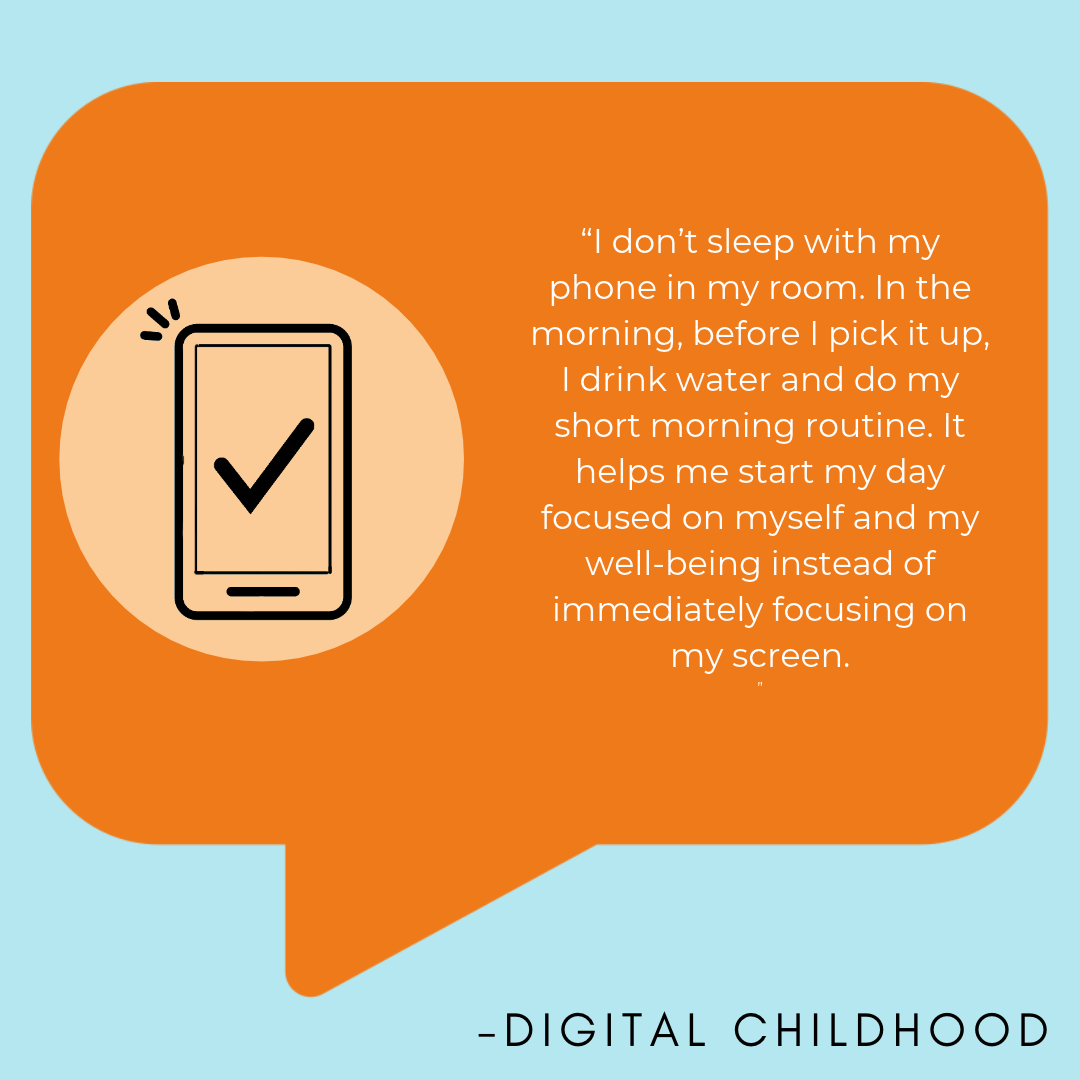
I do. First of all, I don't sleep with my phone in my room. Good girl. I just put it right outside and charge it right outside. So in case sometimes if I can't sleep, I'll listen to something on the Calm app. I don't know if you know that app. Mm-hmm. But they're free versions. If I can't sleep, I can always put it in my room if I need it, but it's not there. So right when I wake up, I'm like, "I need to check my phone." But I think a habit that I have started doing is I leave little glass of water right by my bedside table and I drink my water and I do my little morning routine, and then I check my phone if I have plans. Like if I have a reason for checking it, I will check it. But I will always do my morning routine first.
Chloe Parsons Cohn: (51:28)
That way my brain is kind of awake and I'm not rushing to check my phone. Because my morning routine's not that long. The, the person who texted me about the plans for the day can wait 15 minutes for me to relax and for me to wake up. So that is my healthy habit for screens that I would recommend for everyone to do.
Hillary Wilkinson: (51:50)
Yeah, I love it. And giving yourself that time to wake up lets you be less susceptible to scams and phishing that happens online. Right. Mm-hmm. Because when we're in those, you know, the, those, the, the bad guys that are out there really are counting on us not being so clear in the morning. And a lot of times they'll hit you right off the bat.
Chloe Parsons Cohn: (52:12)
Exactly. Okay. Well, Hillary, thank you so much for joining me today. I really enjoyed learning about healthy screen habits, your work helping families, your perspective on motivation habits, and of course technology. Thank you everyone who is listening. If you enjoyed this episode, be sure to subscribe to Digital Childhood and share this conversation with a friend, parent, teacher, or anyone who's trying to build a healthier relationship with technology, with themselves and becoming the best version of them. Thank you so much for listening and I'll see everyone in the next episode. Bye guys.
About the podcast host, Hillary Wilkinson
Hillary found the need to take a big look at technology when her children began asking for their own devices. Quickly overwhelmed, she found that the hard and fast rules in other areas of life became difficult to uphold in the digital world. As a teacher and a mom of 2 teens, Hillary believes the key to healthy screen habits lies in empowering our kids through education and awareness.
Parenting is hard. Technology can make it tricky. Hillary uses this podcast to help bring these areas together to help all families create healthy screen habits.
Recent Episodes